On this page
- 01Key takeaways
- 02What counts as a repetitive task in a small business?
- 03How much time do repetitive tasks take up?
- 04Which repetitive tasks can a UK SME outsource?
- 05How do you decide if a repetitive task is ready to outsource?
- 06Should you stop, simplify, automate or outsource it?
- 07How do you hand over a repetitive task?
- 08What does outsourcing repetitive tasks cost?
- 09When should repetitive tasks stay in-house?
- 10How do you keep quality and compliance under control?
- 11What happens to your team when routine work moves?
- 12How do repetitive tasks differ by sector?
- 13What does this look like in practice?
- 14Repetitive task outsourcing checklist
- 15More guides on repetitive tasks
- 16Next step
- 17Sources and further reading
- 18Frequently asked questions
Key takeaways
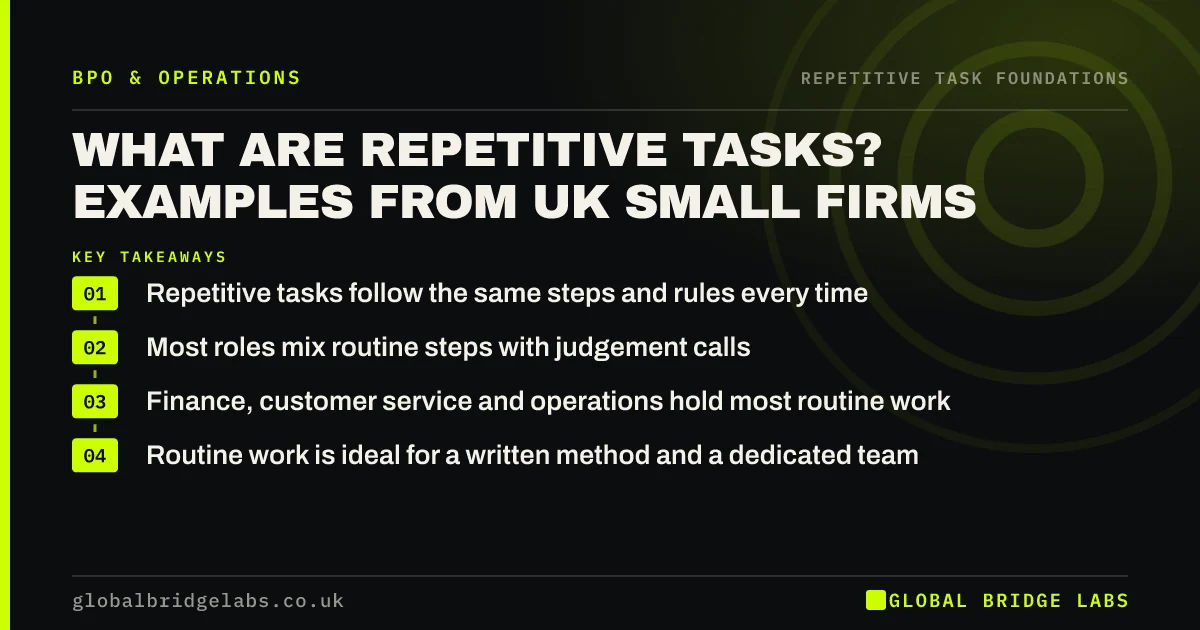
UK SMEs use outsourcing to handle repetitive tasks by handing frequent, rule-based work such as invoices, data updates, reminders, bookings and order admin to a managed team that runs it daily to a written method. It works when the task is stable and measurable. Simplify or stop the task first, keep judgement in-house, and check samples every week.
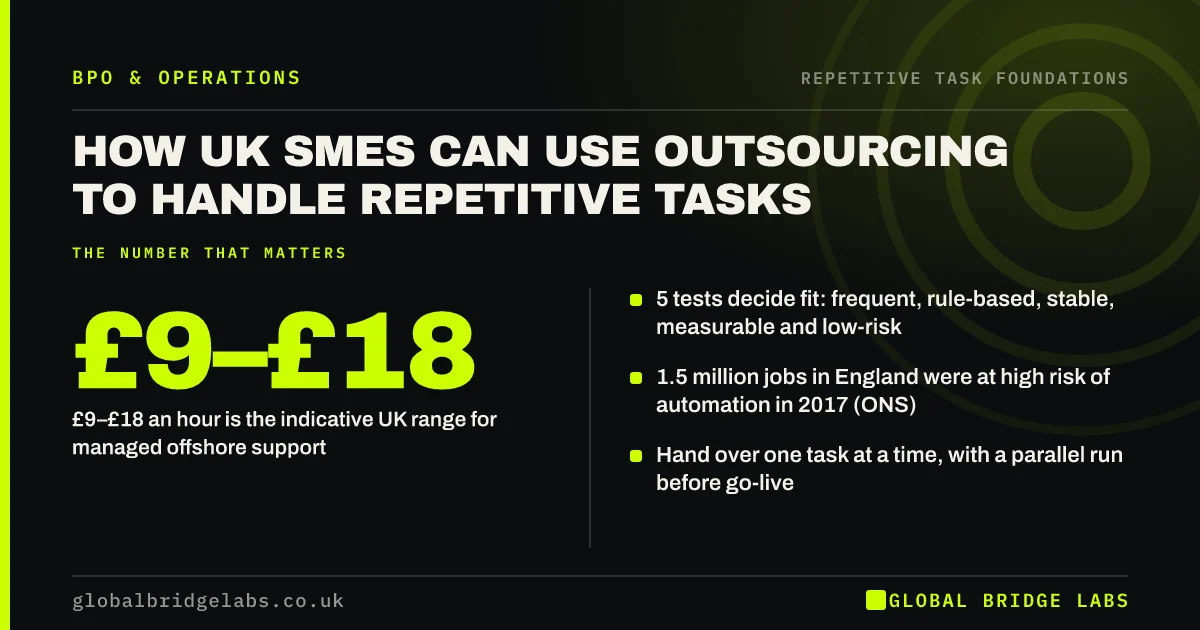
- 5 tests decide fit: frequent, rule-based, stable, measurable and low-risk.
- £9–£18 an hour is the indicative UK range for managed offshore support.
- 1.5 million jobs in England were at high risk of automation in 2017 (ONS).
- Hand over one task at a time, with a parallel run before go-live.
Want to know which of your repetitive tasks would pass the five tests? Message us on WhatsApp with the three that eat most of your week.
Chat on WhatsApp →What counts as a repetitive task in a small business?
A repetitive task is work done the same way many times, following rules that rarely change, where the output can be checked against a clear standard. In a small business that usually means invoices, purchase orders, timesheets, data updates, appointment reminders, order queries and the paperwork around each job. Repetitive does not mean unimportant: these tasks keep cash, customers and compliance moving.
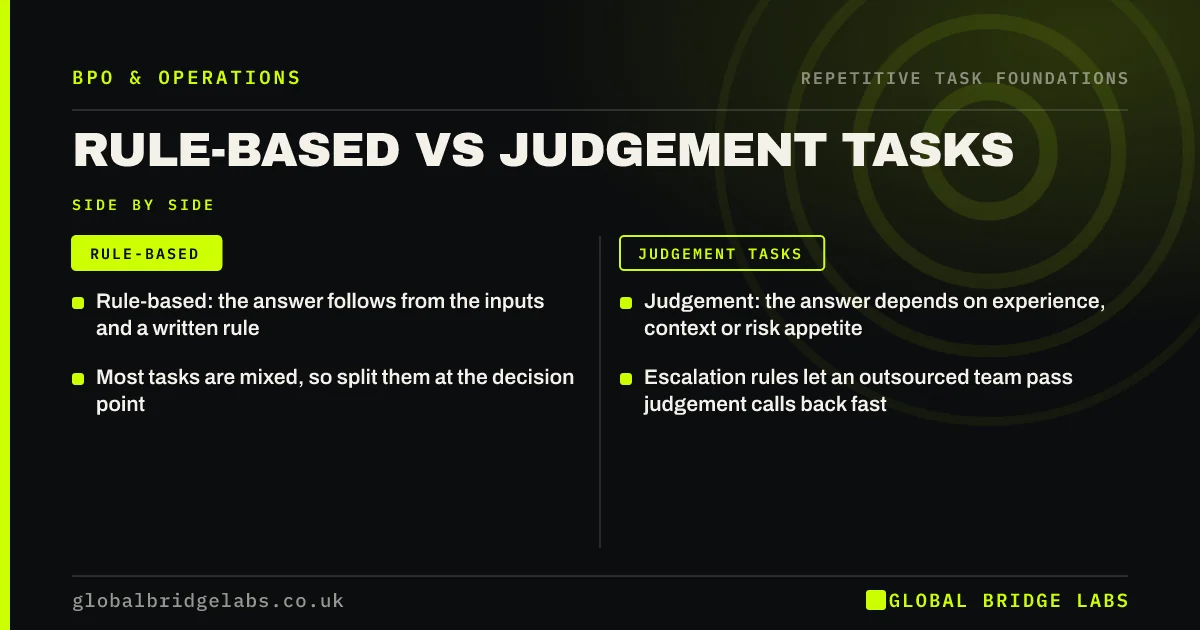
The useful distinction is between rule-based work, where a written method produces the right answer, and judgement work, where the right answer depends on experience, relationships or risk appetite. Most roles mix the two. Outsourcing works by separating them, so the rule-based share runs daily with a dedicated team and the judgement share stays with your people.
How much time do repetitive tasks take up?
Repetitive tasks typically take a larger share of the week than owners expect, because they arrive in small pieces spread across several people. The Office for National Statistics estimated in 2019 that 1.5 million jobs in England, 7.4% of those analysed, were at high risk of having some of their tasks automated, and those were mainly roles built on routine work.
Inside one business the better measure is your own: count how often each recurring task happens and how long it takes. A task inventory and two weeks of counting usually reveal 15 to 30 hours a week of repeatable work in a firm of 10 to 20 people. That is a GBL rule of thumb from discovery work, not a benchmark, so measure yours.
Which repetitive tasks can a UK SME outsource?
Almost any repetitive task with digital inputs and a written method can be outsourced. The families that suit UK SMEs best are finance routines, customer-facing admin, data and content upkeep, office and operations scheduling, and the sector-specific paperwork that professional, trades, health and logistics firms carry. Each family has its own guide below.
- Finance: purchase orders, timesheets, supplier statements, cash allocation and Direct Debit admin.
- Customers: reminders, order queries, refunds, warranty claims, callbacks and review requests.
- Data and content: enrichment, migration, product listings, photo editing and transcription.
- Operations: rotas, engineer scheduling, delivery booking, stock checks and supplier chasing.
- Sector paperwork: AML checks, sales progression, CIS, recalls, customs and Gift Aid.
- Purchase order processing: raise, match and close POs
- Timesheet processing: collect, check and pay on time
- Cash allocation: match customer payments to invoices daily
- Appointment reminders: cut no-shows without more admin
- 'Where is my order?' queries: handle them at scale
- Data enrichment: fill the gaps in your customer records
- Product listing services: upload and update your catalogue
- Engineer scheduling: fill the diary and cut wasted miles
- Stock reconciliation: make the system match the shelf
- AML check admin: client due diligence without a backlog
- Repetitive tasks by industry: where UK SMEs lose hours
How do you decide if a repetitive task is ready to outsource?
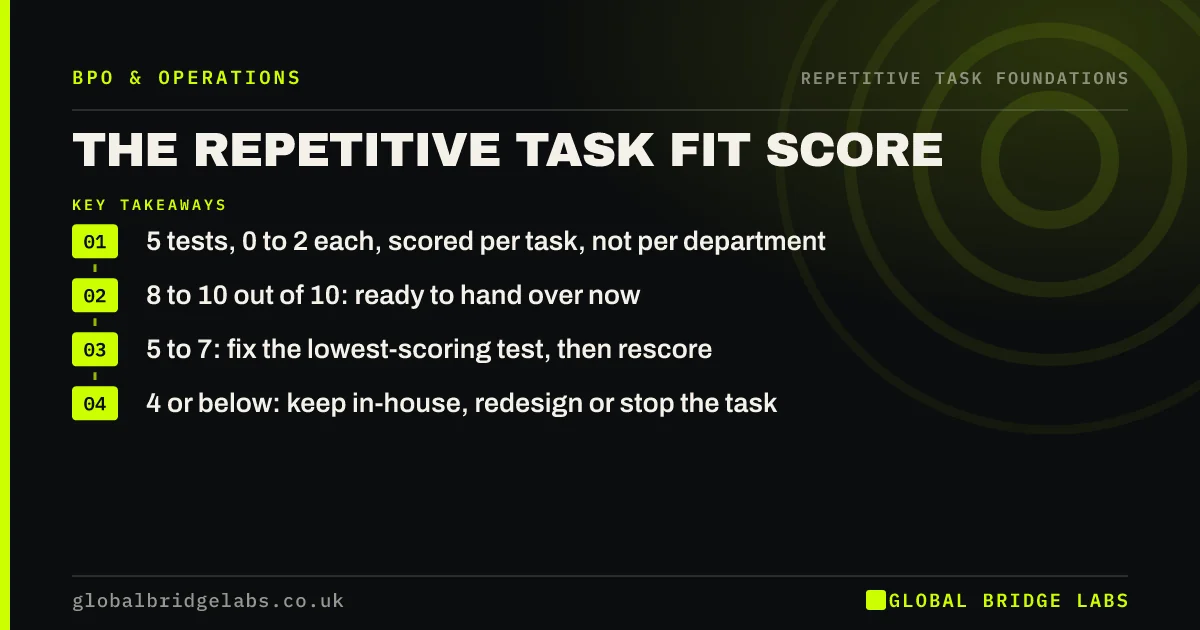
Score the task on five tests: is it frequent, rule-based, stable, measurable and low-risk? We call this the GBL Repetitive Task Fit Score. Each test scores 0 to 2, for a total out of 10. A score of 8 to 10 means hand it over now, 5 to 7 means fix the weakest test first, and 4 or below means keep it in-house or redesign it.
The score stops the two common errors: outsourcing a task that changes every week, and keeping a task in-house that a dedicated team would run faster and more accurately. Score ten tasks in one sitting and the order of handover becomes obvious.
- Frequent: it happens daily or weekly, in enough volume to learn quickly.
- Rule-based: a written rule gives the right answer most of the time.
- Stable: the method has not changed in the last three months.
- Measurable: you can count it and check it against a done standard.
- Low-risk: errors are caught before a customer or regulator sees them.
Should you stop, simplify, automate or outsource it?
Ask the four questions in that order. Stop the task if nobody uses the output. Simplify it by removing steps, combining checks and fixing inputs. Automate the parts that are fully predictable and run in one system. Outsource what remains, which is usually the work that needs a person to read, check, chase or decide within rules.
The ECRS method (eliminate, combine, rearrange, simplify) gives this a structure. Robotic process automation and AI tools handle more each year, but most small-business tasks still carry exceptions, messy inputs and customer contact, which is where a managed team earns its place alongside the tools.
- ECRS: simplify a repetitive task before you hand it over
- Robotic process automation for small firms: worth it?
- AI versus BPO: what to automate and what to staff
- Workflow automation for small businesses: where to start
- A stop doing list for your business
- Human in the loop: pairing AI tools with an outsourced team
How do you hand over a repetitive task?
Hand over one task at a time in six steps, starting with the highest-scoring task. A single well-run task builds the method, the trust and the scorecard you will reuse for every task after it. Most single tasks take two to four weeks from inventory to go-live, depending on how much of the method is written down already.
- Count the volume and time per item for two weeks.
- Write the method, the rules and the known exceptions.
- Agree a scope of work, turnaround and accuracy target.
- Set up access to only the systems the task needs.
- Run both teams side by side for one to two weeks.
- Go live, sample work weekly and review after 30 days.
What does outsourcing repetitive tasks cost?
As indicative UK market ranges, a managed offshore team costs £9–£18 an hour and an onshore provider £20–£35 an hour, depending on skills, hours and volume. These are not GBL prices. For comparison, a UK employee on £30,000 costs about £19.81 per worked hour once employer National Insurance, pension and holiday are included, before recruitment, equipment and management time.
In an illustrative firm with 22 hours a week of repetitive tasks spread across senior staff, the provider cost at offshore rates is about £200–£400 a week, plus two to three hours of your own review. The larger gain is usually the senior time returned and the faster turnaround, so price the provider, your oversight and the set-up effort together.
- BPO cost per hour in the UK
- Work out your cost per task before you outsource
- BPO pricing models explained
- The true cost of an employee in the UK
- Standard times: how long should a routine task take?
Want this worked through with your own task volumes? Send them on WhatsApp and we will discuss your requirements.
Chat on WhatsApp →When should repetitive tasks stay in-house?
Keep a repetitive task in-house when it is too small to learn, changes every week, depends on knowledge only one person holds, or carries decisions a regulator expects your staff to make. Also keep it when the task is your product, such as a bespoke service where the routine steps are part of what customers pay for.
Sometimes the honest answer is that it is quicker to do it yourself: a ten-minute weekly task with five exceptions costs more to explain than to do. Bundle it with similar tasks first, or leave it alone.
- Volume is under about two hours a week and cannot be bundled.
- The method changes faster than it can be written down.
- The decision needs a qualified person, such as an AML sign-off.
- Errors would reach customers before anyone could check them.
How do you keep quality and compliance under control?
Quality holds when four things exist: a written method, a done standard for each item, a weekly sample of finished work and a named owner in your business. People make predictable slips on repetitive work, so the method should catch them by design rather than relying on attention.
Under UK GDPR your business stays the controller of personal data the provider handles, so you need a written processor contract, and a transfer to a country without UK adequacy regulations needs a safeguard such as the International Data Transfer Agreement (IDTA). Give the team access only to the systems each task needs.
What happens to your team when routine work moves?
Your team usually gains the most. Repetitive work is a common source of boredom, slips and quiet resignations, so moving it lets you redesign roles around customers, quality and growth. Ask staff which tasks they would hand over first; they know where the repetition is. If an existing role would disappear, take advice on TUPE and consultation before any change.
How do repetitive tasks differ by sector?
The method is the same in every sector, but the repetitive task that hurts most differs. Accountants carry AML checks and Self Assessment preparation, law firms carry file opening and bundles, estate agents carry sales progression, trades carry job sheets and certificates, clinics carry recalls and letters, logistics carries customs and tachograph admin, and charities carry Gift Aid.
- Repetitive tasks by industry: where UK SMEs lose hours
- Self Assessment preparation support for accountants
- File opening in a law firm: checks, letters and set-up
- Sales progression outsourcing for estate agents
- Job sheet admin for trades: from completed job to invoice
- Patient recall admin: bring patients back on time
- Customs paperwork support for UK importers and exporters
- Gift Aid admin: declarations, claims and records
What does this look like in practice?
A pattern we see in UK firms with 8 to 25 staff: repetitive work is spread thinly across everyone, so no single person feels it is worth handing over. A task inventory shows the same handful of tasks done by four people in four ways. Once those tasks are written down, bundled and run daily by one managed team, the errors fall first and the senior hours come back after.
Across our client work, back-office cost per task has fallen by 42% once the process was written down and run by a managed team, and owners have got 31 hours a week back.
Repetitive task outsourcing checklist
Work through these steps before you hand anything over.
- List every recurring task with its frequency and owner.
- Count volumes and minutes per item for two weeks.
- Score the top ten on the five-test fit score.
- Stop, simplify or combine before you outsource.
- Write the method, rules and exceptions for the first task.
- Agree scope, turnaround, accuracy and a sampling rate.
- Run in parallel, then go live and review at 30 days.
- Add the next task only when the first is stable.
More guides on repetitive tasks
These guides cover each repetitive task in more detail, from finance routines to sector paperwork.
- Asking customers for reviews: a routine that stays legal
- Refund processing: fast, fair and correctly recorded
- Warranty claims admin: log, check and resolve faster
- Callback requests: a routine that really calls back
- Cancellation requests: process them quickly and fairly
- Subject access requests: a routine for small firms
- Chargeback disputes: gather evidence and respond on time
- Failed deliveries: rebook fast and stop repeat contacts
- Data migration: move systems without losing records
- Product photo editing: consistent images at volume
- Marketplace listing management: Amazon, eBay and Etsy
- Competitor price monitoring: a weekly routine that pays
- Transcription outsourcing: accurate text from audio
- Minute-taking support: clear minutes without late nights
- Document formatting support: proposals that look right
- Email list cleaning: remove bounces and stay PECR-safe
- Supplier statement reconciliation: catch missing invoices
- Marketplace payout reconciliation for online sellers
- Direct Debit admin: mandates, failed payments and retries
- Fixed asset register: keep it current all year
- Supplier price updates: keep costs and prices current
- Making Tax Digital records: the weekly routine that helps
- Trade credit applications: process them fast and safely
- Staff rota admin: build, change and share rotas faster
- Business travel booking admin: less time, fewer changes
- Post handling and scanning: paper post into a digital inbox
- Delivery booking admin: slots, confirmations and changes
- Backorder management: keep customers informed, not chasing
- Supplier chasing: expedite orders before they slip
- Fleet admin: fines, renewals and vehicle records
- Leaver admin: final pay, P45s and access done right
- Outsourcing repetitive tasks in a business of 2 to 9 people
- Conveyancing admin support: keep files moving
- Court bundle preparation: support for small law firms
- Property viewing booking: fill diaries, cut no-shows
- Landlord compliance certificates: track every expiry
- Insurance renewal admin for brokers: start earlier
- Company secretarial admin: confirmation statements on time
- Hotel rate and availability updates across booking sites
- Allergen information updates: keep menus and labels right
- Membership admin: renewals, records and payments
- Event registration admin: sign-ups to name badges
- Candidate compliance checks for recruitment agencies
- Job advert posting: one routine across every job board
- Training records admin: track certificates and renewals
- Volunteer admin for charities: rotas, checks and records
- Maintenance request admin for letting agents
- Estimating support for builders and contractors
- RAMS preparation: risk assessments and method statements
- CIS admin: verification, deductions and monthly returns
- Competent person scheme notifications: never miss one
- Medical typing: clinic letters out in days, not weeks
- Referral processing for private clinics: faster bookings
- Tachograph admin: downloads, analysis and infringements
Next step
Send us your team size and the repetitive tasks that take most of your week. In a 30-minute call we will score them with you on the five tests, say plainly which should stay in-house, and outline what a managed team would run for the rest.
Message us on WhatsApp for a repetitive task review, or book a 30-minute consultation.
Chat on WhatsApp →Sources and further reading
- The probability of automation in England: 2011 and 2017 · Office for National Statistics
- Rates and thresholds for employers 2026 to 2027 · HM Revenue & Customs
- Contracts and liabilities between controllers and processors · Information Commissioner's Office
- International transfers of personal data · Information Commissioner's Office
- Business transfers, takeovers and TUPE · GOV.UK
- Human factors: managing human failures · Health and Safety Executive
Frequently asked questions
What repetitive tasks can a small business outsource?
Most rule-based tasks with digital inputs can be outsourced: invoices and purchase orders, timesheets, data updates, appointment reminders, order queries, refunds, product listings, scheduling and sector paperwork such as AML checks or CIS returns. Keep tasks that need qualified judgement, change weekly or are too small to learn.
How do I know if a task is suitable for outsourcing?
Score it on five tests: frequent, rule-based, stable, measurable and low-risk, each 0 to 2. A total of 8 to 10 means it is ready, 5 to 7 means fix the weakest test first, and 4 or below means keep it in-house or redesign it before handing over.
Is it better to automate or outsource repetitive tasks?
Automate the parts that are fully predictable and live in one system, such as moving data between two tools. Outsource the parts that need a person to read, check, chase or handle exceptions. Many small businesses use both: automation for the steps, a managed team for everything around them.
How much does it cost to outsource repetitive tasks in the UK?
As indicative UK market ranges, managed offshore support costs £9–£18 an hour and onshore support £20–£35 an hour, depending on skills and volume. These are not GBL prices. Add your own review time, usually two to three hours a week, and the set-up effort when you compare options.
How long does it take to outsource a repetitive task?
A single task usually takes two to four weeks from counting the volume to going live, including one to two weeks of parallel running. The first task takes longest because the method, access and scorecard are new. Later tasks reuse all three and move faster.
Written by

Global Bridge Labs (GBL) is a UK–Sri Lanka partner for social media, websites and BPO. Everything here comes from client delivery, not theory.