On this page
Key takeaways
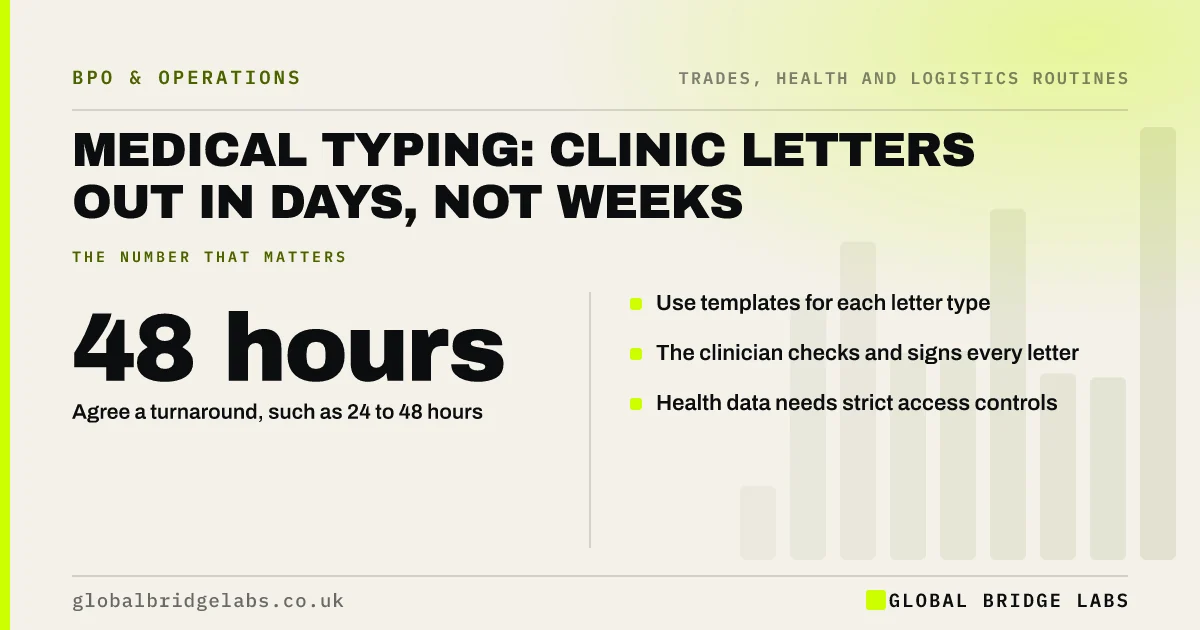
Medical typing turns clinicians' dictation into clinic letters, reports and referrals using the practice's templates. It is repetitive and specialist: medical terms, drug names and accuracy matter. A dedicated typing routine with an agreed turnaround, often 24 to 48 hours, gets letters to patients and GPs faster, with every letter checked and signed by the clinician.
- Agree a turnaround, such as 24 to 48 hours.
- Use templates for each letter type.
- The clinician checks and signs every letter.
- Health data needs strict access controls.
Clinic letters weeks behind? Message us on WhatsApp with your weekly dictation volume.
Chat on WhatsApp →What does medical typing involve?
It involves receiving dictation files securely, typing them into the right template, checking spellings of medical terms and drugs against references, flagging anything unclear for the clinician, sending drafts for sign-off and, once signed, sending letters to patients, GPs and referrers and filing them in the record.
How do you keep typing accurate?
Accuracy comes from good inputs and a firm rule never to guess. Typists flag unclear words rather than filling them in, and clinicians correct drafts before signing. AI drafting tools can help speed, but the human check matters more in medical letters than almost anywhere else.
- Clear dictation with patient identifiers spelled out.
- A glossary of the clinician's common terms.
- Unclear words flagged, never guessed.
- Clinician review and sign-off on every letter.
What does slow typing cost?
In an illustrative example, a clinic with 120 letters a week and a two-week backlog has around 240 letters waiting, each a patient or GP waiting for information and a possible phone call chasing it. These are example figures. A 48-hour routine removes the backlog and the calls.
Send us your weekly letter volume on WhatsApp and we will estimate the routine with you.
Chat on WhatsApp →What about patient data?
Dictation and letters contain special category health data. Use secure transfer, limited access and a processor contract, and keep files only as long as needed. For NHS-funded work, providers must meet the Data Security and Protection Toolkit. The clinician remains responsible for the content of every letter.
What does this look like in practice?
A pattern we see: a clinic's typing backlog grows every holiday season when the in-house secretary is off. A dedicated routine with cover keeps the turnaround the same all year.
Medical typing checklist
Set up the routine with these points.
- Secure dictation upload.
- Templates for each letter type.
- Agreed turnaround.
- Flag, never guess.
- Clinician sign-off before sending.
Next step
Send us your weekly dictation volume and current turnaround. We will suggest a typing routine and say plainly what controls it needs.
Message us on WhatsApp about medical typing, or book a 30-minute consultation.
Chat on WhatsApp →Sources and further reading
- Special category data · Information Commissioner's Office
- Data Security and Protection Toolkit · NHS England
Frequently asked questions
What is a medical typing service?
A medical typing service turns clinicians' dictated notes into typed letters, reports and referrals using the practice's templates. Typists are trained in medical terminology, flag unclear words for the clinician and return drafts within an agreed turnaround for checking and signing.
How fast should clinic letters be typed?
Many clinics aim for 24 to 48 hours from dictation to draft, so letters reach patients and GPs within a few days of the appointment. Set a turnaround you can keep all year, including holidays, and track it weekly.
Is outsourced medical typing safe for patient data?
It can be, with the right controls: secure transfer, limited access, a processor contract and agreed retention. Health information is special category data under UK GDPR, and NHS work requires Data Security and Protection Toolkit compliance. The clinician still signs every letter.
Written by

Global Bridge Labs (GBL) is a UK–Sri Lanka partner for social media, websites and BPO. Everything here comes from client delivery, not theory.