On this page
Key takeaways
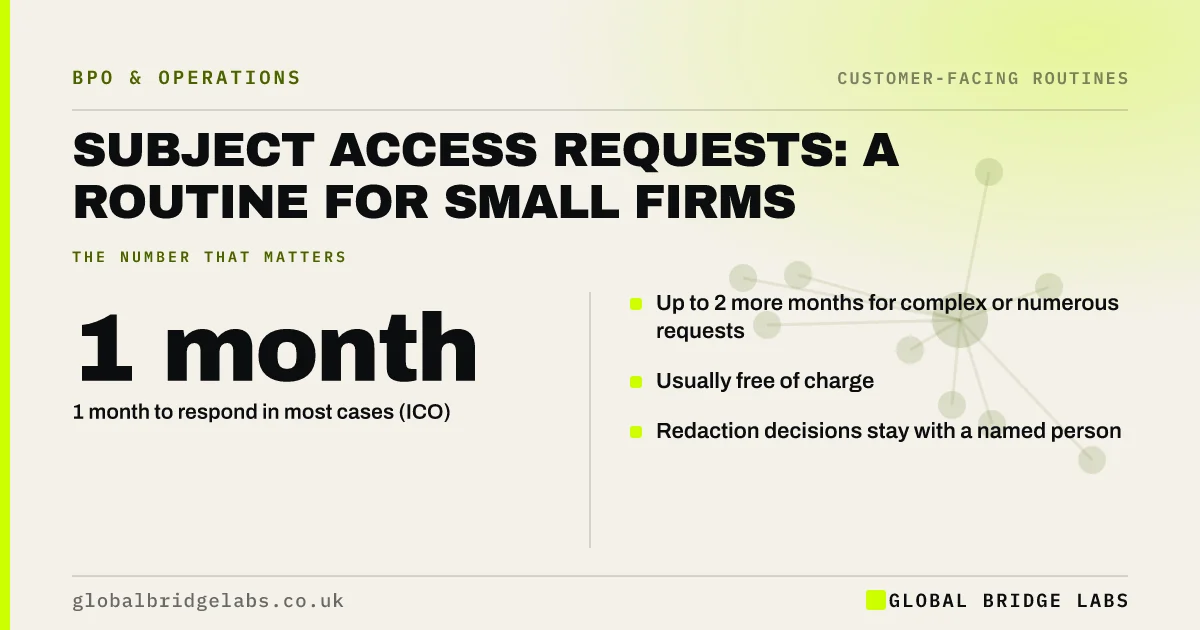
A subject access request (SAR) is a person's right under UK GDPR to receive a copy of their personal data. You usually have one month to respond, extendable by up to two further months for complex or numerous requests, and you normally cannot charge. The searching, collating and logging repeat for every request, so a written routine keeps you on time.
- 1 month to respond in most cases (ICO).
- Up to 2 more months for complex or numerous requests.
- Usually free of charge.
- Redaction decisions stay with a named person.
Received a SAR and not sure where to start? Message us on WhatsApp and we will talk through a routine.
Chat on WhatsApp →How do you recognise a subject access request?
A SAR does not need to use the words 'subject access' or be in writing to a particular person. Any request from someone for their own personal data counts, whether by email, letter, social media or phone. Train front-line staff to recognise one and log it the same day, because the clock starts when it is received.
What are the steps in a SAR routine?
Log the request and the deadline, confirm the requester's identity if reasonably necessary, search every system that may hold their data, collate the results, apply any exemptions and redact third-party data, then send the response with the supporting information the ICO lists. Keep a record of what was searched and sent.
- Log the request and calculate the deadline.
- Confirm identity where reasonably needed.
- Search email, CRM, files, phone notes and backups.
- Redact other people's data.
- Send the response and keep a record.
How long does a SAR take?
In an illustrative example, a SAR from a former customer of a 20-person firm takes about 4 hours to search five systems and collate, plus an hour of review and redaction. A request from a former employee can take much longer because of email volume. These are example figures. A list of systems to search saves the most time.
Want a ready list of systems and steps for your business? Send us your main tools on WhatsApp.
Chat on WhatsApp →Which parts should stay in-house?
Decisions on exemptions, redaction of sensitive material and any refusal must be made by a named person accountable for data protection, because they need judgement. A support team can log, search and collate under your instructions, as your processor, with access limited to the request.
What does this look like in practice?
A pattern we see: a business misses the deadline on its first SAR because nobody knew where all the data lived. A one-page routine with a systems list makes the second one straightforward.
SAR routine checklist
Prepare these before the next request arrives.
- Staff know how to recognise a SAR.
- A log with deadlines.
- A list of every system holding personal data.
- A named person for exemptions and redaction.
- A response template with the required information.
Next step
Tell us which systems hold customer and staff data. We will help you draft a SAR routine and say plainly which steps a support team could take on.
Message us on WhatsApp about subject access requests, or book a 30-minute consultation.
Chat on WhatsApp →Sources and further reading
- A guide to subject access · Information Commissioner's Office
- Contracts and liabilities between controllers and processors · Information Commissioner's Office
- Advice for small organisations · Information Commissioner's Office
Frequently asked questions
How long do you have to respond to a subject access request?
According to the ICO, you must usually respond within one month of receiving the request. You can extend by up to two further months if the request is complex or the person has made several requests, but you must tell them within the first month and explain why.
Can you charge for a subject access request?
In most cases, no. You can charge a reasonable fee, or refuse, only if a request is manifestly unfounded or excessive, or for further copies of the same data. The ICO's guidance explains how to decide and what to tell the requester.
Can a SAR be handled by an outsourced team?
Parts of it can. A support team acting as your processor can log the request, search systems and collate data under your instructions. Decisions on exemptions, redaction and refusals should be made by a named person in your business who is accountable for data protection.
Written by

Global Bridge Labs (GBL) is a UK–Sri Lanka partner for social media, websites and BPO. Everything here comes from client delivery, not theory.