On this page
- 01Key takeaways
- 02What is a repetitive task?
- 03What are examples of repetitive tasks by department?
- 04How is repetitive work different from simple work?
- 05How much repetitive work does a small business have?
- 06When is a routine task not worth changing?
- 07What does this look like in practice?
- 08Repetitive task spotting checklist
- 09Next step
- 10Sources and further reading
- 11Frequently asked questions
Key takeaways
Repetitive tasks are pieces of work done the same way many times, following rules that rarely change, with an output that can be checked. In UK small firms they include invoices, purchase orders, timesheets, data updates, reminders, order queries and job paperwork. They matter because they keep cash and customers moving, and because they quietly fill senior diaries.
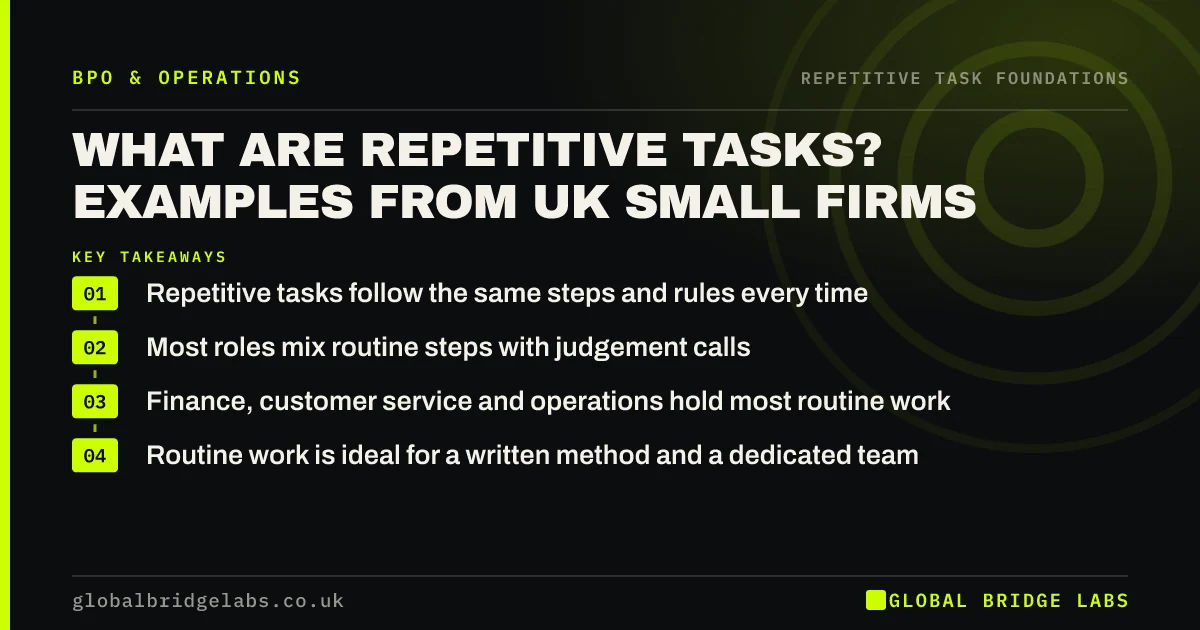
- Repetitive tasks follow the same steps and rules every time.
- Most roles mix routine steps with judgement calls.
- Finance, customer service and operations hold most routine work.
- Routine work is ideal for a written method and a dedicated team.
Not sure which of your tasks count as repetitive? Message us on WhatsApp with a typical week and we will sort them with you.
Chat on WhatsApp →What is a repetitive task?
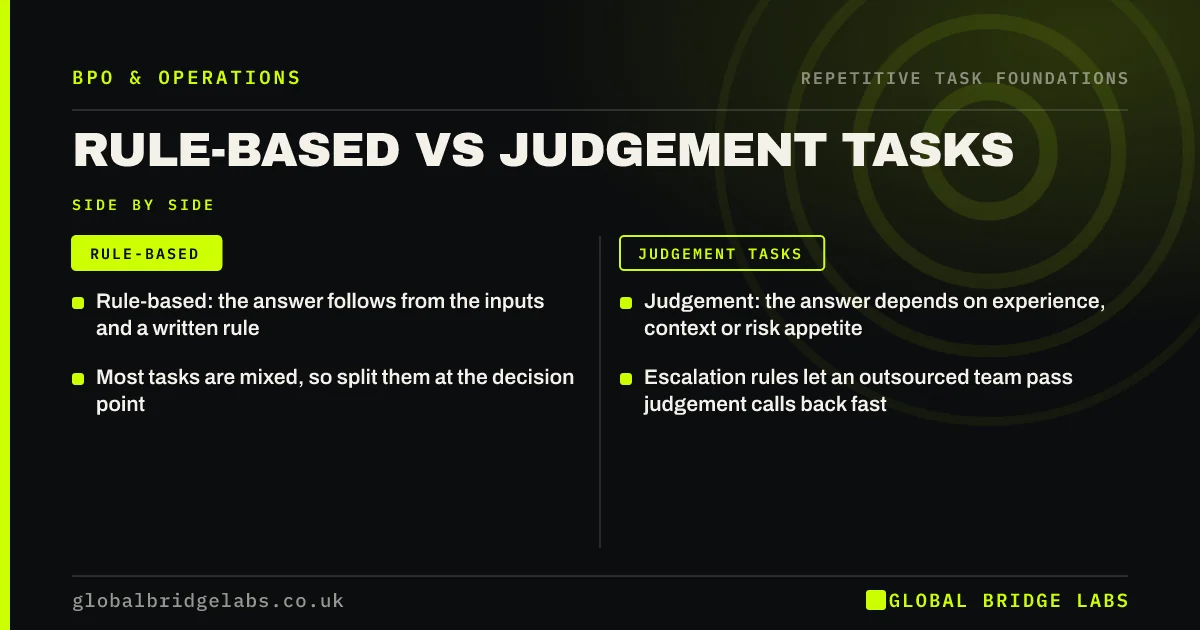
A repetitive task is a unit of work that recurs often, follows a stable method and produces an output you can check against a standard. Raising a sales invoice from a completed job sheet is repetitive. Deciding whether to offer a customer credit terms is not, because the answer depends on judgement about risk.
Repetitive is a property of the method, not the person. A senior manager who rebuilds the same report every Monday is doing repetitive work, however skilled they are.
What are examples of repetitive tasks by department?
Every department of a small business carries repetitive tasks. The examples below are the ones UK SMEs most often find in a task inventory, grouped by where they usually sit. Most take minutes each but recur dozens or hundreds of times a month.
- Finance: purchase orders, timesheets, supplier statements, payment matching, Direct Debits.
- Customer service: order queries, refunds, reminders, callbacks, cancellations.
- Sales and marketing: data enrichment, list cleaning, review requests, listings.
- Operations: rotas, engineer diaries, delivery bookings, stock checks, supplier chasing.
- People: job adverts, candidate checks, training records, leaver admin.
How is repetitive work different from simple work?
Repetitive work is not always simple. Reconciling a supplier statement or preparing a court bundle needs care and training, yet both follow the same method every time. Simple work can also be one-off, such as moving an office. The test is repetition and rules, not difficulty, which is why skilled repetitive work is often the most valuable to hand over.
How much repetitive work does a small business have?
More than it looks, because routine tasks are spread thinly. In an illustrative 15-person firm, 40 invoices, 60 order queries, 30 reminders and a weekly report can add up to about 20 hours a week across five people. These are example figures, not a benchmark. Count your own volumes and minutes per item for two weeks.
- Repetitive task inventory: list every recurring job once
- Count your task volumes before you outsource anything
Want help adding up your repetitive work? Send your task list on WhatsApp and we will discuss it with you.
Chat on WhatsApp →When is a routine task not worth changing?
Leave a routine task alone when it takes a few minutes a week, nobody makes mistakes with it and no one is interrupted by it. The effort of redesigning or handing it over would exceed the time saved. Concentrate on the frequent tasks that interrupt senior people or regularly go wrong.
What does this look like in practice?
A pattern we see when owners list their repetitive tasks: the first list has five items, and the second, written after a week of noting tasks as they happen, has thirty. The extra tasks were never invisible, just too small to notice one at a time.
Repetitive task spotting checklist
A task is probably repetitive if most of these are true.
- It happens at least weekly.
- The steps are the same each time.
- A new starter could learn it from written notes.
- You can tell when it is done correctly.
- It interrupts someone doing more valuable work.
Next step
Send us a week of the routine tasks your team handles. We will help you group them, estimate the hours and say plainly which are worth keeping, simplifying or handing over.
Message us on WhatsApp to sort your repetitive tasks, or book a 30-minute consultation.
Chat on WhatsApp →Sources and further reading
- The probability of automation in England: 2011 and 2017 · Office for National Statistics
- Human factors: managing human failures · Health and Safety Executive
Frequently asked questions
What is an example of a repetitive task?
Raising a sales invoice from a completed job sheet is a typical repetitive task: it recurs often, follows the same steps and can be checked against the job details. Other examples are processing timesheets, sending appointment reminders, answering order status queries and updating customer records.
Are repetitive tasks bad for employees?
Not always, but a role made mostly of repetitive work tends to lower motivation and raise the chance of slips, because attention fades on familiar tasks. Mixing routine work with varied, meaningful work, or moving the routine share to a dedicated team, usually helps both quality and retention.
Can repetitive tasks be outsourced?
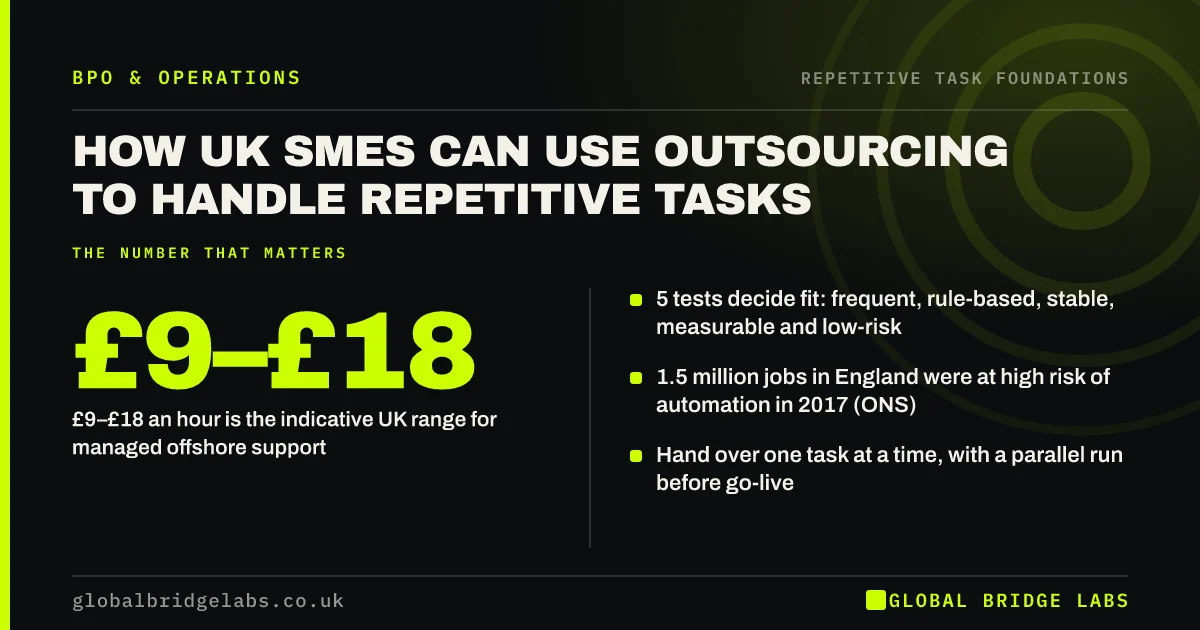
Yes. Repetitive tasks are the easiest work to outsource because they can be written down, measured and checked. Start with frequent, rule-based tasks that are stable and low-risk, and keep tasks that rely on qualified judgement or change every week in-house.
Written by

Global Bridge Labs (GBL) is a UK–Sri Lanka partner for social media, websites and BPO. Everything here comes from client delivery, not theory.