On this page
- 01Key takeaways
- 02Why does how you tell staff matter?
- 03When should you tell the team?
- 04What should you say?
- 05How do you answer questions about jobs?
- 06What are your legal duties if roles are affected?
- 07How do you involve staff in the handover?
- 08What mistakes should you avoid?
- 09What should you tell customers?
- 10What does this look like in practice?
- 11Communication checklist
- 12Next step
- 13Sources and further reading
- 14Frequently asked questions
Key takeaways
How to tell staff about outsourcing: tell them early, explain why, be specific about what changes and what does not, and answer the job question directly. If roles are affected, TUPE and redundancy rules may require consultation, so take advice before announcing. Most outsourcing in SMEs adds capacity rather than replacing people, and saying so clearly matters.
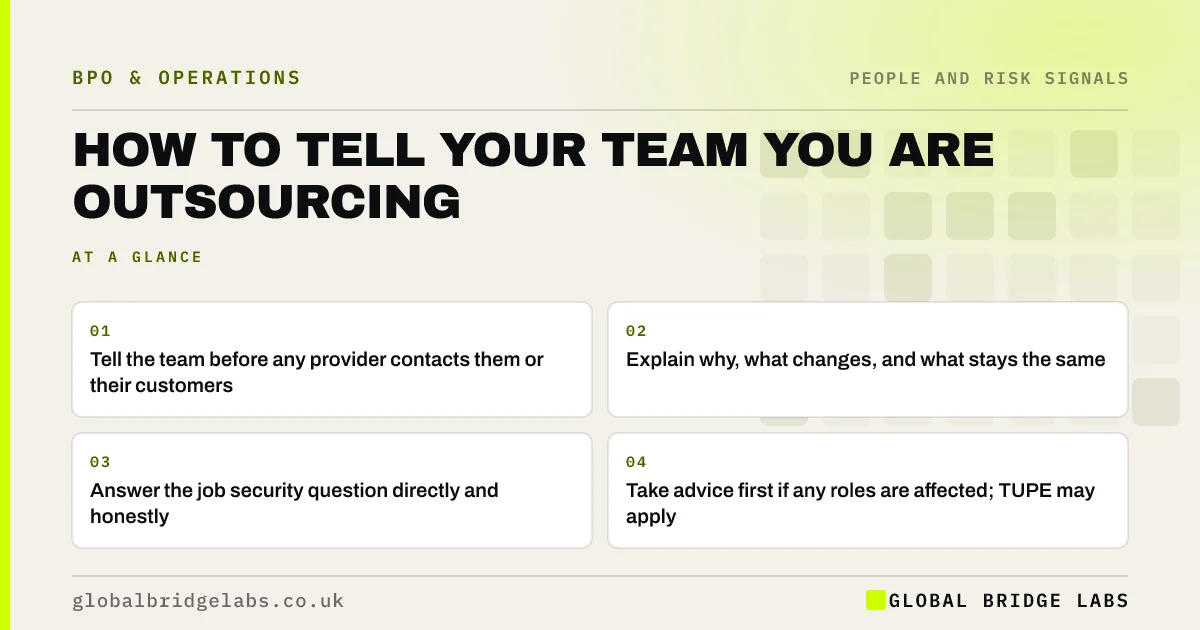
- Tell the team before any provider contacts them or their customers.
- Explain why, what changes, and what stays the same.
- Answer the job security question directly and honestly.
- Take advice first if any roles are affected; TUPE may apply.
Planning how to explain outsourcing to your team? Message us on WhatsApp.
Chat on WhatsApp →Why does how you tell staff matter?
Because outsourcing sounds like job losses to most people, even when it is not. If staff hear about it indirectly, they assume the worst, and good people start looking elsewhere. A clear, early explanation keeps trust, and staff who understand the change help the handover succeed. They know the process better than anyone.
When should you tell the team?
Tell them once the decision is made and before the provider starts, ideally before any documentation work begins, because staff will be involved. If roles might be affected, take legal advice before announcing anything, because consultation duties may apply and the timing and content of what you say matters.
What should you say?
Be specific. Vague reassurance is less convincing than clear facts. Cover the reason, the scope, what it means for each person, and how they will be involved.
- Why: the problem you are solving, such as overload or missing cover.
- What: exactly which tasks move, and which do not.
- Who: how each person's role changes, if at all.
- How: their part in documenting and training.
- When: the timeline and review points.
Want a simple outline for the conversation? Ask us on WhatsApp.
Chat on WhatsApp →How do you answer questions about jobs?
Directly and honestly. If no roles are at risk, say so plainly and explain what their roles will focus on instead. If roles may change, say that you are taking advice, will consult properly and will explain options. Do not promise what you cannot guarantee, and do not hide what you already know.
What are your legal duties if roles are affected?
If an activity carried out by employees moves to a provider, TUPE may apply, and affected employees may transfer to the provider on their existing terms, with duties to inform and consult. If roles become redundant, redundancy rules apply, including consultation and statutory redundancy pay for employees with two years' service. Take advice before acting.
How do you involve staff in the handover?
Ask them to help document the process, review the provider's early work and act as the escalation point. That uses their knowledge, gives them a clear role in the change, and often turns sceptics into supporters once they see the work they disliked being handled well.
What mistakes should you avoid?
Avoid announcing by email, letting staff find out from the provider or customers, describing the change as cost-cutting without context, and asking staff to train their replacements without explaining what happens to them. Each of these damages trust and makes the handover harder.
What should you tell customers?
Usually very little, if the service improves. Customers care that replies are fast and accurate, not who sends them. If contact details, opening hours or processes change, tell them what is different and why it helps them, such as longer phone hours. Make sure your privacy notice reflects any new processors handling their data.
What does this look like in practice?
A pattern we see in UK service businesses: the owner worries the office team will see outsourcing as a threat. A team meeting explaining that phones and data entry are moving so they can stop working evenings and focus on customers, with no roles at risk, is followed by the team helping write the process. The handover goes faster as a result.
Communication checklist
Use this before telling your team.
- Take advice first if any roles may be affected.
- Tell the team in person, before the provider starts.
- Explain why, what, who, how and when.
- Answer the job question directly.
- Involve staff in documenting and reviewing.
- Follow up after the first month.
Next step
Tell us what you plan to outsource and how your team is set up. We will help you think through the conversation and the handover.
Message us on WhatsApp about telling your team, or book a 30-minute consultation.
Chat on WhatsApp →Sources and further reading
- Business transfers, takeovers and TUPE · GOV.UK
- Redundancy: your rights · GOV.UK
- Work-related stress and how to manage it · Health and Safety Executive
Frequently asked questions
How do I tell employees about outsourcing?
In person, before the provider starts. Explain why you are outsourcing, exactly which tasks move, how each person's role changes, how they will be involved and the timeline. Answer questions about jobs directly and honestly, and take advice first if roles may be affected.
Do I have to consult staff before outsourcing?
If employees' work moves to a provider, TUPE may apply, with duties to inform and consult. If roles become redundant, redundancy consultation rules apply. If no roles are affected, there may be no legal duty, but telling staff early is still good practice.
How do I reassure staff worried about outsourcing?
Be specific about what changes and what does not, answer the job question honestly, and involve them in the handover. When outsourcing is adding capacity rather than replacing people, explain what their roles will focus on instead.
Written by

Global Bridge Labs (GBL) is a UK–Sri Lanka partner for social media, websites and BPO. Everything here comes from client delivery, not theory.