On this page
- 01Key takeaways
- 02How does repetitive work affect employees?
- 03What does HSE guidance say?
- 04Does repetitive work drive staff turnover?
- 05What does rebalancing a role look like?
- 06When is repetitive work fine to keep?
- 07What does this look like in practice?
- 08Role balance checklist
- 09Next step
- 10Sources and further reading
- 11Frequently asked questions
Key takeaways
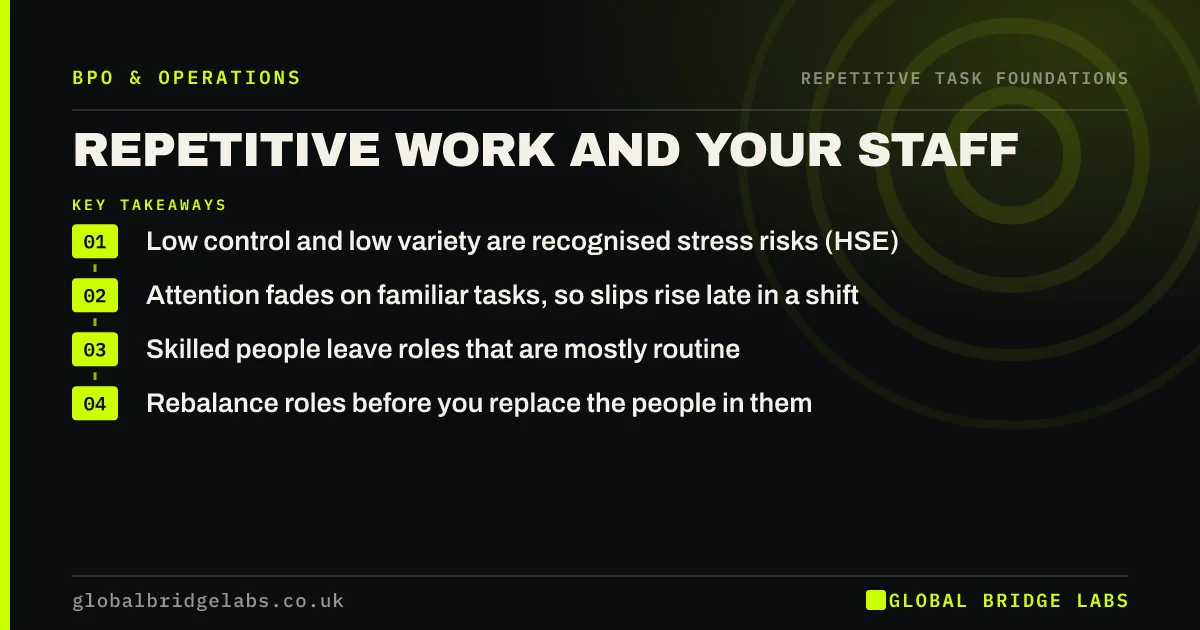
Roles made mostly of repetitive work tend to lower motivation, raise the rate of slips and push good people to leave. The Health and Safety Executive's Management Standards name low control over how work is done as a cause of work-related stress. Rebalancing roles, by mixing tasks or moving the routine share elsewhere, protects both quality and retention.
- Low control and low variety are recognised stress risks (HSE).
- Attention fades on familiar tasks, so slips rise late in a shift.
- Skilled people leave roles that are mostly routine.
- Rebalance roles before you replace the people in them.
Want to talk through a role that has become mostly routine? Message us on WhatsApp.
Chat on WhatsApp →How does repetitive work affect employees?
Repetitive work affects employees in three ways: it lowers engagement, because the work offers little variety or sense of progress; it raises error rates, because attention drifts on familiar steps; and it can add stress when people have little control over the pace or method. None of this is a character flaw. It is a predictable effect of how the role is designed.
What does HSE guidance say?
The Health and Safety Executive's Management Standards for work-related stress cover six areas: demands, control, support, relationships, role and change. Roles packed with repetitive work at a fixed pace often score poorly on control and demands. Employers have a duty to assess the risk of work-related stress, so role design is a legal matter as well as a management one.
Does repetitive work drive staff turnover?
It is a common factor. Capable people accept routine work early in a role, then leave when it becomes most of the job and there is no route to something more varied. Each departure costs recruitment, training and lost accuracy while a new person learns. Turnover in admin roles is often a design signal rather than a hiring failure.
What does rebalancing a role look like?
In an illustrative example, an accounts assistant spends 30 of 37.5 hours on data entry and matching. Moving 20 of those hours to a managed team frees time for supplier relationships, cash forecasting and month-end analysis. These are example figures. The role becomes harder to fill with the wrong person and easier to keep the right one in.
- What your in-house team should do once work is outsourced
- Cash allocation: match customer payments to invoices daily
Want help redesigning a role around the routine work you move? Send us the job description on WhatsApp.
Chat on WhatsApp →When is repetitive work fine to keep?
Some people genuinely like steady, predictable work, and some roles are better for it, such as a part-time role that fits around other commitments. The problem is not repetition itself but repetition without choice, variety or progress. Ask people what they want before redesigning their job.
What does this look like in practice?
A pattern we see: the person who does the most repetitive work is also the one who best understands where it goes wrong. Involving them in writing the method and checking the outsourced output often turns a routine role into a quality role.
Role balance checklist
Check each role in the team against these points.
- What share of the week is repetitive work?
- Does the person choose how or when they do it?
- Is there a route to more varied work?
- Are slips rising late in the day or week?
- Have you asked them what they would hand over?
Next step
Send us one role that has become mostly routine. We will help you separate the repetitive share and suggest what the role could look like without it.
Message us on WhatsApp to rebalance a role, or book a 30-minute consultation.
Chat on WhatsApp →Sources and further reading
- What are the Management Standards for work-related stress? · Health and Safety Executive
- Work-related stress and how to manage it · Health and Safety Executive
Frequently asked questions
Is repetitive work bad for mental health?
Repetitive work is not harmful in itself, but roles with high repetition, low control over pace and little variety are linked to stress and low engagement. HSE's Management Standards treat low control and high demands as stress risks that employers should assess and reduce.
How do you motivate staff doing repetitive work?
Give people control over how and when they do the work, mix routine tasks with varied ones, show them how their work affects customers, and involve them in improving the method. Where a role is mostly routine, moving part of it to a dedicated team frees time for more meaningful work.
Why do employees leave repetitive jobs?
Usually because the role offers little variety, progress or control once the work is learned. Capable people outgrow it and move on. Redesigning the role, so routine work is a smaller share, is often cheaper than repeatedly recruiting and training replacements.
Written by

Global Bridge Labs (GBL) is a UK–Sri Lanka partner for social media, websites and BPO. Everything here comes from client delivery, not theory.