On this page
- 01Key takeaways
- 02What changes for the in-house team?
- 03What are the four retained roles?
- 04Where should the freed hours go?
- 05How should you talk to staff about it?
- 06When might TUPE apply?
- 07When does the retained team go wrong?
- 08What does this look like in practice?
- 09Retained team checklist
- 10Next step
- 11Sources and further reading
- 12Frequently asked questions
Key takeaways
The in-house team's role after outsourcing shifts from doing routine volume to directing it. Four jobs remain inside: owning the process, handling exceptions, checking quality and improving how the work is done. Decide in advance where the freed hours will go, or they will be absorbed without benefit.
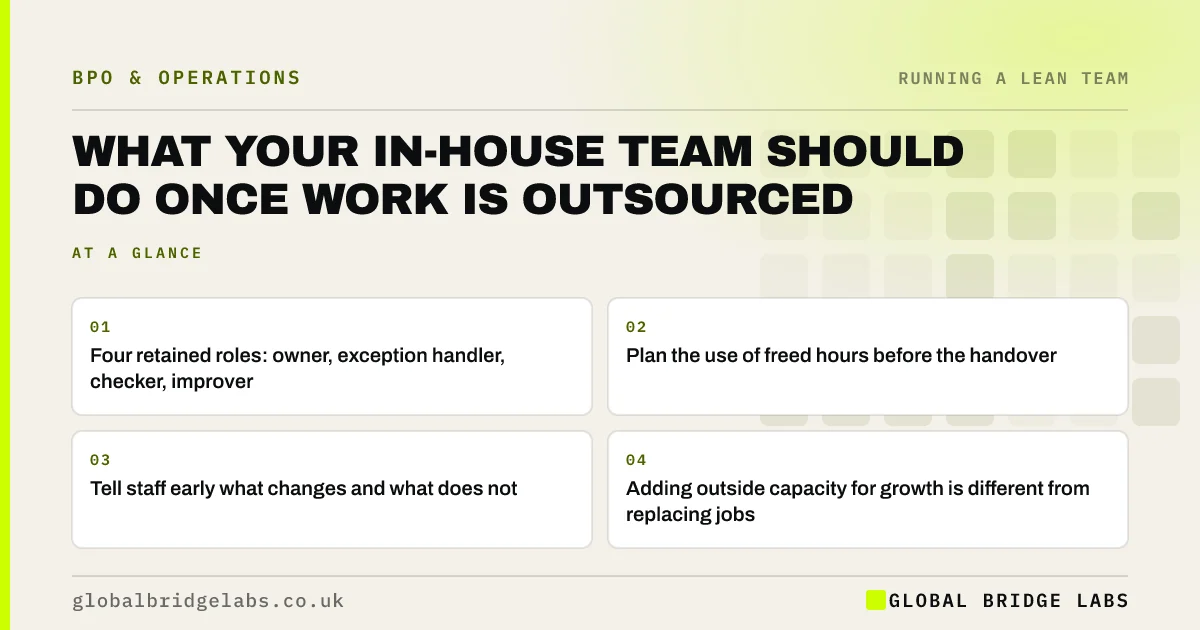
- Four retained roles: owner, exception handler, checker, improver.
- Plan the use of freed hours before the handover.
- Tell staff early what changes and what does not.
- Adding outside capacity for growth is different from replacing jobs.
Unsure what your team should focus on after a handover? Message us on WhatsApp.
Chat on WhatsApp →What changes for the in-house team?
When routine work moves to a provider, the in-house team stops being the people who process every case and becomes the people who make sure cases are processed well. The work is less repetitive and carries more responsibility. For most staff that is an improvement, provided the change is explained and the new role is real.
What are the four retained roles?
Four roles stay in-house after outsourcing. In a small business one person may hold more than one, but each should be named.
- Process owner: keeps the guide current and answers questions.
- Exception handler: takes cases needing judgement or authority.
- Quality checker: samples work and gives feedback weekly.
- Improver: removes causes of repeat work and updates the process.
Where should the freed hours go?
Freed hours should go to work that grows the business or protects it: selling, serving key customers, delivering projects that have been waiting, training and improvement. Write down the intended use before the handover and check after 60 days that it happened. Unplanned hours tend to vanish into meetings and inboxes.
Want help planning what your team does with the time? Send us your roles on WhatsApp.
Chat on WhatsApp →How should you talk to staff about it?
Tell staff early, plainly and before the provider starts. Explain what is moving, why, what each person's role will be and what is not changing. Where the purpose is to absorb growth, say that jobs are not at risk. Involve the people who do the work in writing the process: they know it best.
When might TUPE apply?
The Transfer of Undertakings (Protection of Employment) regulations, known as TUPE, can apply when an activity carried out by employees is transferred to a contractor. Whether they apply depends on the facts, including whether there is an organised group of employees whose main purpose is that activity. Take advice before moving work that people currently do full-time.
When does the retained team go wrong?
The retained team goes wrong in two ways. Either nobody is given the time to own and check the work, so quality drifts, or the team keeps doing the work in parallel because they do not trust the handover. Both are solved by naming the roles, setting a scorecard and giving the provider a fair trial period.
What does this look like in practice?
A pattern we see in UK offices after a first handover: the administrator who used to process every order now reviews exceptions, updates the guide and calls customers with unusual requests. Their job has become more skilled, and the owner has someone who understands the process well enough to improve it.
Retained team checklist
Agree these before the handover date.
- A named process owner with time allocated.
- Clear rules for what counts as an exception.
- A weekly sample of work to check.
- A written plan for the freed hours.
- A staff briefing before the provider starts.
- Advice taken on TUPE where roles are affected.
- A 60-day review of how time is being used.
Next step
Tell us which work you are thinking of moving and who does it today. We will outline the retained roles and how to brief the team.
Message us on WhatsApp to plan your retained team, or book a 30-minute consultation.
Chat on WhatsApp →Sources and further reading
- Business transfers, takeovers and TUPE · GOV.UK
- What are the Management Standards for work-related stress? · Health and Safety Executive
Frequently asked questions
What happens to employees when work is outsourced?
It depends on the purpose. Where outsourcing adds capacity for growth, employees usually keep their jobs and move to higher-value work such as exceptions, quality and customer relationships. Where existing roles transfer to a provider, TUPE may protect employees' terms, and specialist advice is needed.
What is a retained team in outsourcing?
A retained team is the group of in-house staff who stay responsible for an outsourced function. They own the process, manage the provider relationship, handle exceptions and check quality. In a small business the retained team may be one person spending a few hours a week.
How do I stop staff feeling threatened by outsourcing?
Be clear and early. Explain why the change is happening, what will move, what each person will do afterwards and whether any jobs are affected. Involve staff in documenting the process and choosing what to hand over. Uncertainty causes more anxiety than the change itself.
Who manages quality after outsourcing?
The provider manages day-to-day quality through its own supervisors, but the client should check a sample of work each week and review a scorecard. A named person inside the business owns that check, feeds back findings and agrees corrections with the provider.
Written by

Global Bridge Labs (GBL) is a UK–Sri Lanka partner for social media, websites and BPO. Everything here comes from client delivery, not theory.