On this page
- 01Key takeaways
- 02What does marketplace listing management involve?
- 03What does the daily routine look like?
- 04What does the routine take?
- 05When should listing work stay in-house?
- 06What does this look like in practice?
- 07Marketplace routine checklist
- 08Next step
- 09Sources and further reading
- 10Frequently asked questions
Key takeaways
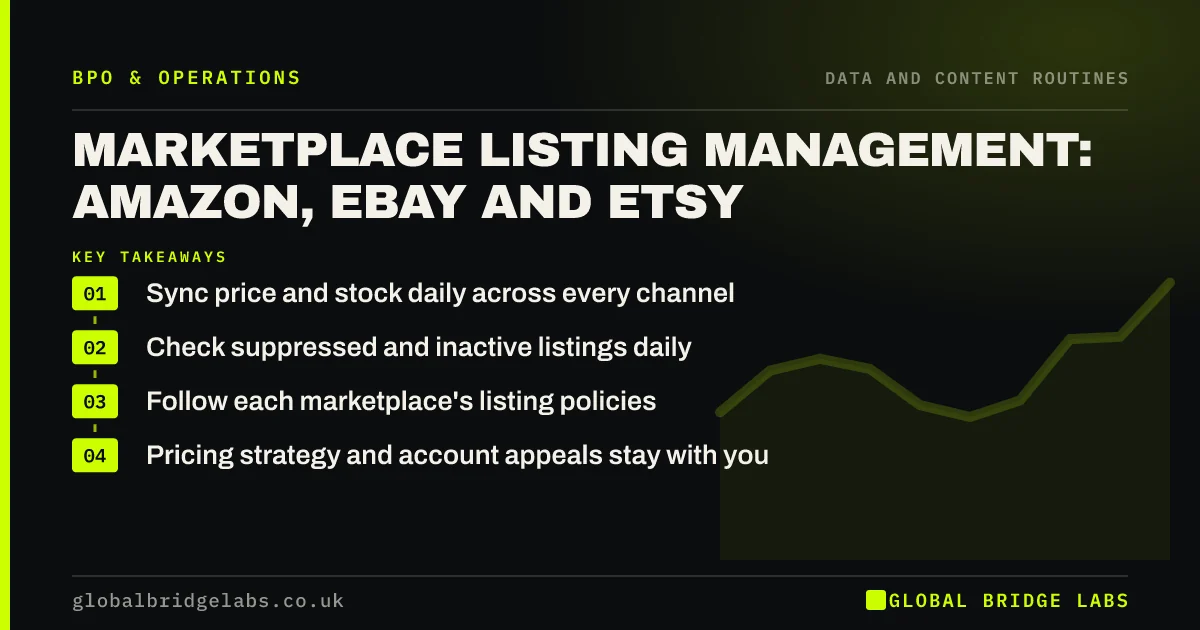
Marketplace listing management is the daily and weekly routine of creating listings, keeping price and stock in sync with your own shop, fixing suppressed or inactive listings, and responding to account health notices. Each marketplace has its own rules, but the tasks repeat. A dedicated team keeps listings live and stops stock-outs or oversells.
- Sync price and stock daily across every channel.
- Check suppressed and inactive listings daily.
- Follow each marketplace's listing policies.
- Pricing strategy and account appeals stay with you.
Listings going inactive or overselling? Message us on WhatsApp with your channels and SKU count.
Chat on WhatsApp →What does marketplace listing management involve?
It involves creating listings to each marketplace's format, matching to existing catalogue entries where required, setting prices and stock, monitoring suppressed or inactive listings, fixing missing attributes or images, and tracking notices about policy or performance. Multi-channel sellers repeat this for every platform.
What does the daily routine look like?
A short daily routine prevents most problems. The aim is that no listing is live with the wrong price or stock, and no listing is inactive without someone knowing why.
- Check stock sync and correct mismatches.
- Review suppressed and inactive listings.
- Fix missing attributes, images or categories.
- Log marketplace notices and deadlines.
- Update prices from your agreed price list.
What does the routine take?
In an illustrative example, a seller with 800 SKUs on three marketplaces spends about 1 to 2 hours a day on sync checks, fixes and new listings. These are example figures. Time rises sharply when stock sync is manual, so an inventory tool plus a team for exceptions is often the best mix.
- Marketplace payout reconciliation for online sellers
- Workflow automation for small businesses: where to start
Send us your SKU count and channels on WhatsApp and we will estimate the routine with you.
Chat on WhatsApp →When should listing work stay in-house?
Keep pricing strategy, advertising spend and account appeals in-house, because they need commercial judgement and carry risk to the account. Give any team the minimum account permissions they need, using each marketplace's user permission settings rather than sharing a login.
What does this look like in practice?
A pattern we see: a listing goes inactive over a missing attribute and nobody notices for weeks because the seller checks the dashboard only when sales drop. A daily check catches it the same day.
Marketplace routine checklist
Run these checks every day.
- Stock in sync across channels.
- No unexplained inactive listings.
- Notices logged with deadlines.
- Prices match the agreed list.
- Team access by permission, not shared login.
Next step
Tell us which marketplaces you sell on and how many SKUs. We will suggest a daily routine and say plainly what a team could run.
Message us on WhatsApp about marketplace listings, or book a 30-minute consultation.
Chat on WhatsApp →Sources and further reading
- Google Merchant Center Help · Google
- Password administration for system owners · National Cyber Security Centre
Frequently asked questions
What is marketplace listing management?
Marketplace listing management is the ongoing work of creating and maintaining product listings on platforms such as Amazon, eBay and Etsy: keeping prices and stock accurate, fixing suppressed or inactive listings, meeting each platform's listing rules and tracking account notices.
Why do Amazon listings get suppressed?
Listings are commonly suppressed for missing or invalid information, such as a missing main image, title issues, pricing errors or category requirements not met. The seller dashboard usually shows the reason. A daily check of suppressed listings lets you fix them before sales are lost.
Can marketplace listing management be outsourced?
Yes. A managed team can create listings, sync stock and prices, fix suppressed listings and log notices, using permission-based access to your seller accounts. Keep pricing strategy, advertising and account appeals in-house because they carry commercial and account risk.
Written by

Global Bridge Labs (GBL) is a UK–Sri Lanka partner for social media, websites and BPO. Everything here comes from client delivery, not theory.