On this page
- 01Key takeaways
- 02Why does it feel quicker to do it yourself?
- 03How do you work out the break-even?
- 04When is it genuinely quicker to do it yourself?
- 05What does keeping every task cost?
- 06What does this look like in practice?
- 07Quicker myself checklist
- 08Next step
- 09Sources and further reading
- 10Frequently asked questions
Key takeaways
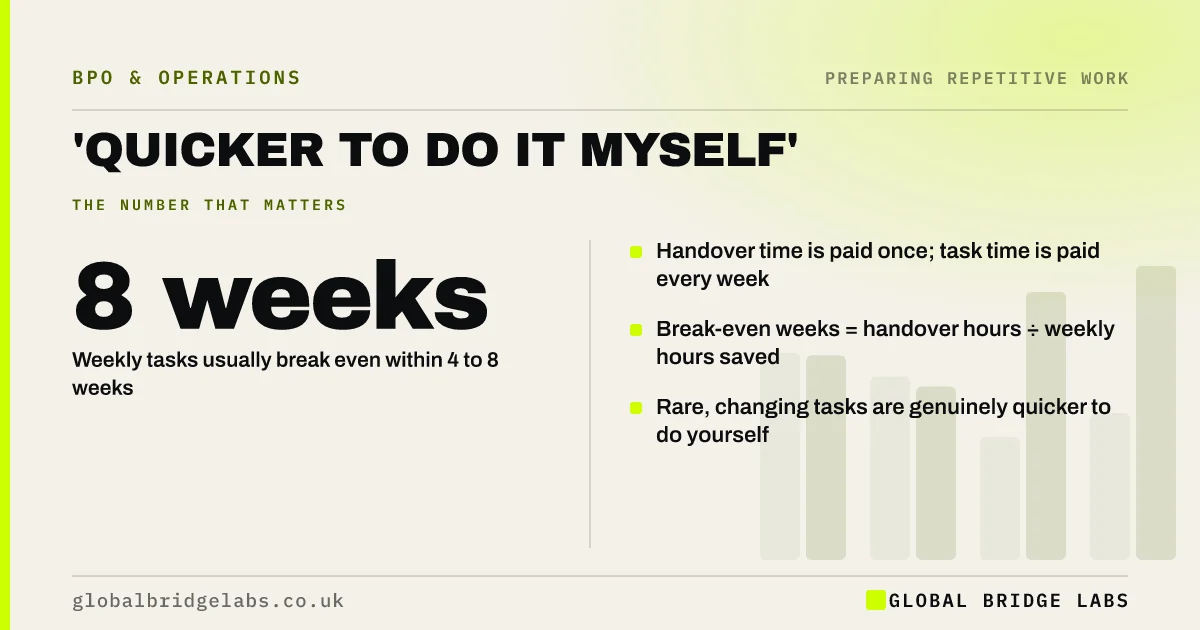
'Quicker to do it myself' is true for a task once and false for a task done every week. Explaining a repetitive task takes a fixed amount of time; doing it takes time every week forever. Compare the one-off handover time with the weekly time saved, and most tasks that recur weekly pay back within a month or two.
- Handover time is paid once; task time is paid every week.
- Break-even weeks = handover hours ÷ weekly hours saved.
- Weekly tasks usually break even within 4 to 8 weeks.
- Rare, changing tasks are genuinely quicker to do yourself.
Want to test the claim on your own tasks? Message us on WhatsApp with three you always keep.
Chat on WhatsApp →Why does it feel quicker to do it yourself?
It feels quicker because you compare one explanation with one doing of the task. You already know the method, the exceptions and the systems, so this week's item takes ten minutes, while explaining it takes an hour. The comparison ignores next week, and the fifty weeks after that.
How do you work out the break-even?
Estimate the hours to document, explain and check the task during handover, then divide by the hours a week it will save you once it runs. In an illustrative example, a task taking you 2 hours a week needs 6 hours to hand over and 30 minutes a week to review. Saving 1.5 hours a week, it breaks even in four weeks. These are example figures.
- Handover hours: write, explain, parallel run.
- Weekly hours saved: task time minus review time.
- Break-even weeks: handover ÷ weekly saving.
Send us your three 'quicker myself' tasks on WhatsApp and we will run the numbers with you.
Chat on WhatsApp →When is it genuinely quicker to do it yourself?
It is genuinely quicker when the task happens a few times a year, changes every time, depends on relationships only you hold, or takes minutes with no errors. It can also be right during a crisis, when there is no time to explain. Note those tasks and revisit them when they recur.
What does keeping every task cost?
Keeping every small task costs your focus as well as your hours. Each interruption breaks concentration on higher-value work, and research summarised by the American Psychological Association suggests switching between tasks can cost as much as 40% of productive time. The cost of doing it yourself is rarely just the ten minutes.
What does this look like in practice?
A pattern we see: an owner keeps a dozen small tasks because each is quick. Bundled, they come to a full day a week, and handing them over as one block takes less explaining than the owner expected because they share systems and rules.
Quicker myself checklist
Ask these questions before you keep a task.
- How often does it recur?
- How long does it take each time?
- How long would it take to explain once?
- What is the break-even in weeks?
- What would you do with the time instead?
Next step
Send us the tasks you always end up doing yourself. We will help you work out which ones are worth handing over and which really are quicker to keep.
Message us on WhatsApp to test your task list, or book a 30-minute consultation.
Chat on WhatsApp →Sources and further reading
- Multitasking: switching costs · American Psychological Association
- What are the Management Standards for work-related stress? · Health and Safety Executive
Frequently asked questions
Is it really quicker to do it yourself?
Only for tasks that happen rarely or change each time. For weekly repetitive tasks, the one-off time to explain is usually repaid within one or two months, after which you save the full task time every week. Work out the break-even before deciding.
How do I stop doing tasks I should hand over?
List the tasks you keep, work out the break-even for each, and hand over the one with the shortest payback first. Write the method as you do it next time, run it in parallel for a week, then remove yourself from the process except for a weekly check.
What tasks should a business owner keep?
Keep tasks that rely on your judgement, relationships or authority, such as pricing decisions, key client conversations and hiring. Keep rare, changing tasks too. Hand over the frequent, rule-based work that fills the gaps between those, because it costs your focus as well as your time.
Written by

Global Bridge Labs (GBL) is a UK–Sri Lanka partner for social media, websites and BPO. Everything here comes from client delivery, not theory.