On this page
Key takeaways
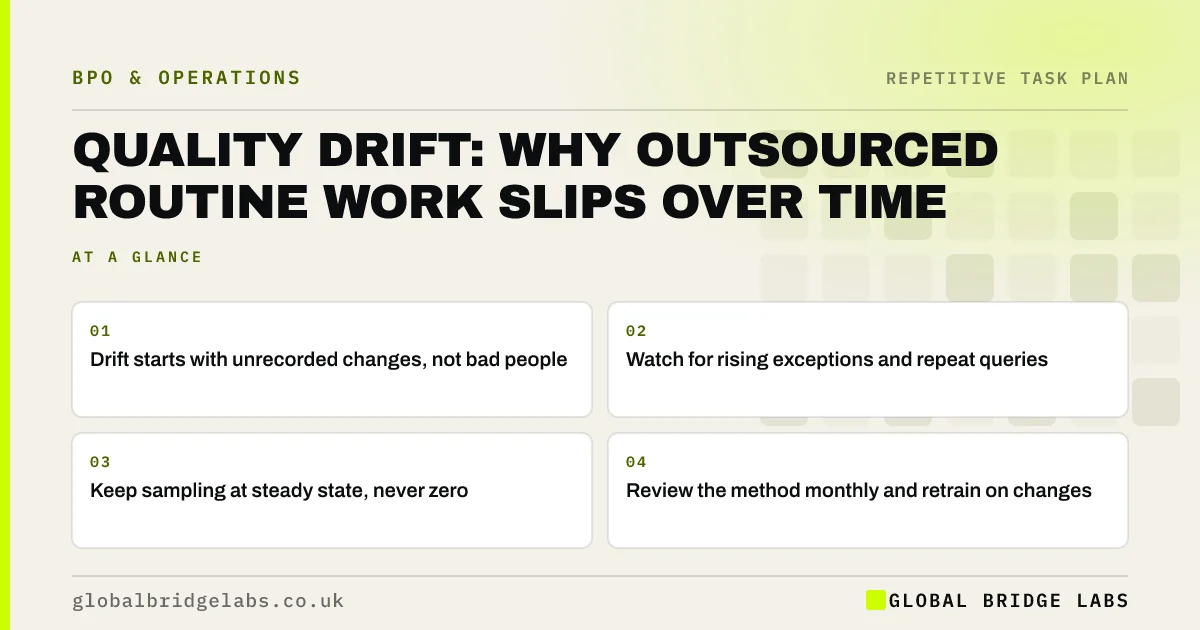
Quality drift is the slow decline in accuracy or consistency that can appear months after a successful handover. It usually comes from small changes nobody wrote down: new exceptions, staff turnover, rule tweaks agreed by email, or sampling that stopped. It is preventable with a living method, steady sampling and a monthly review.
- Drift starts with unrecorded changes, not bad people.
- Watch for rising exceptions and repeat queries.
- Keep sampling at steady state, never zero.
- Review the method monthly and retrain on changes.
Outsourced work not as good as it was? Message us on WhatsApp and we will help you find the cause.
Chat on WhatsApp →Why does quality drift?
Quality drifts because the task changes while the method does not. A new product line adds exceptions, a rule changes in a chat message, a trained team member moves on, or sampling quietly stops because things look fine. Each change is small, and together they move the work away from the standard.
What are the early warning signs?
Drift shows up in the scorecard before customers notice, if you are looking.
- More items referred as exceptions.
- The same questions asked again.
- Turnaround creeping up on the same volume.
- Sample error rate rising for two or more weeks.
How do you prevent drift?
Treat the method as a living document. Record every rule change in it, not just in messages, and retrain the team when it changes. Keep sampling at a steady rate. Hold a monthly review of exceptions and errors, and refresh training whenever team members change.
- Every rule change written into the method.
- Steady-state sampling, never stopped.
- Monthly review of exceptions and errors.
- Refresher training when people change.
What does drift cost?
In an illustrative example, an error rate creeping from 1% to 4% over six months on 2,000 items a month means 60 extra corrections a month, at 15 minutes each, 15 hours of rework. These are example figures. A monthly review catches it at 2%.
- Right first time rate: the quality number that cuts cost
- Admin errors costing money? When accuracy says outsource
Want a monthly review format that catches drift? Ask us on WhatsApp.
Chat on WhatsApp →When is drift really a scope change?
Sometimes falling quality is a sign that the task itself has grown: more variants, more judgement, more volume than was agreed. Then the answer is to rescope, rescore on the fit score and perhaps split the task, rather than push the team harder.
What does this look like in practice?
A pattern we see: a task runs well for months, then errors rise after the business launches a new service nobody told the team about. A standing item in the monthly review, 'what has changed?', prevents it.
Drift prevention checklist
Keep these in place for every outsourced task.
- Method updated with every change.
- Steady sampling.
- Weekly scorecard reviewed.
- Monthly 'what has changed?' review.
- Refresher training on staff changes.
Next step
Send us the scorecard for a task that has slipped. We will help you find where the drift started and what to change.
Message us on WhatsApp about quality drift, or book a 30-minute consultation.
Chat on WhatsApp →Sources and further reading
- Human factors: managing human failures · Health and Safety Executive
- Principle (d): Accuracy · Information Commissioner's Office
Frequently asked questions
Why does outsourced quality decline over time?
Usually because the task changes but the written method does not: new exceptions, rules changed informally, staff turnover or sampling that stopped. The decline is gradual, so it is easy to miss without a weekly scorecard and a monthly review of errors and exceptions.
How do you keep outsourced work consistent?
Keep the method up to date with every change, retrain when it changes or when people join, keep sampling at a steady rate, review a weekly scorecard and hold a monthly review of exceptions and errors with a standing question about what has changed.
Should sampling ever stop once quality is good?
No. Step it down to a steady rate, such as about one item in twenty, but keep it going. Sampling is how you spot drift early. Stopping it entirely removes the early warning and makes problems visible only when customers complain.
Written by

Global Bridge Labs (GBL) is a UK–Sri Lanka partner for social media, websites and BPO. Everything here comes from client delivery, not theory.