On this page
Key takeaways
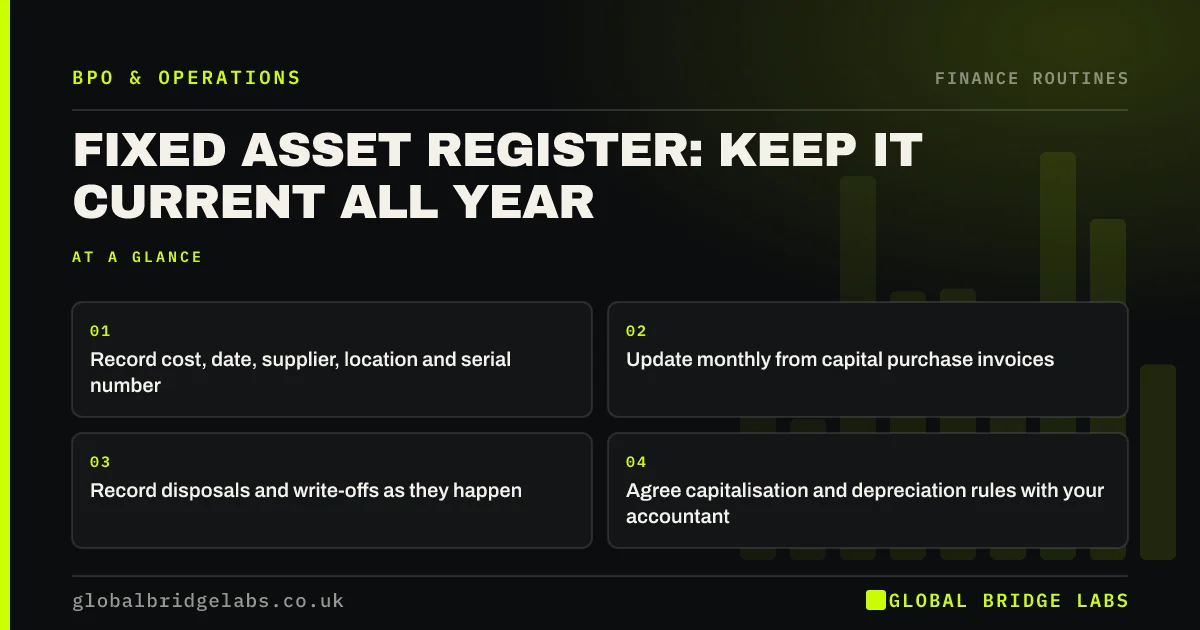
A fixed asset register lists the equipment, vehicles and other long-term assets a business owns, with cost, purchase date, location, depreciation and disposal. Updated monthly from purchase invoices and disposal notes, it supports accurate accounts and capital allowance claims. Left to year-end, it becomes a scramble through a year of invoices.
- Record cost, date, supplier, location and serial number.
- Update monthly from capital purchase invoices.
- Record disposals and write-offs as they happen.
- Agree capitalisation and depreciation rules with your accountant.
Facing a year-end scramble over assets? Message us on WhatsApp and we will help you set up a monthly routine.
Chat on WhatsApp →What should a fixed asset register record?
Record enough to identify each asset and account for it: description, cost, purchase date, supplier, location, serial or registration number, asset category, depreciation method and rate, and any disposal date and proceeds. Your accountant will advise on the capitalisation threshold, below which purchases are expensed rather than registered.
What is the monthly routine?
Each month, review purchase invoices over the capitalisation threshold, add new assets, record disposals reported by staff, and post depreciation. Once a year, check that assets on the register still exist. The work is rule-based and quick when done monthly, which makes it a good addition to a finance task bundle.
- Review purchases over the threshold.
- Add new assets with full details.
- Record disposals and sale proceeds.
- Post monthly depreciation.
- Run a physical check once a year.
Why does it matter for tax?
Capital allowances let businesses deduct qualifying spending on plant and machinery from taxable profits, and HMRC expects records that support the claim. A current register makes the claim straightforward. In an illustrative example, finding £12,000 of unregistered equipment at year-end means searching a year of invoices; monthly updates make it ten minutes. These are example figures.
Want help setting up the monthly routine? Send us your current register on WhatsApp.
Chat on WhatsApp →When is a register overkill?
For a business with a handful of laptops and no vehicles or plant, a simple list maintained by your accountant at year-end may be enough. The register earns its keep once assets are numerous, spread across sites or regularly moved, sold or scrapped.
What does this look like in practice?
A pattern we see: assets sold or scrapped years ago are still on the register, overstating the balance sheet. A disposal note that staff complete when equipment leaves fixes it going forward.
Asset register checklist
Keep the register current with these points.
- Capitalisation threshold agreed with your accountant.
- Monthly review of capital purchases.
- A disposal note for equipment leaving.
- Depreciation posted monthly.
- Annual physical check.
Next step
Send us your current register or list of assets. We will suggest a monthly routine and say plainly what a managed team could keep current.
Message us on WhatsApp about your asset register, or book a 30-minute consultation.
Chat on WhatsApp →Sources and further reading
- Claim capital allowances · HM Revenue & Customs
- Running a limited company: company and accounting records · GOV.UK
Frequently asked questions
What is a fixed asset register?
A fixed asset register is a record of the long-term assets a business owns, such as equipment, vehicles and machinery. It records each asset's cost, purchase date, location, depreciation and eventual disposal, supporting the accounts and capital allowance claims.
How often should a fixed asset register be updated?
Monthly is best: add assets from capital purchase invoices, record disposals and post depreciation. A physical check once a year confirms assets still exist. Updating only at year-end makes errors more likely and turns a short routine into a long search through invoices.
Can a fixed asset register be outsourced?
Yes. A managed team can review purchase invoices, add assets, record disposals and post depreciation within rules agreed with your accountant. The capitalisation threshold, depreciation policy and any judgement on unusual items should be agreed with your accountant first.
Written by

Global Bridge Labs (GBL) is a UK–Sri Lanka partner for social media, websites and BPO. Everything here comes from client delivery, not theory.