On this page
- 01Key takeaways
- 02Which parts of estimating are repetitive?
- 03How do you keep support accurate?
- 04What does estimating support save?
- 05What must stay with the estimator?
- 06What does this look like in practice?
- 07Estimating support checklist
- 08Next step
- 09Sources and further reading
- 10Frequently asked questions
Key takeaways
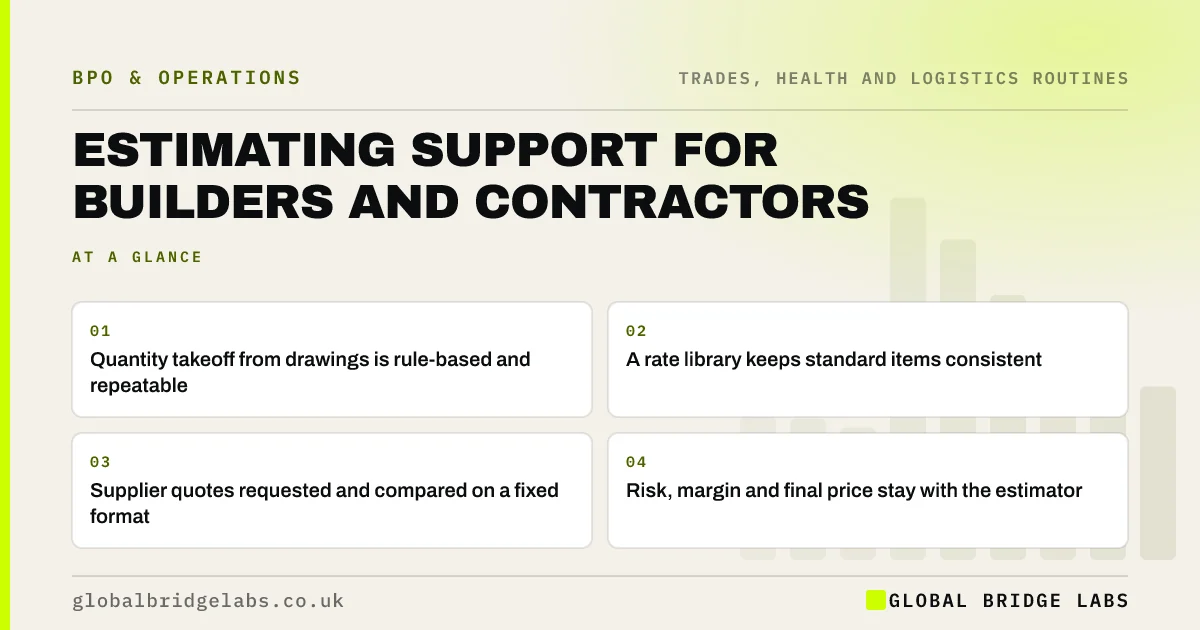
Much of estimating is repetitive preparation: measuring quantities from drawings, pricing standard items from a rate library, requesting and comparing supplier and subcontractor quotes, and assembling the estimate. The judgement, such as risk, programme and margin, belongs to the estimator. Support with the preparation lets contractors price more tenders without missing deadlines.
- Quantity takeoff from drawings is rule-based and repeatable.
- A rate library keeps standard items consistent.
- Supplier quotes requested and compared on a fixed format.
- Risk, margin and final price stay with the estimator.
Turning down tenders for lack of estimating time? Message us on WhatsApp with how many you price a month.
Chat on WhatsApp →Which parts of estimating are repetitive?
Measuring, pricing standard items and collating quotes follow the same steps for every job. They take most of the hours and are where an estimating backlog builds.
- Quantity takeoff from drawings and specifications.
- Pricing standard items from your rate library.
- Sending enquiries to suppliers and subcontractors.
- Comparing returned quotes like for like.
- Assembling the estimate in your format.
How do you keep support accurate?
Give the team your measurement rules, rate library and estimate template, and have the estimator review takeoffs on the first few jobs line by line. After that, sample. Keep a list of the items that always need the estimator's eye, such as groundworks, temporary works and anything with access constraints.
What does estimating support save?
In an illustrative example, a contractor prices 12 jobs a month at about 10 hours each, two-thirds of it takeoff and quote collation. Moving that preparation frees around 80 hours, enough to price more work or review each estimate more carefully. These are example figures.
- Quote turnaround time: how fast should you send a quote?
- Skilled staff stuck doing admin? What it costs you
Send us your monthly tender volume on WhatsApp and we will estimate the support with you.
Chat on WhatsApp →What must stay with the estimator?
Interpreting ambiguous drawings, judging risk and programme, setting margins and deciding the final price must stay with the estimator or director. Commercial terms and tender qualifications need the same care. Support prepares; the estimator decides.
What does this look like in practice?
A pattern we see: the estimator spends evenings measuring, so estimates go out late and with little time for review. Moving takeoffs to a support team gives the estimator time to check risk properly.
Estimating support checklist
Set up support with these points.
- Written measurement rules.
- A current rate library.
- Standard supplier enquiry format.
- Estimator review of early takeoffs.
- List of items always reviewed in full.
Next step
Send us a recent estimate and how it was prepared. We will say plainly which parts a support team could prepare and what stays with your estimator.
Message us on WhatsApp about estimating support, or book a 30-minute consultation.
Chat on WhatsApp →Sources and further reading
- Construction (Design and Management) Regulations 2015 · Health and Safety Executive
- Late commercial payments: charging interest and debt recovery · GOV.UK
Frequently asked questions
What is a quantity takeoff?
A quantity takeoff is the measurement of materials and work items from drawings and specifications, such as areas of brickwork, lengths of pipe or numbers of fittings. It is the starting point for pricing an estimate and follows consistent measurement rules.
Can construction estimating be outsourced?
The preparation can be: takeoffs, pricing standard items from your rate library, requesting and comparing quotes and assembling the estimate. Risk, programme, margin and the final price should stay with your estimator, who reviews the prepared work before it goes out.
How do you check outsourced takeoffs?
Review the first few takeoffs line by line against the drawings, then move to sampling. Keep a list of high-risk items, such as groundworks or temporary works, that are always checked in full, and track any corrections so the measurement rules improve.
Written by

Global Bridge Labs (GBL) is a UK–Sri Lanka partner for social media, websites and BPO. Everything here comes from client delivery, not theory.