On this page
- 01Key takeaways
- 02What is job enrichment?
- 03How is enrichment different from enlargement?
- 04Which job features should you build in?
- 05What does an enriched role look like?
- 06When does enrichment not work?
- 07What does this look like in practice?
- 08Job enrichment checklist
- 09Next step
- 10Sources and further reading
- 11Frequently asked questions
Key takeaways
Job enrichment means redesigning a role so it carries more responsibility, variety and ownership of outcomes, not just more tasks. The idea comes from Frederick Herzberg's work on motivation in 1968. When repetitive tasks move to an outsourced team, enrichment is how you turn the freed hours into a better role rather than an emptier one.
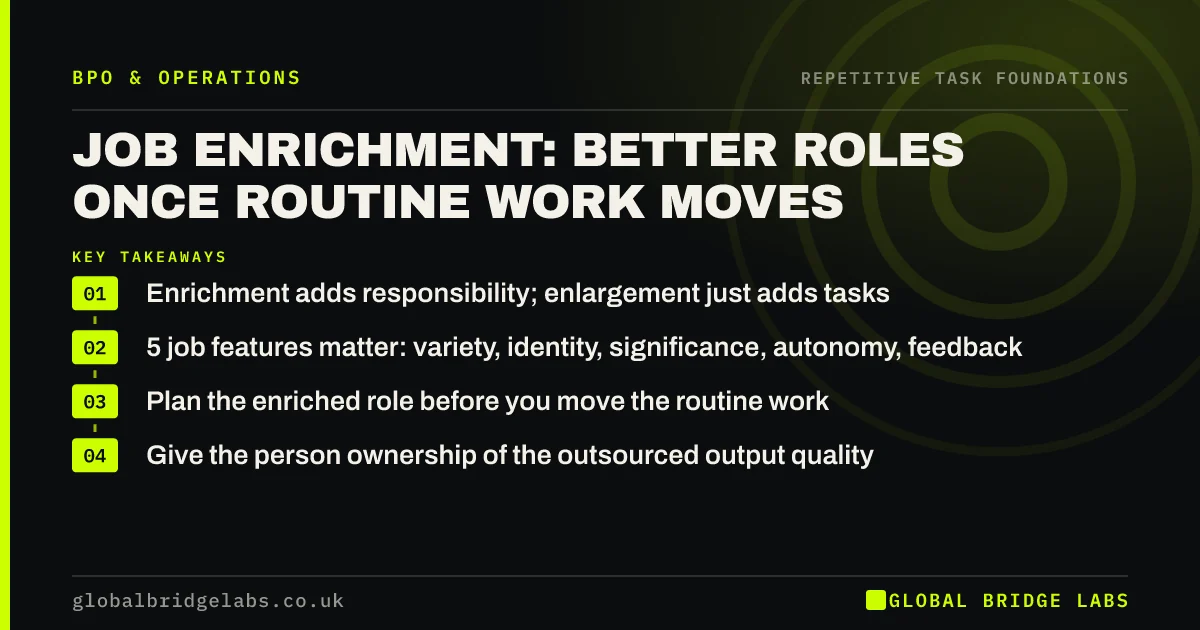
- Enrichment adds responsibility; enlargement just adds tasks.
- 5 job features matter: variety, identity, significance, autonomy, feedback.
- Plan the enriched role before you move the routine work.
- Give the person ownership of the outsourced output quality.
Planning to move routine work out of a role? Message us on WhatsApp and we will help plan what replaces it.
Chat on WhatsApp →What is job enrichment?
Job enrichment is the deliberate redesign of a role to give the person more control, more complete pieces of work and more responsibility for results. Frederick Herzberg argued in the Harvard Business Review in 1968 that pay and conditions prevent dissatisfaction but do not motivate; achievement, responsibility and the work itself do. Enrichment builds those into the job.
How is enrichment different from enlargement?
Job enlargement adds more tasks at the same level, such as giving an administrator a second inbox. Job enrichment adds depth, such as giving them ownership of supplier performance. Enlargement often feels like more of the same; enrichment feels like progress. When routine work is removed, the risk is filling the gap with enlargement by default.
Which job features should you build in?
Hackman and Oldham's Job Characteristics Model (1976) names five features that make work motivating. Use them as a checklist when you redesign a role after routine tasks move out.
- Skill variety: different skills used across the week.
- Task identity: a whole piece of work, start to finish.
- Task significance: a visible effect on customers or colleagues.
- Autonomy: choice over method and timing.
- Feedback: clear results the person can see.
What does an enriched role look like?
In an illustrative example, a customer service assistant hands 15 hours a week of order queries and refunds to a managed team. The freed time goes to owning the weekly quality sample, analysing why customers contact the business and fixing two causes a month. These are example figures. The role moves from answering contacts to reducing them.
- 'Where is my order?' queries: handle them at scale
- Customer feedback loop: turn complaints into fewer contacts
Want help designing the role that replaces the routine work? Send us the current job on WhatsApp.
Chat on WhatsApp →When does enrichment not work?
Enrichment fails when it is imposed without asking, when the new responsibilities come without authority or training, or when the person wanted a stable, predictable role. It also fails if the business cannot fund the new work, so be honest about whether the freed hours will be used or the role will shrink.
What does this look like in practice?
A pattern we see: the best-run outsourced tasks have an in-house owner who used to do the work, now checks samples and improves the method. Their role became more senior, and the outsourced work got better because someone cared about it.
Job enrichment checklist
Work through these points before routine work moves.
- Agree the freed hours with the person affected.
- Choose responsibilities, not just extra tasks.
- Check the five job features in the new role.
- Give authority and training to match.
- Review the role after three months.
Next step
Send us the role you are changing. We will suggest which routine tasks could move and what an enriched version of the role could own instead.
Message us on WhatsApp to plan a role redesign, or book a 30-minute consultation.
Chat on WhatsApp →Sources and further reading
- What are the Management Standards for work-related stress? · Health and Safety Executive
- Business transfers, takeovers and TUPE · GOV.UK
Frequently asked questions
What is an example of job enrichment?
A common example is giving an administrator ownership of a whole outcome, such as supplier performance or customer onboarding quality, instead of a list of tasks. They decide how to improve it, see the results and answer for them, which adds responsibility and variety rather than just volume.
What is the difference between job enrichment and job enlargement?
Job enlargement adds more tasks at the same level, so the person does more of similar work. Job enrichment adds responsibility, autonomy and ownership, so the work becomes deeper. Enrichment tends to improve motivation; enlargement alone often does not.
How does outsourcing help job enrichment?
Outsourcing repetitive tasks frees hours that can be filled with more meaningful responsibilities, such as quality ownership, customer analysis or improvement work. It only helps if those responsibilities are planned in advance and agreed with the person, rather than the gap being filled with more routine tasks.
Written by

Global Bridge Labs (GBL) is a UK–Sri Lanka partner for social media, websites and BPO. Everything here comes from client delivery, not theory.