On this page
- 01Key takeaways
- 02What is a repetitive task inventory?
- 03What should each row record?
- 04How do you find the tasks nobody mentions?
- 05What does an inventory reveal in numbers?
- 06When is an inventory overkill?
- 07What does this look like in practice?
- 08Inventory checklist
- 09Next step
- 10Sources and further reading
- 11Frequently asked questions
Key takeaways
A repetitive task inventory is one list of every recurring task in the business, with its frequency, volume, minutes per item, owner, systems and rules. It takes a week to build and replaces guesswork about where routine time goes. Use it to score tasks, bundle small ones and choose what to hand over first.
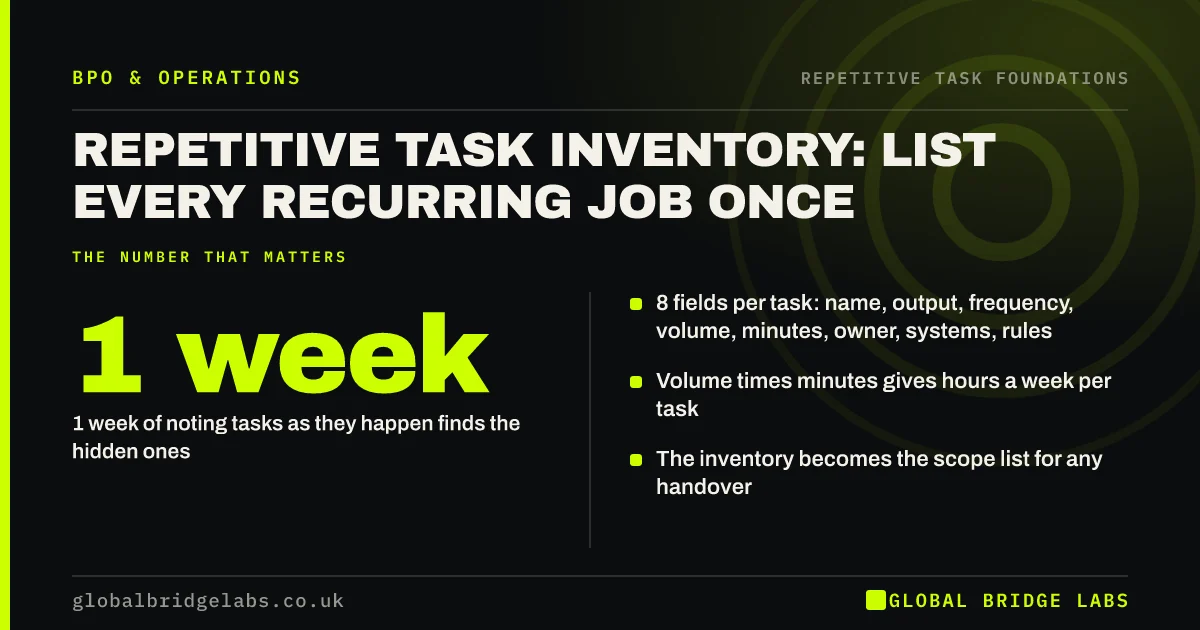
- 8 fields per task: name, output, frequency, volume, minutes, owner, systems, rules.
- 1 week of noting tasks as they happen finds the hidden ones.
- Volume times minutes gives hours a week per task.
- The inventory becomes the scope list for any handover.
Want our inventory layout? Message us on WhatsApp and we will send it over.
Chat on WhatsApp →What is a repetitive task inventory?
A repetitive task inventory is a register of the recurring work a business does, one row per task, recorded in enough detail that someone else could estimate its size. It differs from a time audit, which shows where a person's hours go, because it is organised by task rather than by person. The same task done by three people appears once.
What should each row record?
Record eight fields per task. Keep each to a few words so the list stays readable, and add a link to any written method you already have. The minutes field should be typical, not best case.
- Task name and the output it produces.
- Frequency: daily, weekly, monthly or seasonal.
- Volume per period and minutes per item.
- Current owner, and who covers when they are off.
- Systems used and any personal data involved.
- Rules, known exceptions and where they are written down.
How do you find the tasks nobody mentions?
Ask each person to note every recurring task as it happens for one week, then add the monthly, quarterly and annual tasks from the diary, the accounts calendar and compliance deadlines. Shared inboxes, spreadsheets with weekly tabs and calendar reminders are good places to look, because recurring tasks leave recurring traces.
What does an inventory reveal in numbers?
In an illustrative 12-person firm, an inventory of 34 tasks shows 6 of them account for about 70% of routine hours, and 3 tasks are done by different people in different ways. These are example figures. The pattern of a few large tasks and many small ones is common, and it tells you where to start.
- The 80/20 rule in business: find the work that matters
- Process standardisation: one best way, lower cost per task
Send us your inventory on WhatsApp and we will help you read it.
Chat on WhatsApp →When is an inventory overkill?
For a business of two or three people with a handful of obvious routine tasks, a full inventory is overkill. A short list of the five most frequent tasks and their weekly hours is enough to decide. The inventory earns its keep once routine work is spread across several people.
What does this look like in practice?
A pattern we see: building the inventory is the first time anyone has seen all the routine work in one place, and the conversation shifts from whether to outsource to which tasks to bundle and stop.
Inventory checklist
Build the inventory in this order.
- Create one row per task, not per person.
- Fill the eight fields for every row.
- Collect a week of live notes from each person.
- Add monthly, quarterly and annual tasks.
- Calculate weekly hours per task.
- Score the largest tasks on the fit score.
Next step
Send us your list, however rough. We will help you complete the fields that matter and point out the tasks worth handing over first.
Message us on WhatsApp to review your task inventory, or book a 30-minute consultation.
Chat on WhatsApp →Sources and further reading
- Labour productivity · Office for National Statistics
- Controllers and processors · Information Commissioner's Office
Frequently asked questions
What should a task inventory include?
Each row should include the task name and output, frequency, volume, minutes per item, owner and cover, systems used, personal data involved, and the rules and known exceptions. With those fields you can estimate hours, spot duplication and score each task for outsourcing.
How long does it take to build a task inventory?
Most small businesses build a useful inventory in about a week: a day to set up the list, five working days of live notes from each person, and an hour to add periodic tasks from the diary and compliance calendar. Keep it updated quarterly after that.
Is a task inventory the same as a time audit?
No. A time audit shows how each person spends their hours. A task inventory lists each recurring task once, with its volume and method, regardless of who does it. The two work well together: the audit finds the time, the inventory describes the work.
Written by

Global Bridge Labs (GBL) is a UK–Sri Lanka partner for social media, websites and BPO. Everything here comes from client delivery, not theory.