On this page
Key takeaways
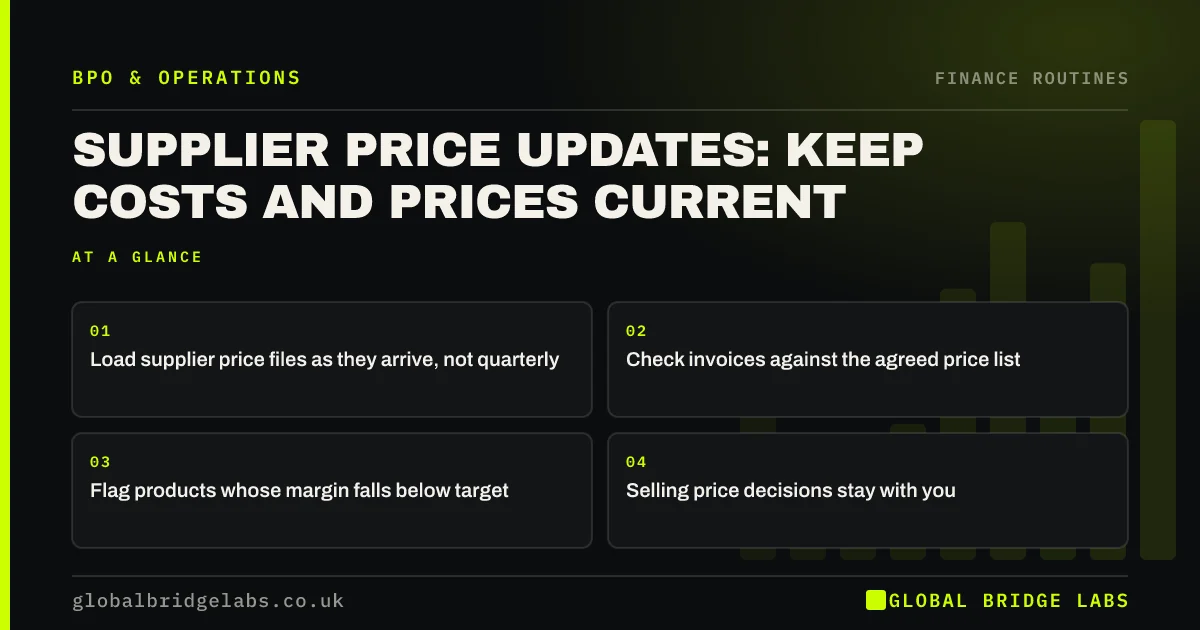
Supplier price updates are the routine of loading new cost prices into your systems when suppliers change them, checking invoices against agreed prices, and flagging where your own selling prices or quotes need reviewing. Missed updates quietly erode margin. The loading and checking are repetitive; the pricing decision is not.
- Load supplier price files as they arrive, not quarterly.
- Check invoices against the agreed price list.
- Flag products whose margin falls below target.
- Selling price decisions stay with you.
Want to know how many price changes you are missing? Message us on WhatsApp with your supplier count.
Chat on WhatsApp →Why do supplier price updates get missed?
They get missed because they arrive in different formats, at different times, often as an email attachment to one person. Each file needs mapping to your product codes, and there is rarely time to do it the day it arrives. Meanwhile quotes and online prices use old costs, and invoices at new prices are paid without a check.
What does the routine involve?
Collect price files from a shared inbox, map them to your product codes, load the new costs with their effective dates, and run a margin check. Products below your target margin go to the person who sets prices. Invoices are checked against the current agreed price, and differences are queried with the supplier.
- Collect files from one shared inbox.
- Map supplier codes to your product codes.
- Load costs with effective dates.
- Run a margin check and flag exceptions.
- Query invoices that do not match.
What do missed updates cost?
In an illustrative example, a wholesaler misses a 6% increase on 200 products for three months, on £30,000 a month of sales at those costs. That is about £5,400 of margin lost before anyone notices. These are example figures. A routine that loads files within days of arrival closes that gap.
Send us your supplier price file formats on WhatsApp and we will estimate the routine with you.
Chat on WhatsApp →When should you keep this in-house?
Keep it in-house when prices are negotiated deal by deal rather than published in files, or when you have only a few suppliers with rare changes. The decision to change your own prices, absorb a rise or switch supplier should always stay with you.
What does this look like in practice?
A pattern we see: a business discovers at year-end that margins fell on its best-selling lines because cost increases were never loaded. A weekly price file routine turns that into a monthly exception list.
Price update checklist
Set up the routine with these points.
- One inbox for supplier price files.
- A code mapping for each supplier.
- Files loaded within three working days.
- Margin check after every load.
- Invoice prices checked against agreed prices.
Next step
Send us how supplier price changes reach your systems today. We will suggest a routine and say plainly which parts a managed team could run.
Message us on WhatsApp about supplier price updates, or book a 30-minute consultation.
Chat on WhatsApp →Sources and further reading
- Inflation and price indices · Office for National Statistics
- Late commercial payments: charging interest and debt recovery · GOV.UK
Frequently asked questions
How do you keep supplier prices up to date?
Collect price files in one shared inbox, map supplier codes to your product codes, load new costs with their effective dates within a few days of arrival, and run a margin check after each load. Check invoices against the agreed price and query any differences.
What happens if supplier price increases are missed?
Quotes and selling prices are based on old costs, so margin falls without anyone noticing, and invoices at the new prices may be paid without checking whether the increase was agreed. The loss often only shows at year-end, when it is too late to recover.
Can supplier price updates be outsourced?
Yes. A managed team can collect files, map codes, load costs, run margin checks and query invoice differences. Decisions on your own selling prices, whether to absorb an increase and whether to switch supplier should stay with you.
Written by

Global Bridge Labs (GBL) is a UK–Sri Lanka partner for social media, websites and BPO. Everything here comes from client delivery, not theory.