On this page
- 01Key takeaways
- 02Why sample instead of checking everything?
- 03What sampling rates should you use?
- 04What does a sample look like in numbers?
- 05When is sampling not enough?
- 06What does this look like in practice?
- 07Sampling plan checklist
- 08Next step
- 09Sources and further reading
- 10Frequently asked questions
Key takeaways
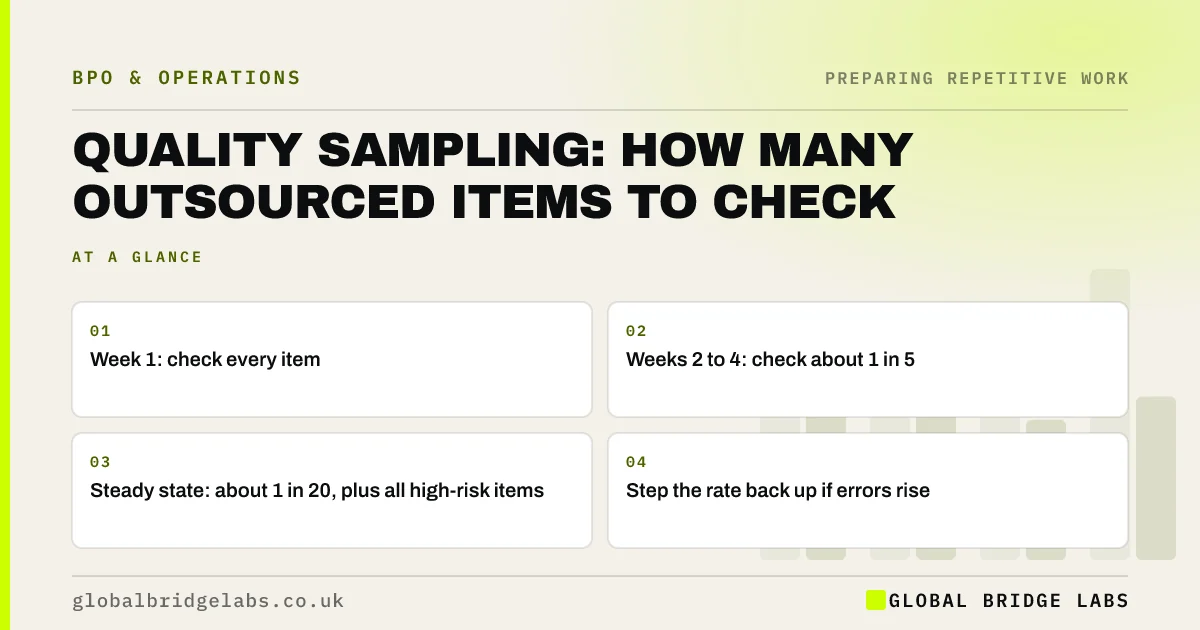
A quality sampling plan says how many finished items you check, how you choose them and what happens when errors rise. For outsourced repetitive work, start high, checking every item for the first week, then step down as accuracy holds. Tie the rate to risk: a payment needs more checks than a record update.
- Week 1: check every item.
- Weeks 2 to 4: check about 1 in 5.
- Steady state: about 1 in 20, plus all high-risk items.
- Step the rate back up if errors rise.
Want a sampling plan for your first outsourced task? Message us on WhatsApp with the task and volume.
Chat on WhatsApp →Why sample instead of checking everything?
Checking every item forever means paying twice for the same work. Sampling checks enough items to know the error rate with reasonable confidence, and saves full checks for high-risk outputs. The point is to catch patterns early, not to find every slip, which is the job of controls built into the method.
What sampling rates should you use?
These are GBL working rules of thumb rather than a statistical standard. Start at 100% in the first week or the parallel run. Move to about one in five for the next three weeks, then about one in twenty once accuracy holds at your target. Always check items above a value or risk threshold in full.
- Go-live week: 100% of items.
- Weeks 2 to 4: about 20%.
- Month 2 onwards: about 5%, chosen at random.
- High-risk items, such as payments over a limit: 100%.
What does a sample look like in numbers?
In an illustrative example, a team processes 800 records a month. At 5% you check 40, roughly 2 a day. If 1 of the 40 is wrong, the estimated error rate is 2.5%. If the target is 2%, step the rate back up to 20% until the cause is fixed. These are example figures.
- Right first time rate: the quality number that cuts cost
- Outsourcing efficiency KPIs: prove the work got faster
Want help setting targets and rates for your volumes? Send them on WhatsApp.
Chat on WhatsApp →When is sampling not enough?
Sampling is not enough when one error is costly or irreversible, such as a supplier payment to the wrong account or a regulatory filing. Use a full second check or a built-in control on those items. Sampling is also weak when volume is very low, because a few items say little.
What does this look like in practice?
A pattern we see: sampling stays at 100% for months because nobody agreed when to step down. Writing the step-down rule into the scope from day one saves those hours.
Sampling plan checklist
Agree these points before go-live.
- Accuracy target per task.
- Sampling rate for each phase.
- Random selection method.
- Full checks for high-risk items.
- The step-up rule when errors rise.
- A weekly log of errors by type.
Next step
Tell us the task, its monthly volume and what an error costs. We will suggest a sampling plan and an accuracy target to match.
Message us on WhatsApp to plan your quality checks, or book a 30-minute consultation.
Chat on WhatsApp →Sources and further reading
- Human factors: managing human failures · Health and Safety Executive
- Principle (d): Accuracy · Information Commissioner's Office
Frequently asked questions
How many items should you check for quality?
As a working rule, check every item in the first week of a new outsourced task, about one in five for the next three weeks, and about one in twenty after that, plus every high-risk item. Raise the rate again whenever the error rate rises above target.
Who should do the quality checks?
Ideally both sides: the provider's own quality checker before work is released, and a named person in your business sampling finished work weekly. Your checks confirm the provider's figures and keep someone in-house close to the detail.
What should a quality log record?
Record the date, item reference, who processed it, whether it passed, the error type and the cause. Grouping errors by type and cause each month shows whether to fix the method, the rules, the inputs or the training.
Written by

Global Bridge Labs (GBL) is a UK–Sri Lanka partner for social media, websites and BPO. Everything here comes from client delivery, not theory.