On this page
- 01Key takeaways
- 02Why do repetitive tasks need an intake form?
- 03What fields should an intake form include?
- 04What does an intake form save?
- 05When is a form the wrong answer?
- 06What does this look like in practice?
- 07Intake form checklist
- 08Next step
- 09Sources and further reading
- 10Frequently asked questions
Key takeaways
A work request intake form is one structured way for staff or customers to send a routine job, with every field the task needs filled in before it starts. It removes the back-and-forth that slows repetitive work, especially when an outsourced team does it. Most small businesses need one short form per task family, not one per task.
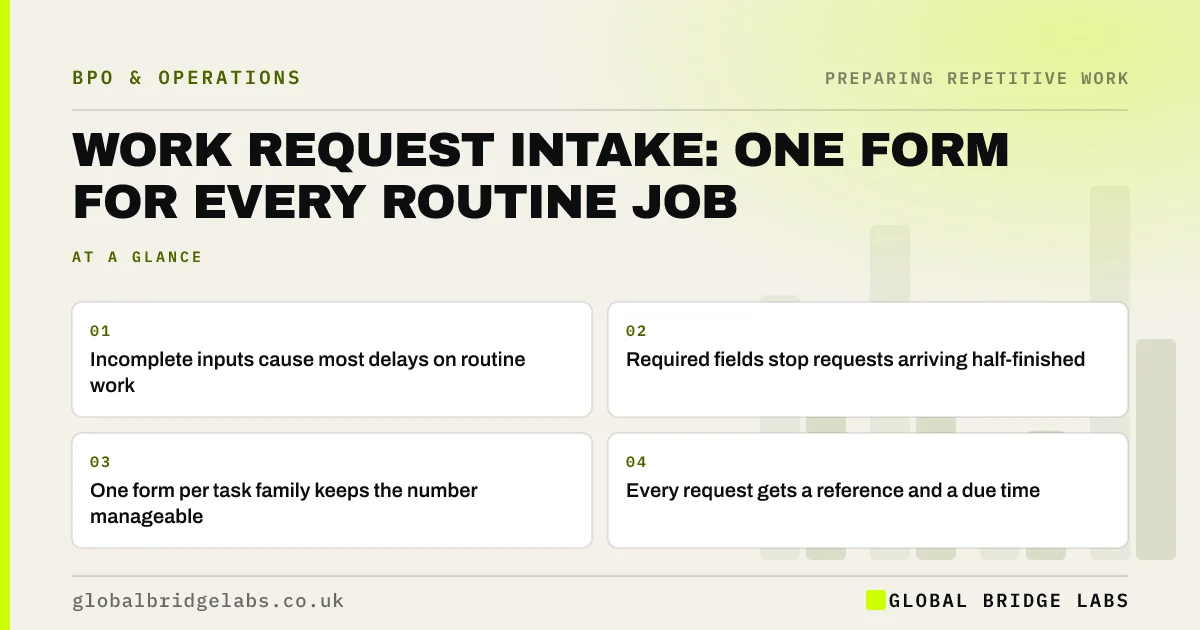
- Incomplete inputs cause most delays on routine work.
- Required fields stop requests arriving half-finished.
- One form per task family keeps the number manageable.
- Every request gets a reference and a due time.
Want help designing an intake form for one task? Message us on WhatsApp with what usually goes missing.
Chat on WhatsApp →Why do repetitive tasks need an intake form?
Repetitive tasks slow down most when the inputs are incomplete: a purchase request without a supplier code, a refund without an order number, a data change without the source. Each gap means a query and a wait. An intake form asks for the inputs once, in a fixed order, so the task can start immediately.
What fields should an intake form include?
Include only the fields the task needs to start and finish without a query. Make the critical ones required, use drop-downs where values are fixed, and ask for attachments where proof is needed. Keep the form under about ten fields, or people will route around it by email.
- Who is asking, and who should receive the result.
- Task type, chosen from a fixed list.
- The reference numbers the task depends on.
- Required attachments, such as a receipt or quote.
- Requested date, and why if it is urgent.
What does an intake form save?
In an illustrative example, 200 internal requests a month with a third arriving incomplete create about 65 queries. At 10 minutes per query on each side, that is about 22 hours a month. A required-field form that halves incomplete requests saves about 11 hours and several days of waiting. These are example figures.
- Right first time rate: the quality number that cuts cost
- Purchase order processing: raise, match and close POs
Want to estimate what incomplete requests cost you? Send us a month of examples on WhatsApp.
Chat on WhatsApp →When is a form the wrong answer?
A form is the wrong answer for urgent customer contact, where a phone call or chat is faster, and for tasks with only a handful of requests a month. It also fails if people can still bypass it by emailing the person they know, so agree that requests outside the form wait.
What does this look like in practice?
A pattern we see: once requests come through one form, the outsourced team stops chasing missing information and the in-house team stops being interrupted with questions.
Intake form checklist
Check your form against these points.
- Ten fields or fewer.
- Critical fields required.
- Fixed lists where values are fixed.
- Every request gets a reference.
- Requests outside the form are redirected.
Next step
Send us the task where requests most often arrive incomplete. We will suggest the fields and rules that stop the chasing.
Message us on WhatsApp to design an intake form, or book a 30-minute consultation.
Chat on WhatsApp →Sources and further reading
- Structuring forms · GOV.UK Service Manual
- Question pages pattern · GOV.UK Design System
Frequently asked questions
What is a work request form?
A work request form is a short, structured form that staff or customers use to submit a routine job, with the information the task needs captured up front. It gives each request a reference and a due date, and stops work starting with missing details.
What should a request form include?
Include who is asking, who receives the result, the task type from a fixed list, the reference numbers the task needs, any required attachments and the requested date. Keep it to about ten fields, and make only the critical ones mandatory.
Do outsourced teams need intake forms?
They benefit more than in-house teams, because they cannot lean over a desk to ask a quick question. A good intake form means the outsourced team can start each item straight away, which shortens turnaround and cuts the queries your staff have to answer.
Written by

Global Bridge Labs (GBL) is a UK–Sri Lanka partner for social media, websites and BPO. Everything here comes from client delivery, not theory.