On this page
- 01Key takeaways
- 02When is outsourcing the wrong decision?
- 03Which situations say do not outsource?
- 04What should you do instead?
- 05Is it ever wrong to outsource customer service?
- 06What does outsourcing at the wrong time cost?
- 07Do regulated businesses need to take extra care?
- 08How do you know when the answer changes?
- 09What does this look like in practice?
- 10Checklist: should you hold off?
- 11Next step
- 12Sources and further reading
- 13Frequently asked questions
Key takeaways
When not to outsource: do not hand over work that is your point of difference, needs judgement on every case, must be done on site, is still changing every month, or takes only a few hours a week. In those cases hiring, automating or simplifying the process is cheaper and safer. The answer can change as volume grows.
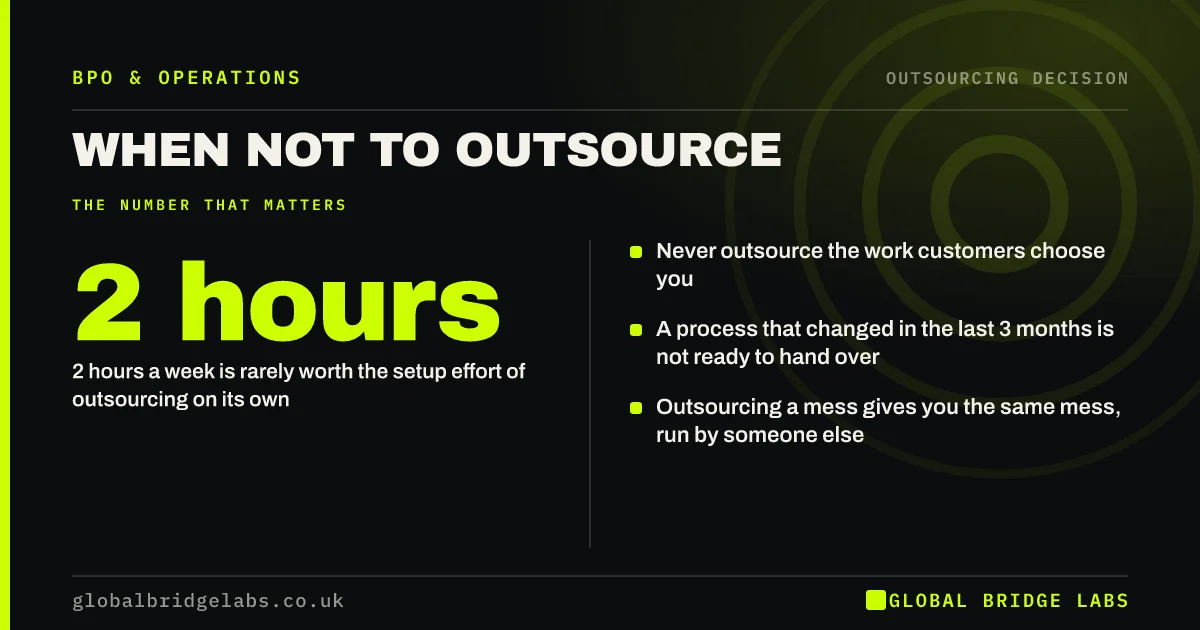
- 2 hours a week is rarely worth the setup effort of outsourcing on its own.
- Never outsource the work customers choose you for.
- A process that changed in the last 3 months is not ready to hand over.
- Outsourcing a mess gives you the same mess, run by someone else.
Not sure whether your case is a yes or a no? Message us on WhatsApp for an honest view.
Chat on WhatsApp →When is outsourcing the wrong decision?
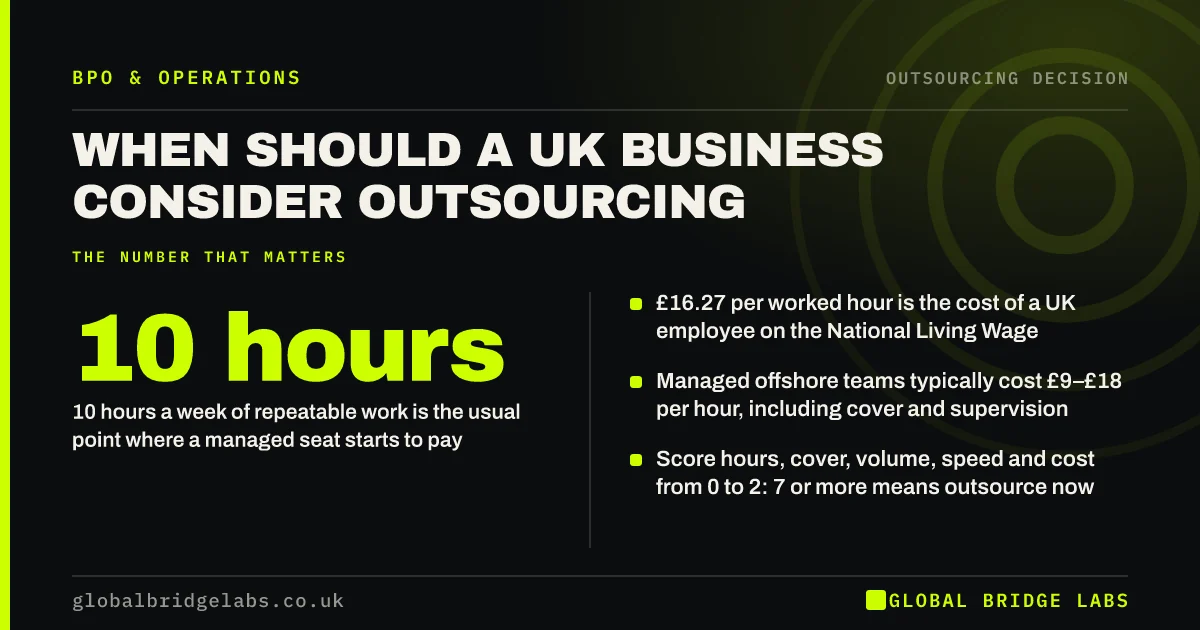
Outsourcing is the wrong decision when the cost of handing over, managing and checking the work is greater than the time and money it saves. That happens with small volumes, unstable processes and work that depends on the specific judgement or relationships of people inside the business.
Which situations say do not outsource?
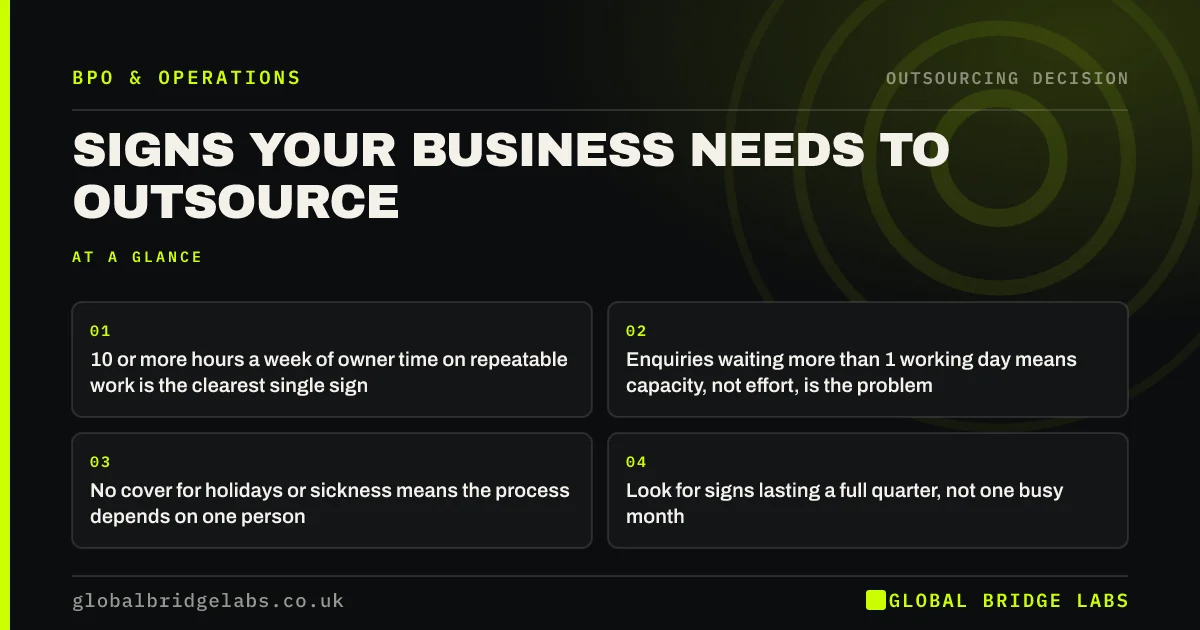
Seven situations reliably point away from outsourcing. If one of them applies, stop and look at the alternative first.
- The work is your competitive edge, such as design, advice or specialist craft.
- Every case needs senior judgement that cannot be written as rules.
- Someone must be physically present, on site or in the shop.
- The process has changed materially in the last three months.
- The volume is only a few hours a week.
- You cannot give an outside team secure access to the systems.
- Nobody inside the business has time to own the relationship.
What should you do instead?
Match the alternative to the reason. For small volumes, use automation or a simple overflow service. For judgement-heavy work, hire or train someone. For unstable processes, fix and document them first. For access problems, sort out logins and permissions. Each of these can make outsourcing viable later.
- Small volume: automation, a booking tool or a part-time UK hire.
- Judgement-heavy: hire or develop an in-house specialist.
- Unstable process: document and simplify for 3 months, then rescore.
- No internal owner: assign one before anything else.
Is it ever wrong to outsource customer service?
Yes, when the service itself is the product, such as a specialist adviser relationship, or when every contact needs deep technical knowledge only your engineers have. Even then, the first line, triage and admin around the specialists can usually be outsourced so they spend their time on the cases that need them.
What does outsourcing at the wrong time cost?
It costs setup effort with no payoff, and sometimes customer goodwill. Handing over an undocumented process means weeks of questions, rework and complaints. Handing over two hours a week means paying for management time on a job that did not need it. Neither makes outsourcing a bad idea; they make it a bad fit at that moment.
Want to know what would need to change before outsourcing makes sense? Ask us on WhatsApp.
Chat on WhatsApp →Do regulated businesses need to take extra care?
Yes. Regulated firms can outsource, but they keep the responsibility. FCA-regulated firms must follow the outsourcing rules in SYSC 8, which require them to keep control of outsourced functions and not impair the regulator's oversight. Healthcare providers handling NHS patient data need to meet the Data Security and Protection Toolkit standards.
In practice this means outsourcing the admin around regulated decisions rather than the decisions themselves. A mortgage broker can outsource case chasing and data entry; the advice stays with the adviser. A clinic can outsource booking and reminders; clinical judgement stays with clinicians.
How do you know when the answer changes?
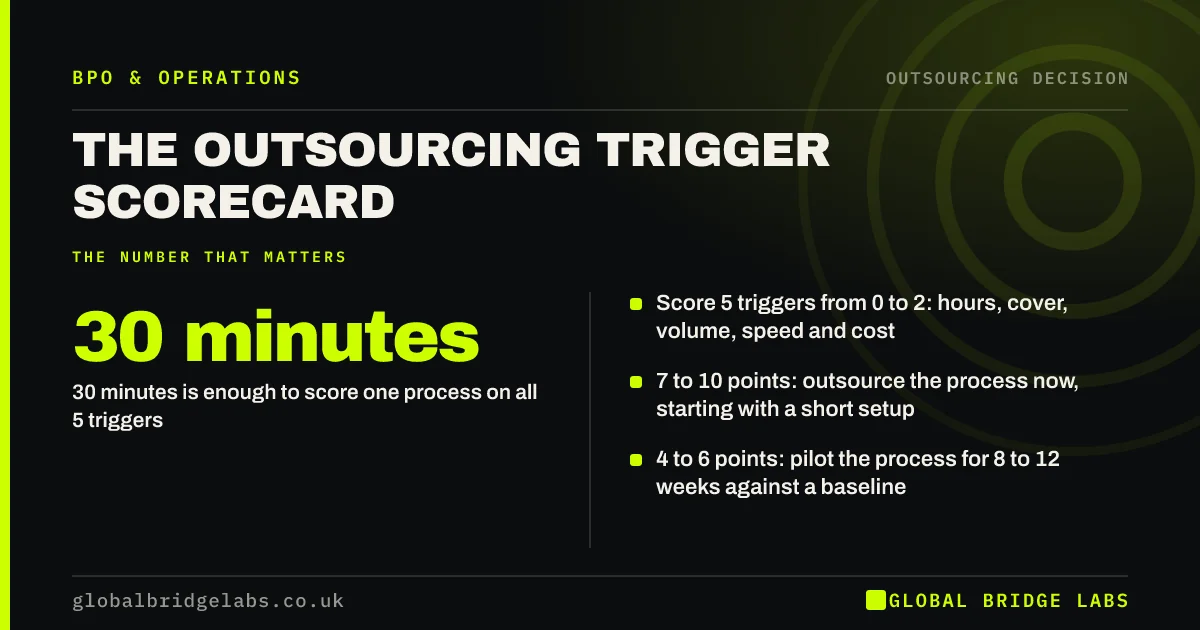
Rescore every quarter. Volume grows, processes settle and teams change. A process that was two hours a week last year may be 12 hours this year. When the GBL Outsourcing Trigger Scorecard moves above 4 and the process has been stable for three months, revisit the decision.
What does this look like in practice?
A pattern we see in UK design and consultancy studios: the owner asks about outsourcing client communication. The honest answer is no, because the relationship is the product. What does get outsourced is the scheduling, the invoicing and the chasing around it, which frees the owner for the client conversations that matter.
Checklist: should you hold off?
If you tick any of these, fix it before outsourcing.
- The work is why customers choose you.
- Every case needs senior judgement.
- Someone must be on site.
- The process changed in the last three months.
- The volume is under a few hours a week.
- Nobody can own the relationship internally.
Next step
If you are unsure whether you are in a do-not-outsource situation, tell us about the work. We will say so plainly if the answer is no, and what would need to change for it to become yes.
Message us on WhatsApp for a straight answer, or book a 30-minute consultation.
Chat on WhatsApp →Sources and further reading
- Contracts and liabilities between controllers and processors · Information Commissioner's Office
- FCA Handbook SYSC 8: Outsourcing · Financial Conduct Authority
- Data Security and Protection Toolkit · NHS England
- Part-time workers' rights · GOV.UK
Frequently asked questions
What should a business never outsource?
The work that customers choose you for, decisions that need senior judgement on every case, and anything that must be done on site. Strategy, pricing and key client relationships usually stay in-house. The admin and repeatable work around them often can be outsourced.
Is outsourcing bad for small businesses?
Not in itself. It goes badly when the volume is too small, the process is unclear, or nobody owns the relationship. With a stable process of 10 or more hours a week and a named internal owner, it often works well even for businesses of a few people.
What are the signs outsourcing will not work?
A process that keeps changing, no written procedure, no secure way to give access, no internal owner, and a volume of only a few hours a week. Any one of these makes success less likely until it is fixed.
Can I outsource part of a process I want to keep in-house?
Yes, and this is often the best answer. Keep the judgement and the relationship in-house and outsource the scheduling, data entry, chasing and first-line triage around it. Specialists then spend their time on the work only they can do.
Written by

Global Bridge Labs (GBL) is a UK–Sri Lanka partner for social media, websites and BPO. Everything here comes from client delivery, not theory.