On this page
- 01Key takeaways
- 02What does job sheet admin involve?
- 03What should every sheet be checked for?
- 04What does same-day invoicing change?
- 05When should job sheets stay in-house?
- 06What does this look like in practice?
- 07Job sheet routine checklist
- 08Next step
- 09Sources and further reading
- 10Frequently asked questions
Key takeaways
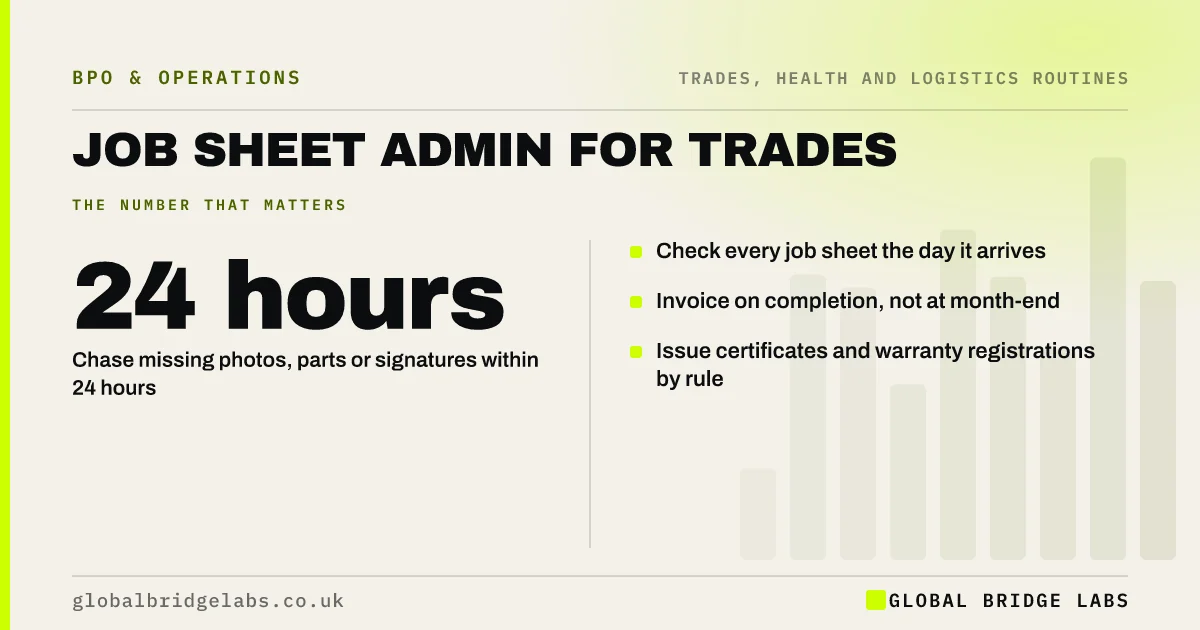
Job sheet admin is the routine that turns a finished job into an invoice, a certificate where needed, a customer update and a closed record. In many trades firms it happens in the evening or at the weekend, so invoices go out late. A dedicated team checking sheets as they arrive and invoicing the same day speeds up cash and frees engineers.
- Check every job sheet the day it arrives.
- Chase missing photos, parts or signatures within 24 hours.
- Invoice on completion, not at month-end.
- Issue certificates and warranty registrations by rule.
Invoices waiting for the weekend paperwork session? Message us on WhatsApp with your weekly job count.
Chat on WhatsApp →What does job sheet admin involve?
It involves receiving the completed job sheet or app record, checking labour, parts and photos against the quote or rate card, chasing anything missing from the engineer, raising the invoice, issuing any certificate or notification, sending a thank-you and review request, and closing the job in the system.
What should every sheet be checked for?
A short check catches most of the errors that delay invoices or cause disputes. Engineers learn quickly when sheets are checked the same day.
- Labour time and parts match the job.
- Photos before and after where required.
- Customer signature or sign-off.
- Certificate or notification needed?
- Follow-up work or quote requested?
What does same-day invoicing change?
In an illustrative example, a firm completing 80 jobs a week at £350 average invoices weekly instead of monthly. Debtor days fall and about £28,000 a week of work is billed while customers still remember it. These are example figures. Admin time per job is around 8 to 12 minutes once the routine runs.
Send us your weekly job count on WhatsApp and we will estimate the routine with you.
Chat on WhatsApp →When should job sheets stay in-house?
Keep pricing disputes, variations and anything needing technical judgement on the work done with the owner or a supervisor. A support team checks, chases and invoices to your rate card, and flags anything that looks wrong rather than deciding it.
What does this look like in practice?
A pattern we see: the owner does the paperwork on Sunday evenings, so invoices go out a week after the job. Same-day checking and invoicing by a team gives the owner the evening back and brings cash in sooner.
Job sheet routine checklist
Run the routine with these points.
- Sheets checked the day they arrive.
- Gaps chased within 24 hours.
- Invoices raised on completion.
- Certificates issued by rule.
- Jobs closed and follow-ups logged.
Next step
Send us how job sheets reach the office today. We will suggest a same-day routine and say plainly what a team could run.
Message us on WhatsApp about job sheet admin, or book a 30-minute consultation.
Chat on WhatsApp →Sources and further reading
- Late commercial payments: charging interest and debt recovery · GOV.UK
- Publishing consumer reviews and complying with consumer protection law · Competition and Markets Authority
Frequently asked questions
How can a trades business invoice faster?
Check job sheets the day they arrive, chase missing details within 24 hours and raise the invoice on completion rather than at the end of the week or month. A rate card and a standard sheet format make checking quick, and a dedicated person or team keeps it daily.
What should a job sheet include?
The customer and address, work done, labour time, parts used, before and after photos where relevant, any certificate or notification needed, customer sign-off and any follow-up work requested. Consistent sheets make invoicing and record keeping straightforward.
Can trades paperwork be outsourced?
Yes. A managed team can check job sheets, chase engineers, raise invoices to your rate card, issue routine certificates and close jobs in your system. Pricing disputes and technical judgements should stay with the owner or supervisor.
Written by

Global Bridge Labs (GBL) is a UK–Sri Lanka partner for social media, websites and BPO. Everything here comes from client delivery, not theory.