On this page
Key takeaways
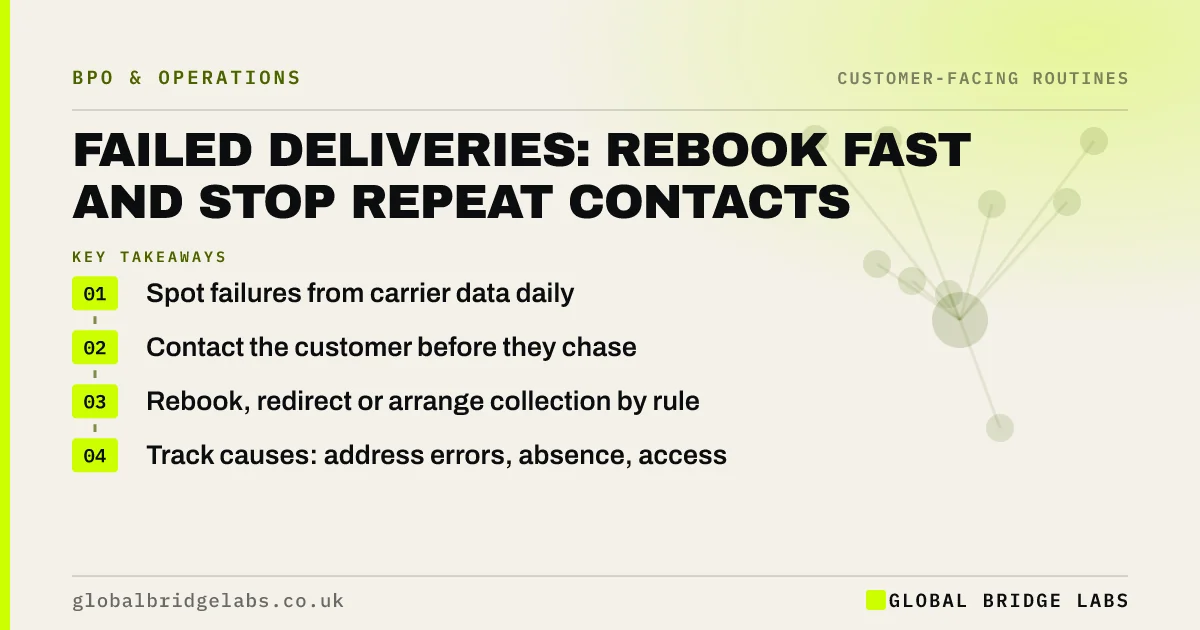
Failed deliveries create repeat contacts, refunds and returned stock. A follow-up routine spots each failure from carrier data the same day, contacts the customer before they contact you, rebooks or redirects the delivery and records the cause. Doing it proactively turns an angry query into a short, helpful message.
- Spot failures from carrier data daily.
- Contact the customer before they chase.
- Rebook, redirect or arrange collection by rule.
- Track causes: address errors, absence, access.
Too many parcels coming back? Message us on WhatsApp with your monthly failed delivery count.
Chat on WhatsApp →Why follow up failed deliveries proactively?
Most customers with a failed delivery will chase, often more than once, and some will raise a chargeback or leave a review about it. Contacting them first, with the reason and a simple rebooking option, resolves most cases in one exchange and prevents parcels being returned to sender.
What does the routine involve?
Check the carrier exceptions report each morning, contact affected customers by email or text, rebook or redirect within the carrier's options, correct addresses in your system, and track parcels returning to you. Record the cause for each failure so you can fix the most common ones.
- Morning check of carrier exceptions.
- Proactive message with rebook options.
- Address corrected in your system.
- Returned parcels logged and resolved.
- Cause recorded for each failure.
What do failed deliveries cost?
In an illustrative example, a seller with 4,000 orders a month and a 2% failure rate has 80 failed deliveries. If each generates two contacts at 5 minutes and a quarter are returned at £8 return postage plus £6 handling, that is about 13 hours and £280 a month. These are example figures.
- Returns processing cost: what each return really costs you
- Cost per contact: compare in-house and outsourced support
Send us your failure rate on WhatsApp and we will estimate what proactive follow-up saves.
Chat on WhatsApp →When is this not worth a routine?
If failures are rare, a few a month, handle them as they arise. If most failures come from one cause, such as checkout address errors, fix the cause first, for example with address lookup at checkout, then run the routine for the rest.
What does this look like in practice?
A pattern we see: returned parcels sit in a corner of the warehouse for weeks because nobody owns them. A daily routine that resolves them within days recovers stock and saves refunds.
Failed delivery checklist
Run the routine with these steps.
- Carrier exceptions checked every morning.
- Customer contacted the same day.
- Rebook options in every message.
- Addresses corrected at source.
- Monthly review of causes.
Next step
Send us your monthly failed deliveries and carriers. We will suggest a follow-up routine and say plainly what a team could run each morning.
Message us on WhatsApp about failed deliveries, or book a 30-minute consultation.
Chat on WhatsApp →Sources and further reading
- Consumer Rights Act 2015 · legislation.gov.uk
- Accepting returns and giving refunds · GOV.UK
Frequently asked questions
What should you do when a delivery fails?
Contact the customer the same day with the reason and simple options to rebook, redirect or collect, update the address in your system if it was wrong, and track the parcel if it is returning to you. Record the cause so repeated failures can be fixed.
How do you reduce failed deliveries?
Use address lookup at checkout, ask for delivery instructions and a phone number, send delivery-day notifications with a rebook option and offer safe places or collection points. Review causes monthly; address errors and absence are usually the largest.
Can failed delivery follow-up be outsourced?
Yes. A managed team with access to your order system and carrier portals can check exceptions daily, contact customers, rebook deliveries and resolve returned parcels within your rules. It works best when the team also records causes for monthly review.
Written by

Global Bridge Labs (GBL) is a UK–Sri Lanka partner for social media, websites and BPO. Everything here comes from client delivery, not theory.