On this page
- 01Key takeaways
- 02What customs paperwork repeats on every shipment?
- 03How do you keep codes and values consistent?
- 04What does customs admin take?
- 05What should stay with you or your broker?
- 06What does this look like in practice?
- 07Customs paperwork checklist
- 08Next step
- 09Sources and further reading
- 10Frequently asked questions
Key takeaways
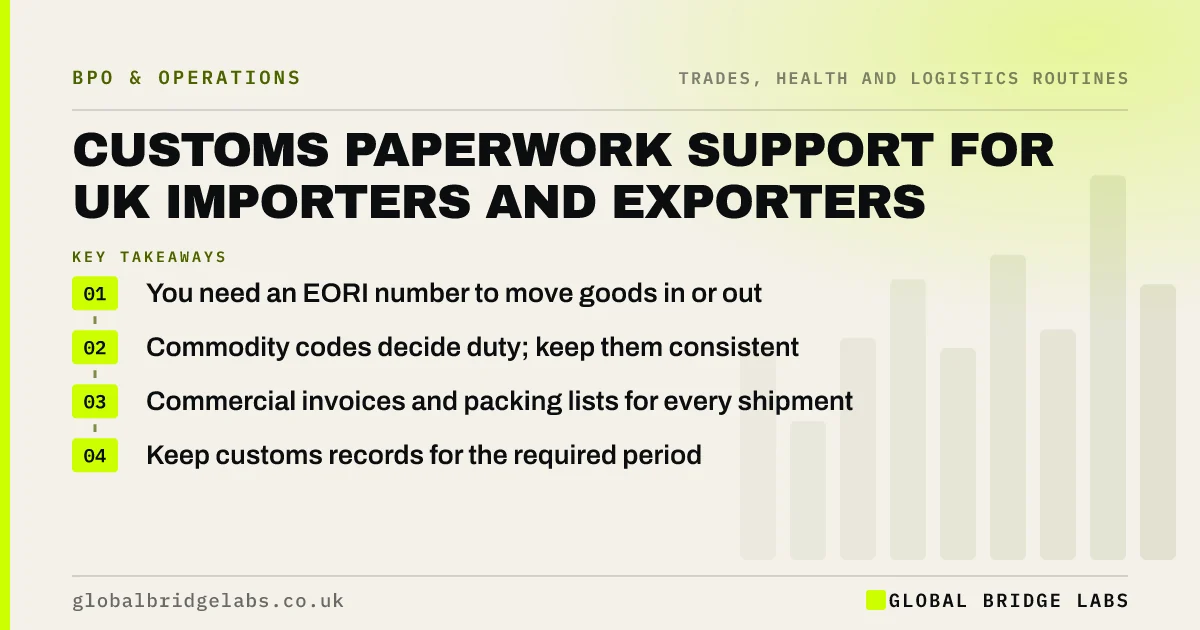
Importing and exporting from the UK means repeating the same paperwork for every shipment: commodity codes, commercial invoices, packing lists, origin information, an EORI number and instructions to your customs agent. The declarations themselves are usually made by a customs broker. The preparation and record keeping around them are repetitive admin that a routine keeps consistent.
- You need an EORI number to move goods in or out.
- Commodity codes decide duty; keep them consistent.
- Commercial invoices and packing lists for every shipment.
- Keep customs records for the required period.
Shipments held up by paperwork? Message us on WhatsApp with how many you send or receive a month.
Chat on WhatsApp →What customs paperwork repeats on every shipment?
Most of the paperwork follows the same template for every shipment, with the details changed. Errors in codes, values or origin are what cause delays and unexpected duty.
- Commercial invoice with values and terms.
- Packing list with weights and quantities.
- Commodity codes for each product.
- Origin information for preferential tariffs.
- Instructions and documents to your customs agent.
How do you keep codes and values consistent?
Keep a product master list with each item's commodity code, origin and description, approved once by someone competent or your customs adviser. Every shipment then draws from the list rather than being worked out again. HMRC's step-by-step guides for importing and exporting set out what you need.
What does customs admin take?
In an illustrative example, an exporter sending 40 shipments a month spends about 30 to 45 minutes each on invoices, packing lists and broker instructions: 20 to 30 hours a month. These are example figures. A held shipment costs storage, delay and an unhappy customer, so accuracy is worth more than speed.
- Delivery booking admin: slots, confirmations and changes
- How to improve office efficiency in a logistics firm
Send us your monthly shipments on WhatsApp and we will estimate the routine with you.
Chat on WhatsApp →What should stay with you or your broker?
Classification decisions on new products, valuation questions, origin claims and the declarations themselves should stay with you, your customs broker or an adviser. You remain responsible for the accuracy of the information. A support team prepares documents from the approved product list and flags anything new.
What does this look like in practice?
A pattern we see: the same product is shipped under different codes by different staff, causing queries and inconsistent duty. A single product master with approved codes fixes it.
Customs paperwork checklist
Check every shipment against these points.
- EORI number on all documents.
- Codes from the approved product list.
- Values and terms match the sale.
- Origin information included where claimed.
- Documents filed for the retention period.
Next step
Send us how customs paperwork is prepared today. We will suggest a routine built on a product master and say plainly what a team could prepare.
Message us on WhatsApp about customs paperwork, or book a 30-minute consultation.
Chat on WhatsApp →Sources and further reading
- Import goods into the UK: step by step · HM Revenue & Customs
- Export goods from the UK: step by step · HM Revenue & Customs
Frequently asked questions
What documents do you need to export goods from the UK?
Typically a commercial invoice, packing list, the correct commodity codes, origin information if claiming a preferential tariff and your EORI number, plus instructions to the customs agent making the declaration. HMRC's step-by-step export guide explains the requirements for your goods and destination.
Who makes customs declarations for small businesses?
Most small businesses use a customs broker or freight forwarder to make declarations on their behalf. The business still provides accurate information, such as codes, values and origin, and remains responsible for it, so consistent paperwork matters.
Can customs paperwork be outsourced?
Preparing invoices, packing lists and broker instructions from an approved product list can be outsourced. Classification of new products, valuation, origin claims and the declarations should stay with you, your broker or an adviser, and you remain responsible for accuracy.
Written by

Global Bridge Labs (GBL) is a UK–Sri Lanka partner for social media, websites and BPO. Everything here comes from client delivery, not theory.