On this page
Key takeaways
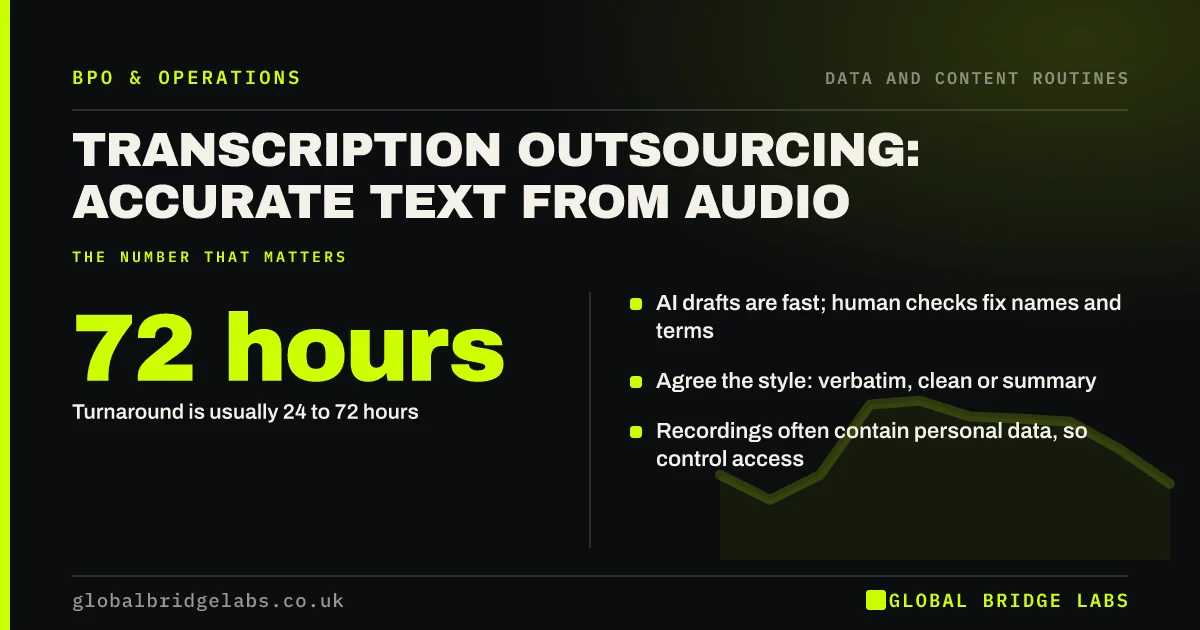
Transcription turns recorded speech into text: meetings, interviews, research calls and dictation. AI tools now produce fast first drafts, but names, technical terms, accents and crosstalk still need a person to check. The common model is AI draft plus human edit, run by a dedicated team to an agreed style and turnaround.
- AI drafts are fast; human checks fix names and terms.
- Agree the style: verbatim, clean or summary.
- Recordings often contain personal data, so control access.
- Turnaround is usually 24 to 72 hours.
Recordings piling up untranscribed? Message us on WhatsApp with your monthly audio hours.
Chat on WhatsApp →What types of transcription do businesses need?
Businesses typically need three types: verbatim, which records everything including hesitations, for legal or research use; clean verbatim, which removes filler words, for most meetings and interviews; and summary notes, which capture decisions and actions. Choose the type before you start, because it changes the time per hour of audio.
When is an AI transcript enough?
An AI transcript is often enough for internal reference, where errors in names or numbers do not matter much. It is not enough when the text will be published, relied on legally, used in a clinical letter or quoted to a client. Then a person should check it against the audio, especially names, figures and technical terms.
What does transcription take?
As a rough guide, checking and correcting an AI draft takes about one to two hours per audio hour, depending on quality, speakers and terminology; full manual transcription takes longer. In an illustrative example, 20 hours of interviews a month needs 20 to 40 hours of editing. These are example figures.
- Count your task volumes before you outsource anything
- Outsourced research support: faster answers for busy teams
Send us your monthly audio hours on WhatsApp and we will estimate the routine with you.
Chat on WhatsApp →What about confidentiality?
Recordings often include personal data and sometimes special category data, such as health information. Tell participants you are recording and why, limit who can access files, and use a processor contract with any provider. Check that AI tools do not retain or train on your recordings unless you have agreed to it.
What does this look like in practice?
A pattern we see: a business tries AI transcripts alone, then spends senior time fixing client names and figures. Adding a dedicated editor between the tool and the reader removes that time.
Transcription checklist
Agree these before starting.
- Style: verbatim, clean or summary.
- A glossary of names and terms.
- Turnaround per recording.
- Secure upload and access rules.
- Recording consent captured.
Next step
Tell us what you record and how many hours a month. We will suggest the right transcript style and say plainly what an AI-plus-editor routine would involve.
Message us on WhatsApp about transcription, or book a 30-minute consultation.
Chat on WhatsApp →Sources and further reading
- Special category data · Information Commissioner's Office
- Contracts and liabilities between controllers and processors · Information Commissioner's Office
Frequently asked questions
Is AI transcription accurate enough for business use?
For internal notes it often is. For anything published, relied on legally, used clinically or sent to clients, a person should check the AI draft against the audio, because names, numbers, technical terms and overlapping speakers are where errors cluster.
How long does it take to transcribe an hour of audio?
Checking and correcting a good AI draft typically takes one to two hours per audio hour, and full manual transcription takes longer. Poor audio, many speakers and specialist terms increase the time, so share sample recordings before agreeing a turnaround.
Can transcription be outsourced securely?
Yes, with controls. Use secure upload and storage, limit access to the people doing the work, put a processor contract in place and agree how long files are kept. Tell participants you are recording and check whether any AI tool used keeps your audio.
Written by

Global Bridge Labs (GBL) is a UK–Sri Lanka partner for social media, websites and BPO. Everything here comes from client delivery, not theory.