On this page
- 01Key takeaways
- 02What did the ONS find?
- 03Which tasks are most exposed?
- 04What does this mean for a small business?
- 05How do you assess your own exposure?
- 06Where should you be cautious with this data?
- 07What does this look like in practice?
- 08Automation exposure checklist
- 09Next step
- 10Sources and further reading
- 11Frequently asked questions
Key takeaways
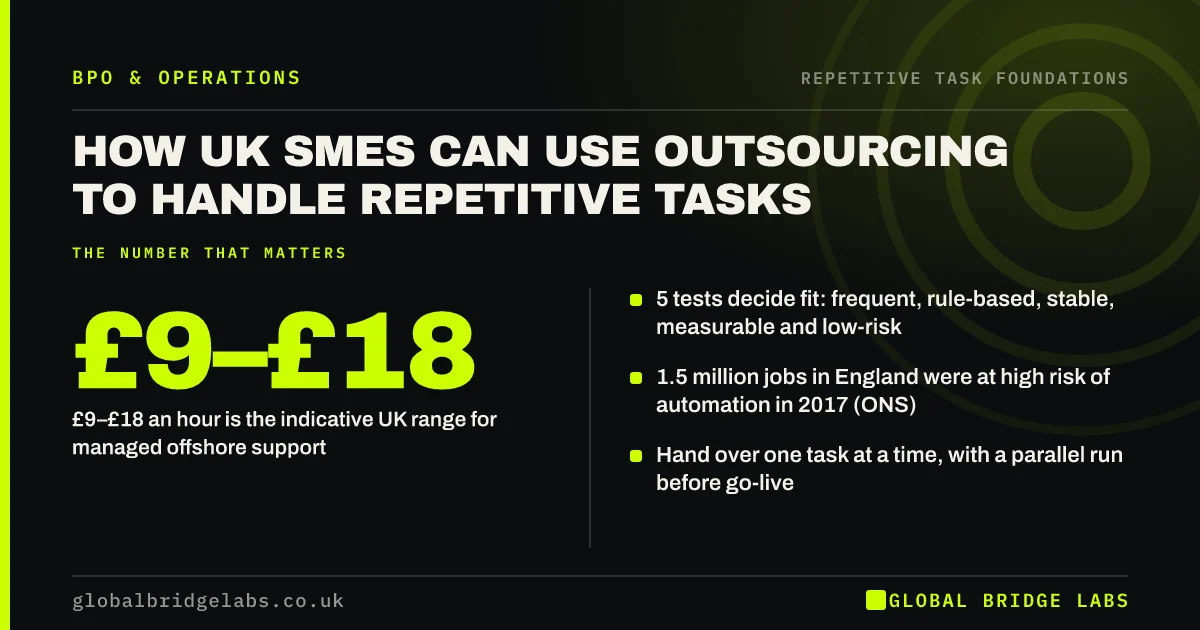
The Office for National Statistics estimated in 2019 that 1.5 million jobs in England, 7.4% of the 19.9 million analysed, were at high risk of some of their tasks being automated, and that high-risk roles were those built on routine tasks. For small businesses the lesson is about tasks, not jobs: routine tasks move first, to software or to dedicated teams.
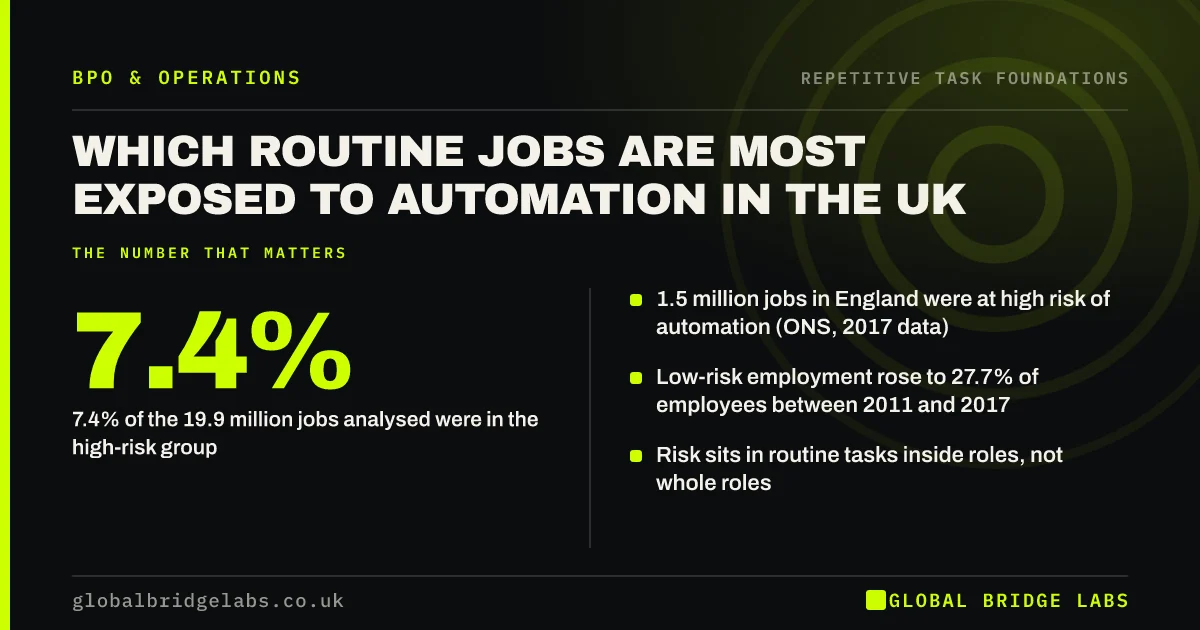
- 1.5 million jobs in England were at high risk of automation (ONS, 2017 data).
- 7.4% of the 19.9 million jobs analysed were in the high-risk group.
- Low-risk employment rose to 27.7% of employees between 2011 and 2017.
- Risk sits in routine tasks inside roles, not whole roles.
Want to know which of your routine tasks are most exposed? Message us on WhatsApp with your task list.
Chat on WhatsApp →What did the ONS find?
The ONS analysis, published in March 2019, estimated the probability that the tasks within each job could be automated. It found 1.5 million jobs in England at high risk in 2017. High-risk employment fell by 46,000 from 2011, while low-risk employment rose to 5.5 million, 27.7% of employees. The analysis looked at tasks within roles, not at whole occupations disappearing.
Which tasks are most exposed?
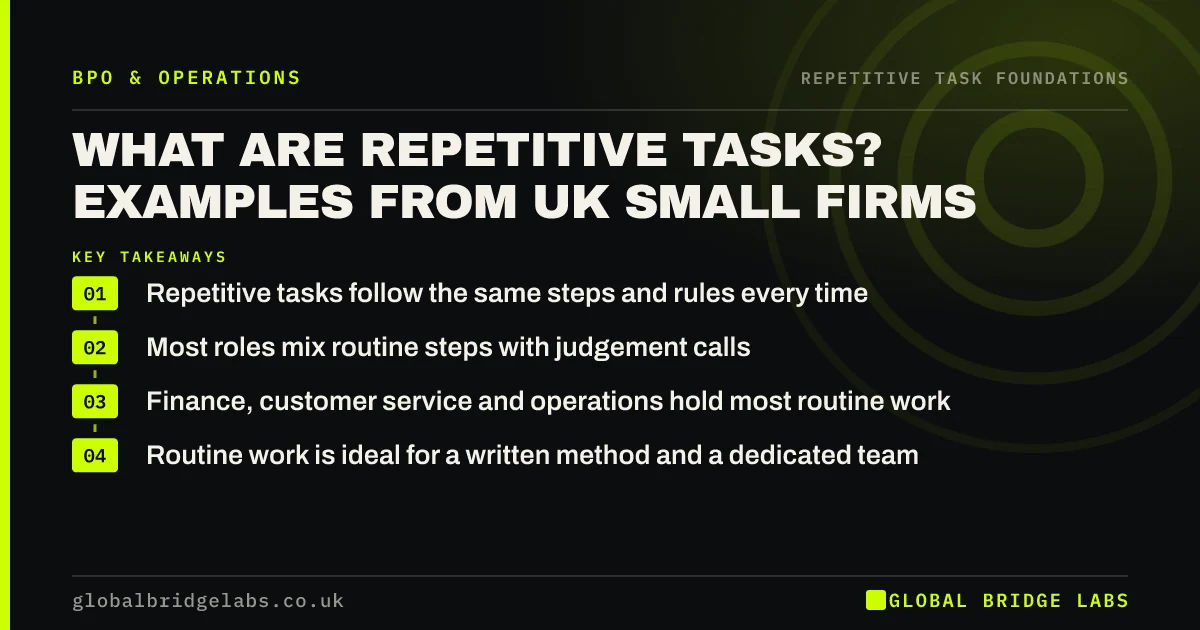
The tasks most exposed are routine, rule-based and done in one system: copying data between fields, matching records, sending standard messages and producing fixed-format reports. Tasks involving judgement, relationships, physical variety or messy inputs are less exposed, because rules and software handle them poorly.
What does this mean for a small business?
It means planning roles around the tasks least likely to stay manual. Routine tasks inside small-business roles are moving to software, to managed teams or to both. Owners who separate those tasks early can redesign roles on their own timetable, rather than when a tool or a resignation forces the change.
How do you assess your own exposure?
List your recurring tasks and mark which are routine, rule-based and done inside one system. In an illustrative 10-person firm, 12 of 30 tasks might meet all three. These are example figures. Those 12 are candidates for automation or a dedicated team; the rest need people who know your customers.
- Repetitive task inventory: list every recurring job once
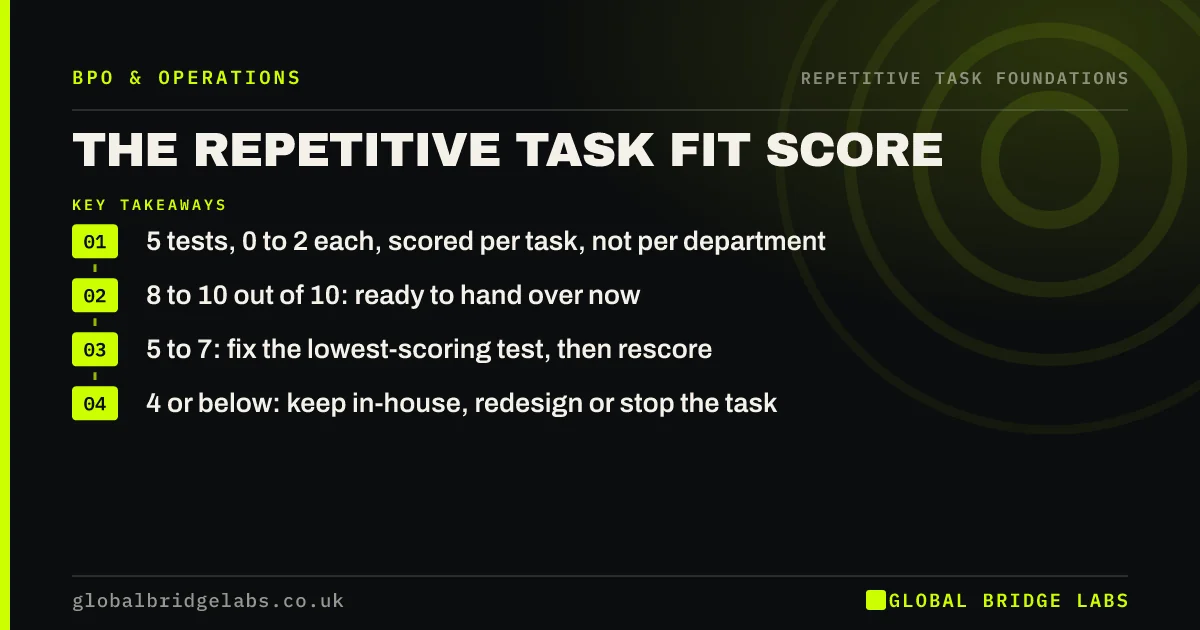
- The repetitive task fit score: ready to hand over?
Want help sorting your task list into exposed and protected work? Send it on WhatsApp.
Chat on WhatsApp →Where should you be cautious with this data?
The ONS figures are a modelled estimate from 2017 data and describe risk, not a forecast of job losses. AI tools have moved quickly since, so treat the numbers as a picture of which kinds of task are exposed rather than a precise count. Check the ONS for newer analysis before quoting figures in your own planning.
What does this look like in practice?
A pattern we see: owners worry about automation replacing whole roles, but the practical change is smaller and faster. A handful of routine tasks move to a tool or a managed team, and the people in those roles spend more time on customers and decisions.
Automation exposure checklist
Use this to review your own tasks.
- List your recurring tasks.
- Mark each routine, rule-based and single-system.
- Separate tasks for a tool from tasks for a team.
- Plan the roles that remain.
- Review the list each year.
Next step
Send us your list of recurring tasks. We will help you separate what software should do, what a managed team should do and what your people should keep.
Message us on WhatsApp to review your routine tasks, or book a 30-minute consultation.
Chat on WhatsApp →Sources and further reading
- The probability of automation in England: 2011 and 2017 · Office for National Statistics
- Labour productivity · Office for National Statistics
Frequently asked questions
How many UK jobs are at risk of automation?
The ONS estimated that 1.5 million jobs in England, 7.4% of the 19.9 million it analysed, were at high risk of some tasks being automated, based on 2017 data published in 2019. The estimate describes the risk to tasks within jobs, not a forecast of jobs disappearing.
Which tasks are most likely to be automated?
Routine, rule-based tasks done inside one system are most exposed: copying data, matching records, sending standard messages and producing fixed reports. Tasks that need judgement, relationships or handling messy inputs are less exposed and usually need people, either in-house or in a managed team.
Should small businesses automate or outsource routine tasks?
Usually both. Automate the steps that are fully predictable and stay in one system. Outsource the work around them that needs a person to read, check, chase or handle exceptions. Deciding task by task gives better results than choosing one approach for everything.
Written by

Global Bridge Labs (GBL) is a UK–Sri Lanka partner for social media, websites and BPO. Everything here comes from client delivery, not theory.