On this page
- 01Key takeaways
- 02What is an outsourcing pilot?
- 03Which process should you pilot?
- 04How do you set success measures?
- 05How should the pilot run week by week?
- 06What should the pilot agreement include?
- 07How do you decide at the end?
- 08What are common pilot mistakes?
- 09Who should own the pilot internally?
- 10What does this look like in practice?
- 11Pilot checklist
- 12Next step
- 13Sources and further reading
- 14Frequently asked questions
Key takeaways
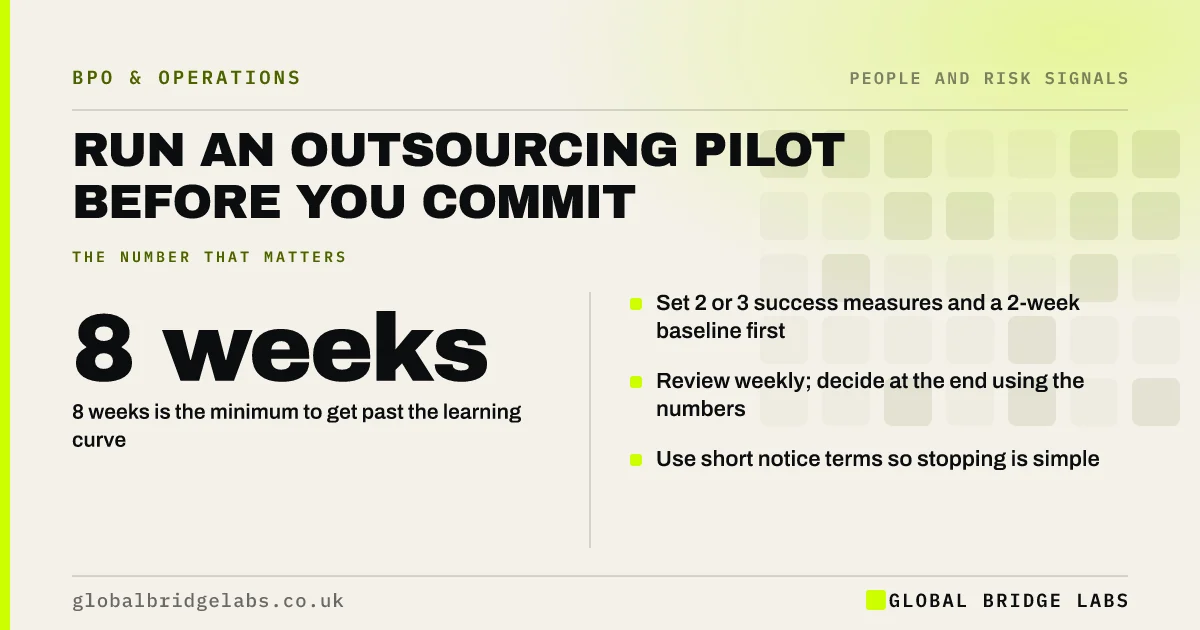
An outsourcing pilot tests one process with a provider for 8 to 12 weeks against a baseline and agreed success measures, before any larger commitment. Choose a process that matters but is not your most sensitive, set two or three measures, review weekly, and decide at the end to expand, adjust or stop, using the numbers.
- 8 weeks is the minimum to get past the learning curve.
- Set 2 or 3 success measures and a 2-week baseline first.
- Review weekly; decide at the end using the numbers.
- Use short notice terms so stopping is simple.
Want to design a pilot for one process? Message us on WhatsApp.
Chat on WhatsApp →What is an outsourcing pilot?
An outsourcing pilot is a time-limited trial of outsourcing one process, with a clear start and end, success measures agreed in advance, and a decision at the end. It lets you test the provider, the process and your own readiness with limited risk, and gives you real numbers for any wider decision.
Which process should you pilot?
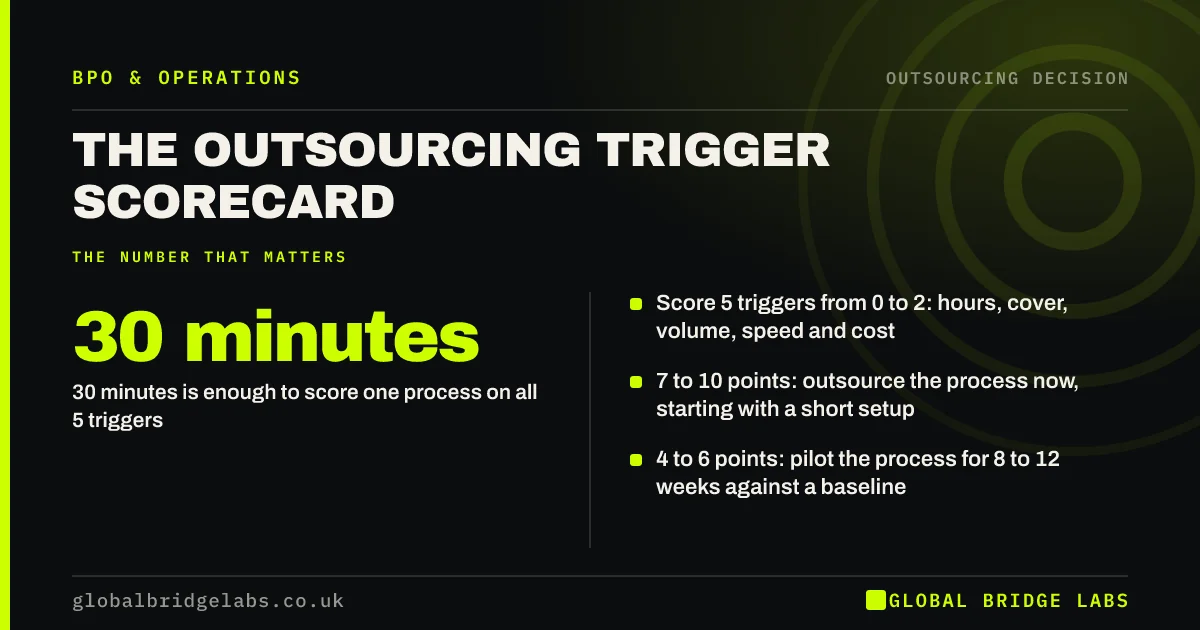
Pick a process that scores 4 or more on the GBL Outsourcing Trigger Scorecard, is stable and documented, and has enough volume to measure. It should matter enough that success is meaningful, but not be so sensitive that early mistakes would cause serious harm. Inbox handling, call answering and data entry are common pilot choices.
How do you set success measures?
Choose two or three measures that reflect why you are outsourcing, record a baseline for at least two weeks before the pilot, and set targets for the end. Include one measure of speed or volume, one of quality, and one of cost or time returned.
- Speed: time to first reply, or items completed per day.
- Quality: accuracy on a weekly sample, or complaints.
- Cost or time: cost per task, or internal hours returned.
Want help choosing your pilot measures? Send us the process on WhatsApp.
Chat on WhatsApp →How should the pilot run week by week?
Expect a learning curve. The first two weeks are setup and shadowing, the next few build towards target, and the last weeks show steady-state performance. Judge the pilot on the final weeks, not the first.
- Weeks 1 to 2: setup, access, shadowing and supervised work.
- Weeks 3 to 6: live work, daily then weekly reviews, process fixes.
- Weeks 7 to 12: steady running against targets.
- Final week: review results and decide.
What should the pilot agreement include?
A clear scope, the success measures, reporting, short notice terms, data protection arrangements and what happens at the end. Make sure you own the documentation created during the pilot. A processor contract is required from day one if personal data is involved, even for a short pilot.
How do you decide at the end?
Compare final-weeks results with the baseline and targets. If targets are met, expand: make the arrangement ongoing or add a second process. If results are close, adjust the process or scope and extend. If results are poor and the cause is the provider rather than the process, stop and try another route.
What are common pilot mistakes?
Starting without a baseline, judging on the first fortnight, choosing a process too small to measure, and giving the provider no written process. Another is not assigning an internal owner, which leaves questions unanswered and makes the provider look slow.
Who should own the pilot internally?
One named person with the authority to answer questions and make small process decisions, and the time to do it: typically two to four hours a week during the pilot. Without an owner, questions wait, the provider guesses, and the pilot measures your responsiveness rather than theirs. The owner also writes the end-of-pilot recommendation.
- Answers the team's questions within an agreed time.
- Runs the weekly review against the measures.
- Updates the written process as issues come up.
- Recommends expand, adjust or stop at the end.
What does this look like in practice?
A pattern we see in UK logistics and e-commerce firms: a 12-week pilot of delivery query handling with targets for first reply time, accuracy and internal hours returned. By week 8 replies are within the hour and the in-house team has its afternoons back, and the business extends the arrangement and adds order status updates.
Pilot checklist
Use this to set up a pilot.
- Pick one stable process scoring 4 or more.
- Record a two-week baseline.
- Set two or three success measures and targets.
- Agree scope, reporting and short notice terms.
- Name an internal owner with time for weekly reviews.
- Decide at the end: expand, adjust or stop.
Next step
Tell us which process you want to test. We will help you design a pilot with clear measures and a simple decision at the end.
Message us on WhatsApp to plan a pilot, or book a 30-minute consultation.
Chat on WhatsApp →Sources and further reading
- Contracts and liabilities between controllers and processors · Information Commissioner's Office
- International transfers of personal data · Information Commissioner's Office
- UK Customer Satisfaction Index · Institute of Customer Service
Frequently asked questions
How long should an outsourcing pilot last?
Usually 8 to 12 weeks. The first two weeks are setup and learning, so a shorter pilot rarely shows steady performance. Judge the result on the final weeks against a baseline recorded before the pilot started.
What should I measure in an outsourcing pilot?
Two or three measures tied to why you are outsourcing: one for speed or volume, such as time to first reply; one for quality, such as accuracy on a weekly sample; and one for cost or time, such as cost per task or internal hours returned.
Can I stop an outsourcing pilot if it is not working?
You should be able to. Agree short notice terms and a clear end date before starting, and make sure you own any documentation created. Decide based on the final weeks' results, and check whether problems come from the provider or the process.
Written by

Global Bridge Labs (GBL) is a UK–Sri Lanka partner for social media, websites and BPO. Everything here comes from client delivery, not theory.