On this page
Key takeaways
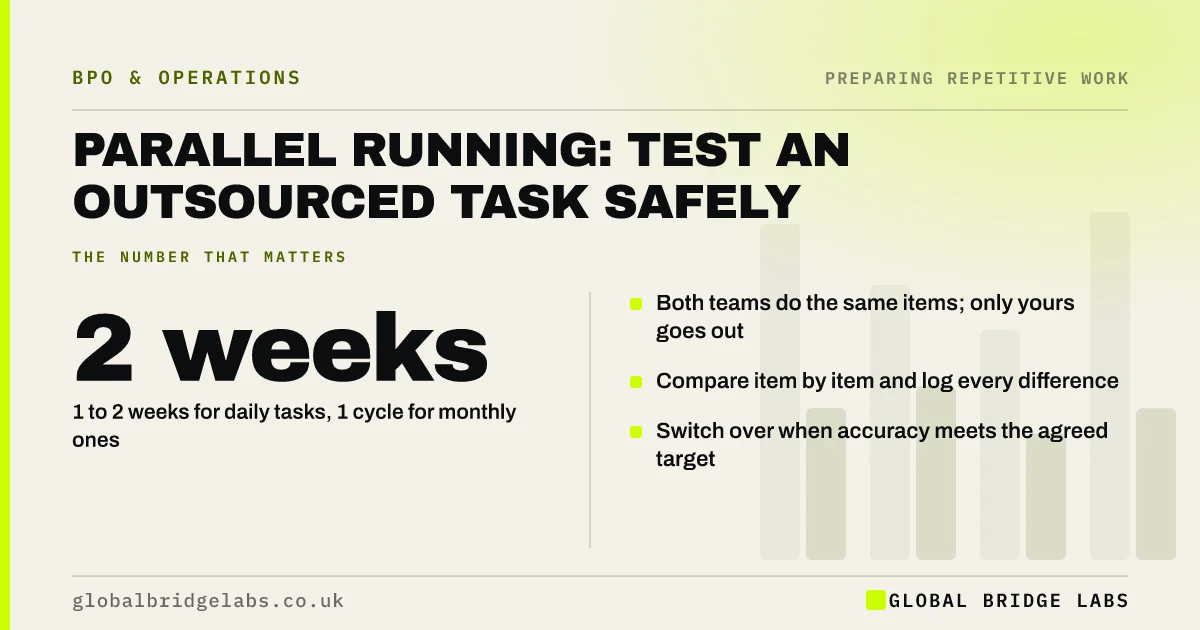
A parallel run means your team and the outsourced team both do the same repetitive task for a short period, and you compare the outputs before switching over. It is the safest way to go live, because errors are caught before customers see them. One to two weeks is usually enough for a daily task; a monthly task needs one full cycle.
- Both teams do the same items; only yours goes out.
- 1 to 2 weeks for daily tasks, 1 cycle for monthly ones.
- Compare item by item and log every difference.
- Switch over when accuracy meets the agreed target.
Planning a go-live? Message us on WhatsApp and we will help you design the parallel run.
Chat on WhatsApp →What is a parallel run?
A parallel run is a controlled test in which the new way of doing a task runs alongside the old one on the same work. Your team's output is the one used; the outsourced team's output is checked against it. Differences show where the method, the rules or the training need fixing, at no risk to customers.
How do you run one?
Choose a period, give both teams the same inputs, and compare outputs daily. Log each difference with its cause: method gap, rule gap, training or input problem. Fix the cause, not just the item. Agree the switch-over target in advance, such as 98% of items matching for five working days.
- Agree the period and the switch-over target.
- Give both teams the same items.
- Compare outputs daily, item by item.
- Log each difference and its cause.
- Fix causes and update the method.
What does a parallel run cost in time?
In an illustrative example, a task of 60 items a day at 4 minutes each costs your team its normal 4 hours a day during the run, plus about 30 minutes a day to compare outputs. Over 10 working days that is about 5 extra hours. These are example figures. Set that against the cost of a week of errors reaching customers.
Want help planning the comparison for your task? Send the volumes on WhatsApp.
Chat on WhatsApp →When can you skip a parallel run?
Skip it when there is nobody left to run the old way, for example after a resignation, or when every item is checked before it leaves anyway. In those cases, use a higher sampling rate for the first month instead, such as checking every item for the first week.
What does this look like in practice?
A pattern we see: most differences in the first days come from rules that were never written down, not from team errors. The parallel run is where the unwritten method becomes written.
Parallel run checklist
Use these steps for your go-live.
- Set the period and the accuracy target.
- Share the same inputs with both teams.
- Compare and log differences daily.
- Update the method for each cause found.
- Switch over only when the target holds.
Next step
Tell us which task you plan to hand over first. We will suggest a parallel run length, a switch-over target and how to compare outputs.
Message us on WhatsApp to plan a parallel run, or book a 30-minute consultation.
Chat on WhatsApp →Sources and further reading
- Contracts and liabilities between controllers and processors · Information Commissioner's Office
- Human factors: managing human failures · Health and Safety Executive
Frequently asked questions
How long should a parallel run last?
For a daily repetitive task, one to two weeks is usually enough to see most exceptions and reach a steady accuracy. For a weekly or monthly task, run at least one full cycle. Agree a switch-over target in advance rather than a fixed end date.
What should you compare in a parallel run?
Compare each finished item from both teams: the result, the time taken and whether the right exception route was followed. Log every difference with its cause, such as a missing rule or a training gap, and fix the cause in the written method.
Is a parallel run worth the extra effort?
Usually, yes. It costs a few extra hours of comparison but catches errors before customers or suppliers see them, and it turns unwritten rules into written ones. For tasks where every output is already checked before release, a higher sampling rate may be enough.
Written by

Global Bridge Labs (GBL) is a UK–Sri Lanka partner for social media, websites and BPO. Everything here comes from client delivery, not theory.