On this page
- 01Short answer
- 02Why does documentation matter before outsourcing?
- 03What should a standard operating procedure include?
- 04How do you capture what people actually do?
- 05How do you document scenarios and exceptions?
- 06How long does documentation take?
- 07How do you keep procedures up to date?
- 08When is documentation not enough?
- 09What does this look like in practice?
- 10Checklist: document a process
- 11Next step
- 12Sources and further reading
- 13Frequently asked questions
Short answer
How to document processes for outsourcing: write one standard operating procedure (SOP) per process, covering its purpose, trigger, steps, common scenarios, exceptions, escalations and quality standard. Record a screen video of each step alongside the text. Keep it short enough to use and store it in your own systems, not the provider's.
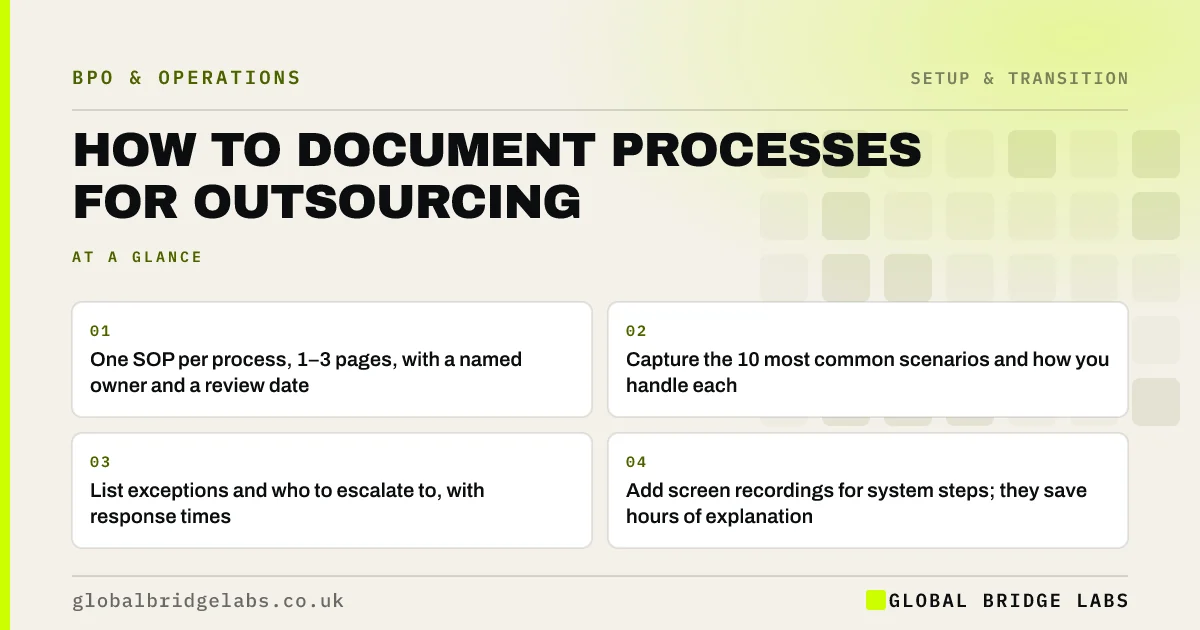
- One SOP per process, 1–3 pages, with a named owner and a review date.
- Capture the 10 most common scenarios and how you handle each.
- List exceptions and who to escalate to, with response times.
- Add screen recordings for system steps; they save hours of explanation.
- Update the SOP every time the same question is asked twice.
Want our one-page SOP template? Message us on WhatsApp and ask for the process documentation template.
Chat on WhatsApp →Why does documentation matter before outsourcing?
Documentation matters because an outsourced team can only be as consistent as the instructions it follows. Business process outsourcing (BPO) replaces knowledge in people's heads with a written process; if the process is not written, the team guesses, and quality depends on luck.
Documentation also has value beyond outsourcing. It protects you from key-person risk, speeds up training for any new hire, and often reveals steps that can be simplified or removed.
What should a standard operating procedure include?
A standard operating procedure is a written description of how a recurring task is done, detailed enough that a trained person can do it consistently. Keep the same structure for every SOP so the team knows where to look.
- Purpose: what the process achieves and why it matters.
- Trigger: what starts it, such as an email, a call or a date.
- Steps: numbered, one action each, starting with a verb.
- Scenarios: the common variations and how to handle each.
- Exceptions: what falls outside the rules and who decides.
- Quality standard: what good looks like and how it is checked.
- Owner and review date.
How do you capture what people actually do?
Watch them do it. Ask the person who currently does the work to talk through each step while sharing their screen, and record it. People forget the small judgement calls they make automatically; recordings catch them.
Then write the SOP from the recording, and ask the same person to check it. Finally, test it: have someone unfamiliar follow it and note where they get stuck.
- Record a screen-share walkthrough of each process.
- Write the steps from the recording.
- Ask the expert to correct the draft.
- Test it with someone who has never done the task.
How do you document scenarios and exceptions?
Scenarios are the predictable variations: a refund request, a delivery complaint, a price query. List the ten most common and write the response for each, including model replies for customer-facing work. That covers most of the volume.
Exceptions are the cases the rules do not cover. Do not try to write rules for everything. Instead, define who decides and how fast, such as "refunds above £100 go to the operations manager, reply within four business hours".
How long does documentation take?
A simple process can be documented in a few hours; a complex one with many scenarios can take several days spread over two weeks. Many providers help write the documentation as part of setup, which is sensible, because they know what their team will need. The knowledge still has to come from your people.
The time pays back quickly. An hour of documentation often saves several hours of questions and corrections in the first month, and those hours are expensive: a UK employee on £26,000 costs about £17.09 per worked hour once employer costs are included.
Want help documenting a process before you outsource it? Tell us about it on WhatsApp and we will discuss your requirements.
Chat on WhatsApp →How do you keep procedures up to date?
Give every SOP an owner and a review date, and make updating it part of normal work. A simple rule: when the same question is asked twice, the answer goes into the SOP. When your business changes a policy, the SOP changes the same day.
Store SOPs in your own systems, such as a shared drive or knowledge base, so they stay yours if you change provider or bring the work back in-house.
When is documentation not enough?
Documentation is not enough when the process itself is unstable or depends on judgement at every step. Writing down a process that changes weekly creates out-of-date instructions. Stabilise the process first, or keep it in-house until it settles.
What does this look like in practice?
A pattern we see in owner-run businesses: the owner says the process is simple, then the recorded walkthrough reveals 14 steps, three systems and five judgement calls. Writing those down usually removes two or three unnecessary steps before anyone else ever does the work.
Checklist: document a process
Follow these steps for each process.
- Record the current expert doing the task.
- Write purpose, trigger and numbered steps.
- List the ten most common scenarios with responses.
- Define exceptions and who decides.
- Add a quality standard.
- Test with someone unfamiliar and fix the gaps.
- Store it in your systems with an owner and review date.
Next step
If your processes live in people's heads, we can help you get them written down, whether or not you then outsource them. 30 minutes, no pitch.
Message us on WhatsApp for the SOP template, or book a 30-minute consultation.
Chat on WhatsApp →Sources and further reading
- Writing to GOV.UK standards: writing guidelines · GOV.UK
- The Sourcing and Consultancy Playbooks · Cabinet Office
- Rates and thresholds for employers 2026 to 2027 · HM Revenue & Customs
Frequently asked questions
What is an SOP?
An SOP, or standard operating procedure, is a written description of how a recurring task is done: its purpose, trigger, steps, scenarios, exceptions and quality standard. It lets any trained person do the task consistently and is the foundation of any outsourced process.
How detailed should a procedure be?
Detailed enough that a trained person unfamiliar with your business can follow it, and short enough that they will. For most processes that is one to three pages plus screen recordings. Cover the common cases in detail and define who decides the rare ones, rather than writing rules for everything.
Who should write the procedures?
The knowledge must come from the people who currently do the work. A provider or colleague can write the document from a recorded walkthrough, then the expert checks it. Testing it with someone unfamiliar with the task catches the gaps both miss.
Should procedures be written or video?
Both. Written steps are easy to search, update and follow; short screen recordings show system steps far faster than text. Use text as the master copy and link videos for each system step, re-recording them when the system changes.
Written by

Global Bridge Labs (GBL) is a UK–Sri Lanka partner for social media, websites and BPO. Everything here comes from client delivery, not theory.