On this page
Key takeaways
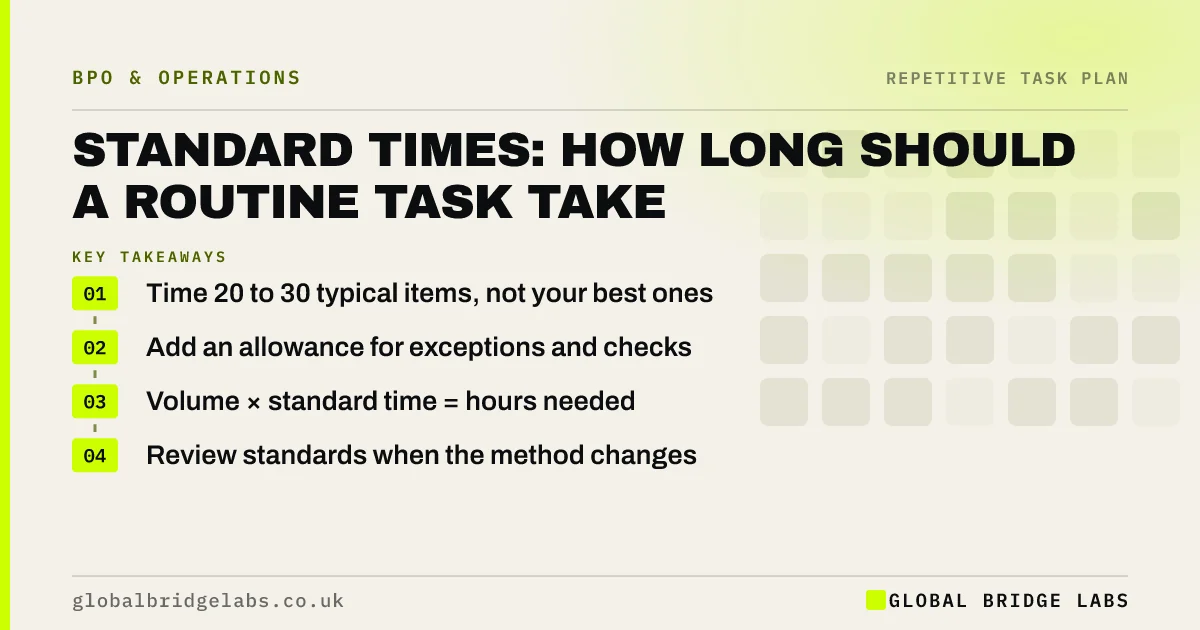
A standard time is the agreed time a trained person should take to complete one item of a routine task to the done standard, including normal checks. Setting one for each repetitive task turns volumes into hours, makes capacity and cost planning possible, and gives a fair basis for comparing in-house and outsourced work. It is a planning tool, not a stopwatch on people.
- Time 20 to 30 typical items, not your best ones.
- Add an allowance for exceptions and checks.
- Volume × standard time = hours needed.
- Review standards when the method changes.
Want help setting standard times for your tasks? Message us on WhatsApp with the task list.
Chat on WhatsApp →What is a standard time?
A standard time is the expected time to complete one unit of a task, such as one invoice or one listing, using the agreed method. It comes from work measurement, a field going back to Frederick Taylor and the Gilbreths, but for office work a simple version is enough: time a sample, take the typical figure and add an allowance.
How do you set one?
Ask a trained person to time 20 to 30 normal items using the written method. Take the median rather than the fastest. Add an allowance for checks and exceptions, often 10% to 20% as a GBL rule of thumb, or time exceptions separately if they are common.
- Use the written method, not a shortcut.
- Time 20 to 30 typical items.
- Take the median.
- Add an allowance or time exceptions separately.
- Record the date and method version.
How do standard times help planning?
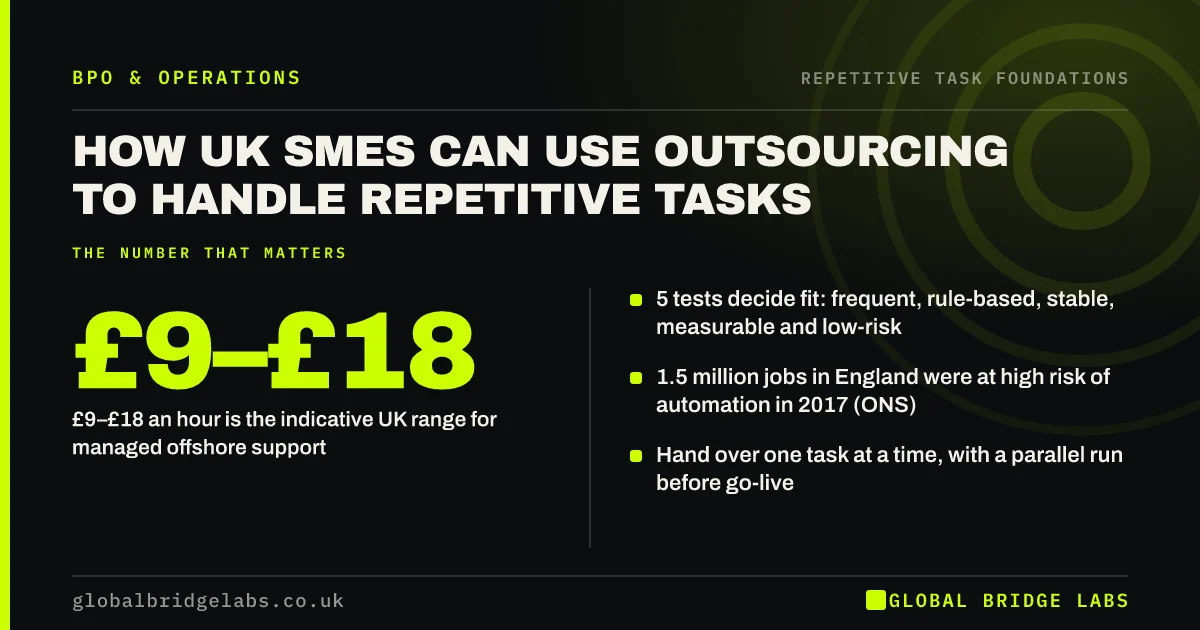
Multiply volume by standard time to get hours. In an illustrative example, 400 purchase invoices a month at 5 minutes standard is about 33 hours; at an indicative offshore rate of £9–£18 an hour that is £300–£600 a month, not a GBL price. These are example figures. The same sum shows when volume will outgrow current capacity.
- Work out your cost per task before you outsource
- How many outsourced seats does a small business need?
- BPO cost per hour in the UK
Send us your volumes and timings on WhatsApp and we will turn them into hours with you.
Chat on WhatsApp →When should you not use standard times?
Avoid using standard times to rate individuals, which damages trust and encourages shortcuts. They also mislead for tasks with very variable items or heavy judgement. Use them for planning and comparison, and look at accuracy and turnaround alongside speed.
What does this look like in practice?
A pattern we see: an outsourcing quote looks expensive until the business times its own work and finds the task takes twice as long in-house as assumed. Standard times put both on the same footing.
Standard time checklist
Set each standard with these points.
- Written method used.
- 20 to 30 typical items timed.
- Median taken.
- Allowance agreed.
- Reviewed when the method changes.
Next step
Send us the tasks you want to plan. We will help you set standard times and turn your volumes into hours and cost.
Message us on WhatsApp about standard times, or book a 30-minute consultation.
Chat on WhatsApp →Sources and further reading
- Labour productivity · Office for National Statistics
- Rates and thresholds for employers 2026 to 2027 · HM Revenue & Customs
Frequently asked questions
How do you calculate standard time for a task?
Time a trained person completing 20 to 30 typical items with the agreed method, take the median, then add an allowance for checks and exceptions, often 10% to 20%. Record the method version, and review the standard whenever the method or tools change.
Why are standard times useful?
They turn task volumes into hours, which lets you plan capacity, estimate cost, compare in-house and outsourced work on the same basis and see when growth will outstrip your team. They are most useful for stable, repetitive tasks.
Should standard times be used to judge staff?
Generally no. Using them to rate individuals encourages shortcuts and damages trust, and speed without accuracy is not a gain. Use standard times for planning and comparison, and review accuracy and turnaround alongside them.
Written by

Global Bridge Labs (GBL) is a UK–Sri Lanka partner for social media, websites and BPO. Everything here comes from client delivery, not theory.