On this page
- 01Key takeaways
- 02What is the repetitive task fit score?
- 03How do you score each of the five tests?
- 04What do you do with a middle score?
- 05What does a scored example look like?
- 06When does the score mislead?
- 07What does this look like in practice?
- 08Fit score checklist
- 09Next step
- 10Sources and further reading
- 11Frequently asked questions
Key takeaways
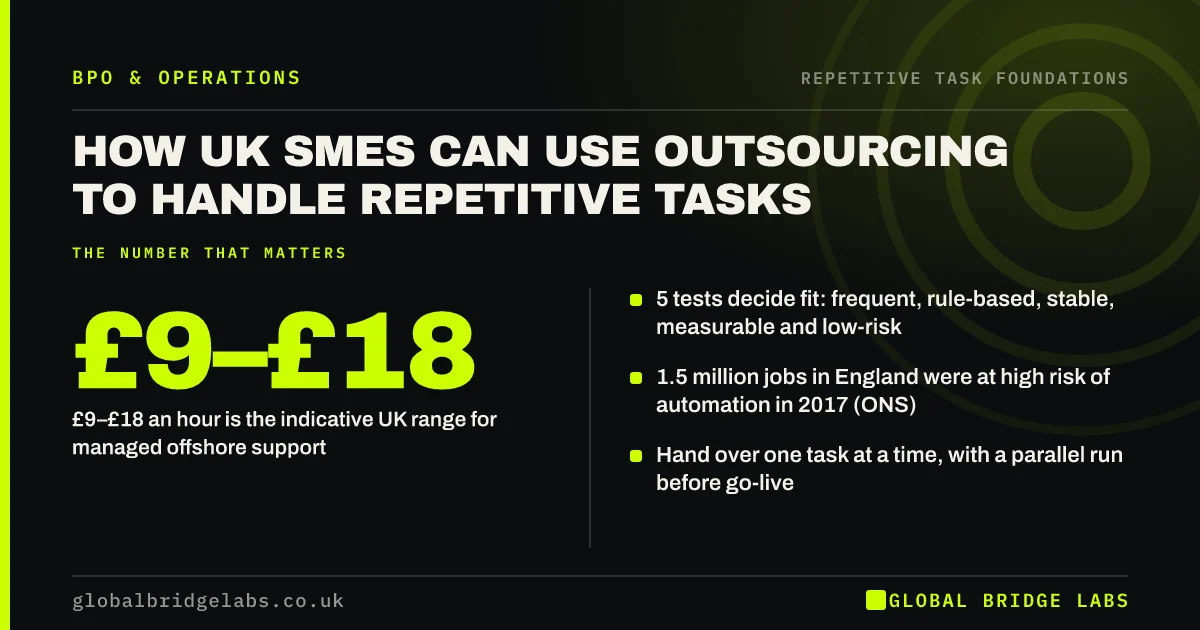
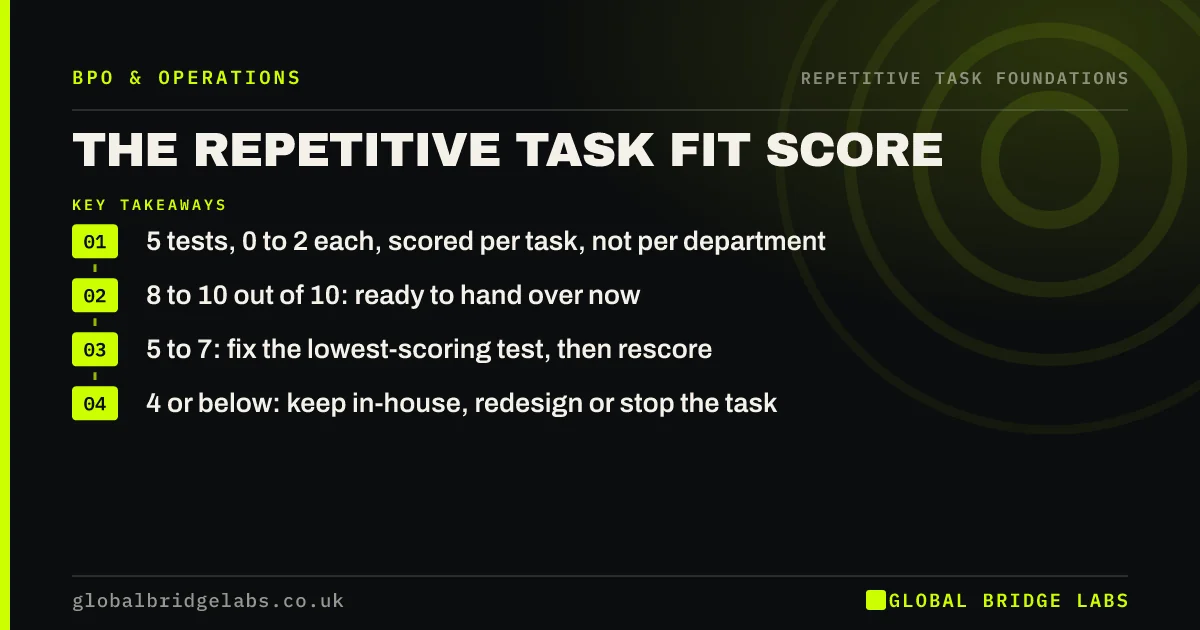
The GBL Repetitive Task Fit Score rates a single task on five tests: frequent, rule-based, stable, measurable and low-risk. Each scores 0 to 2, for a total out of 10. Score 8 to 10 and the task is ready to hand over; 5 to 7, fix the weakest test first; 4 or below, keep it in-house or redesign it.
- 5 tests, 0 to 2 each, scored per task, not per department.
- 8 to 10 out of 10: ready to hand over now.
- 5 to 7: fix the lowest-scoring test, then rescore.
- 4 or below: keep in-house, redesign or stop the task.
Want a second opinion on your scores? Message us on WhatsApp with three tasks and how you scored them.
Chat on WhatsApp →What is the repetitive task fit score?
The fit score is a 10-point check that tells you whether one specific task is ready to run with an outsourced team. It is narrower than a decision about whether to outsource at all. It assumes you have already decided outsourcing could help, and asks which task to hand over first and what to fix before you do.
How do you score each of the five tests?
Score each test 0, 1 or 2 using the descriptions below. Be strict: a 2 should be true on a bad week, not just a good one. Where two people disagree, use the lower score and write down why, because the disagreement is usually the thing to fix.
- Frequent: 2 daily or weekly in volume, 1 monthly, 0 a few times a year.
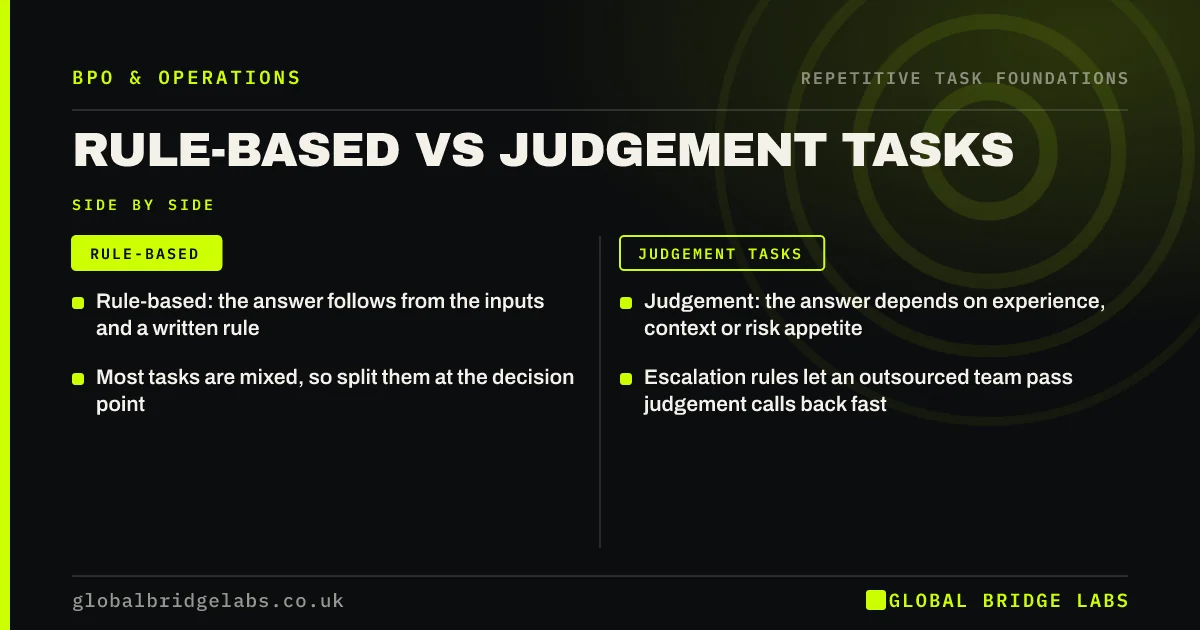
- Rule-based: 2 written rules cover most cases, 1 rules plus judgement, 0 mostly judgement.
- Stable: 2 unchanged for three months, 1 changes quarterly, 0 changes weekly.
- Measurable: 2 counted with a done standard, 1 partly, 0 hard to check.
- Low-risk: 2 errors caught before customers, 1 risk with controls, 0 regulated or irreversible.
What do you do with a middle score?
A score of 5 to 7 is the most common, and the most useful, because it shows exactly what to fix. Low on rule-based? Write a decision table. Low on stable? Agree the method and freeze it for a quarter. Low on measurable? Define done and count it. Low on risk? Add a check before the output leaves the business. Then rescore.
What does a scored example look like?
In an illustrative example, a trades firm scores job sheet invoicing at 9: it happens daily, rules cover pricing, the method is stable, each invoice can be checked against the sheet, and errors are caught before sending. Quoting for new work scores 4, because each quote depends on site judgement. Invoicing goes first; quoting stays with the estimator.
- Job sheet admin for trades: from completed job to invoice
- Estimating support for builders and contractors
Want us to score your top ten tasks with you? Send the list on WhatsApp.
Chat on WhatsApp →When does the score mislead?
The score can mislead when volume is high but spread across many small variants, each of which is really a separate task. It also misleads when the person scoring is the only one who knows the method, because their 2 for rule-based may live only in their head. Ask someone else to read the written method before you trust the score.
What does this look like in practice?
A pattern we see: owners score their own favourite tasks low and their least favourite high. Scoring together with the person who does the task each week corrects that quickly and usually changes which task goes first.
Fit score checklist
Use this sequence for each task.
- Name the task and its output precisely.
- Score the five tests with the person who does it.
- Write a one-line reason for every score below 2.
- Fix the lowest test, then rescore.
- Hand over tasks in score order, one at a time.
Next step
Send us your scored list, or the tasks you have not scored yet. We will go through the tests with you and say plainly which tasks are ready, which need fixing and which should stay in-house.
Message us on WhatsApp for a fit score review, or book a 30-minute consultation.
Chat on WhatsApp →Sources and further reading
- Human factors: managing human failures · Health and Safety Executive
- Contracts and liabilities between controllers and processors · Information Commissioner's Office
Frequently asked questions
What makes a task suitable for outsourcing?
A task suits outsourcing when it is frequent, follows written rules, has not changed recently, can be counted and checked, and carries a low risk of harm if one item goes wrong. Tasks that meet all five can usually be handed over within a few weeks.
Should I outsource a task that scores 6?
Not yet. A score of 6 means one or two tests are weak. Fix the lowest-scoring test first, for example by writing decision rules or adding a final check, then rescore. Most tasks reach 8 after one round of fixes, and the handover then goes far more smoothly.
How often should I rescore tasks?
Rescore a task whenever its method, volume or regulation changes, and review all scores every six months. A task that was unstable last year may be ready now, and an outsourced task whose risk has risen may need an extra check added.
Written by

Global Bridge Labs (GBL) is a UK–Sri Lanka partner for social media, websites and BPO. Everything here comes from client delivery, not theory.