On this page
- 01Key takeaways
- 02What does timesheet processing involve?
- 03What should the checks cover?
- 04What does timesheet admin cost in time?
- 05When should timesheets stay in-house?
- 06What does this look like in practice?
- 07Timesheet routine checklist
- 08Next step
- 09Sources and further reading
- 10Frequently asked questions
Key takeaways
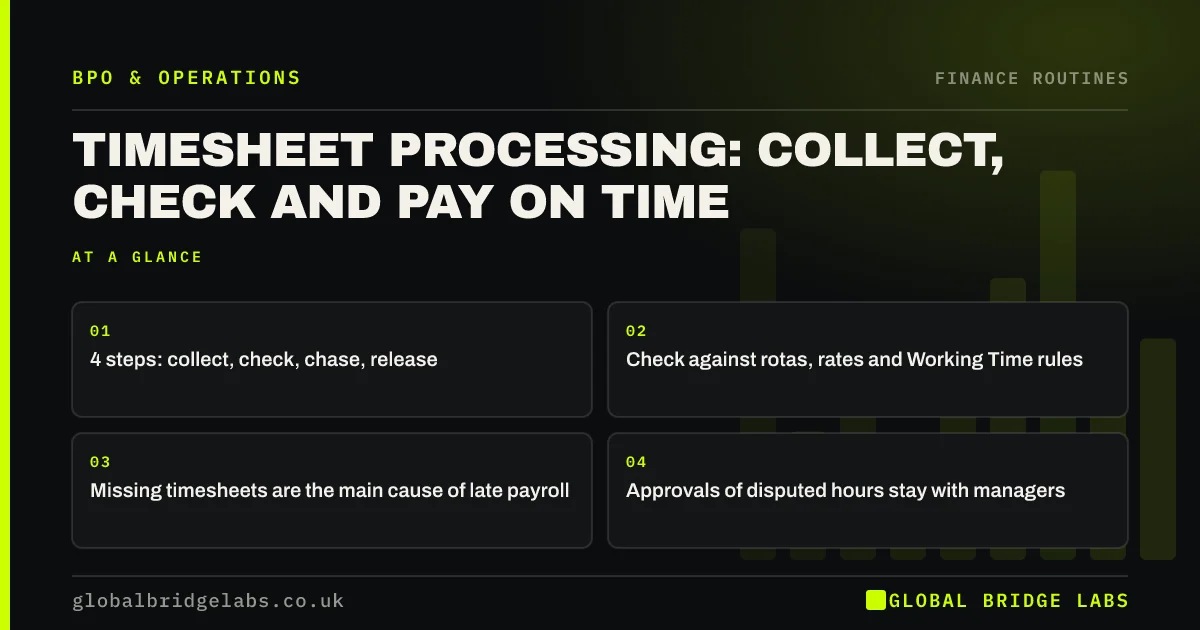
Timesheet processing is the weekly routine of collecting hours from staff or contractors, checking them against rotas, rates and rules, chasing what is missing and passing clean data to payroll or invoicing. It is repetitive, deadline-driven and rule-based, so it suits a dedicated team. Errors cost money twice: in pay corrections and in staff trust.
- 4 steps: collect, check, chase, release.
- Check against rotas, rates and Working Time rules.
- Missing timesheets are the main cause of late payroll.
- Approvals of disputed hours stay with managers.
Want to know what your timesheet routine would look like outsourced? Message us on WhatsApp with your headcount.
Chat on WhatsApp →What does timesheet processing involve?
It involves collecting submitted hours, comparing them with the rota or job record, applying the right rates for overtime, nights or weekends, flagging breaches such as missed breaks, chasing missing or unsigned sheets and sending approved totals to payroll. For agencies and contractors, the same data usually feeds client invoicing too.
What should the checks cover?
Check each sheet against a short list of rules. The most common errors are hours that do not match the rota, the wrong rate type and missing approvals. Flag anything that suggests a working time issue: the Working Time Regulations set a 48-hour average weekly limit unless a worker has opted out, plus rest break rules.
- Hours match the rota or job record.
- The right rate type is applied.
- Breaks and rest periods are recorded.
- The manager's approval is present.
What does timesheet admin cost in time?
In an illustrative example, 80 weekly timesheets at 4 minutes each to check, plus 15 to chase at 10 minutes each, is about 8 hours a week, often squeezed into one day before the payroll cut-off. These are example figures. Spreading the checks through the week with a dedicated team removes the Monday crunch.
- Cut-off times: what same-day processing really means
- Count your task volumes before you outsource anything
Send us your timesheet volumes on WhatsApp and we will work through the hours with you.
Chat on WhatsApp →When should timesheets stay in-house?
Keep timesheets in-house when hours are disputed often, because those disputes need a manager who knows the work. Keep them in-house too when your rotas and rate rules are not written down; fix that first. Personal data is involved, so any provider needs a processor contract under UK GDPR.
What does this look like in practice?
A pattern we see: payroll runs late every month because a few timesheets arrive after the deadline. A team that chases daily from mid-week, rather than on deadline day, makes late payroll rare.
Timesheet routine checklist
Set up the routine with these points.
- One submission method for everyone.
- A written rule for each rate type.
- Chasing starts two days before cut-off.
- Disputes go to the line manager.
- Totals reconciled before release to payroll.
Next step
Send us how timesheets reach payroll today. We will say plainly which checks a managed team could run and what stays with your managers.
Message us on WhatsApp about timesheet processing, or book a 30-minute consultation.
Chat on WhatsApp →Sources and further reading
- Maximum weekly working hours · GOV.UK
- National Minimum Wage and National Living Wage rates · GOV.UK
- Contracts and liabilities between controllers and processors · Information Commissioner's Office
Frequently asked questions
How do you check timesheets accurately?
Compare each timesheet with the rota or job record, confirm the rate type for overtime, nights or weekends, check breaks and rest periods are recorded and make sure the manager has approved it. Reconcile the total hours to the rota before sending figures to payroll.
Can timesheet processing be outsourced?
Yes. An outsourced team can collect, check and chase timesheets and pass clean totals to payroll. Disputed hours and approvals should stay with line managers. Because timesheets hold personal data, you need a written processor contract with the provider.
How do you stop timesheets arriving late?
Use one submission method, publish a clear deadline, start chasing two days before it and make it easy to submit from a phone. Track lateness by person and team; repeat lateness is usually a process or tool problem rather than a people problem.
Written by

Global Bridge Labs (GBL) is a UK–Sri Lanka partner for social media, websites and BPO. Everything here comes from client delivery, not theory.