On this page
- 01Key takeaways
- 02What does purchase order processing involve?
- 03Which steps can an outsourced team run?
- 04What does PO admin cost in time?
- 05When should PO processing stay in-house?
- 06What does this look like in practice?
- 07PO processing checklist
- 08Next step
- 09Sources and further reading
- 10Frequently asked questions
Key takeaways
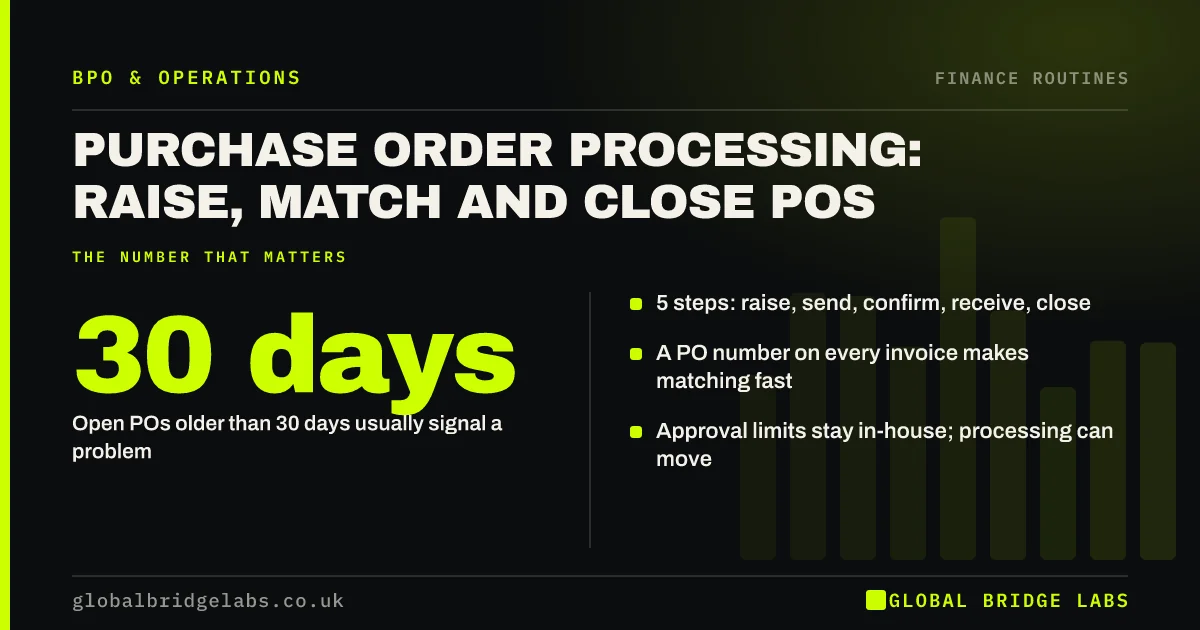
Purchase order processing is the routine of raising a purchase order (PO) from an approved request, sending it to the supplier, confirming price and date, matching the delivery and closing the PO when the invoice is matched. It is rule-based and frequent, so it suits a dedicated team. Keep supplier choice and spend approval in-house.
- 5 steps: raise, send, confirm, receive, close.
- Open POs older than 30 days usually signal a problem.
- A PO number on every invoice makes matching fast.
- Approval limits stay in-house; processing can move.
Want to know what your PO routine would look like outsourced? Message us on WhatsApp with your monthly PO count.
Chat on WhatsApp →What does purchase order processing involve?
Purchase order processing turns an approved request into a commitment to a supplier and tracks it until it is paid. The routine steps are raising the PO with the right codes, sending it, logging the supplier's confirmation, recording goods received and closing the PO once the invoice matches. Each step is repetitive and checkable, which is why it suits a written method.
Which steps can an outsourced team run?
An outsourced team can run every step except the spending decision. It can raise POs from approved requests, chase confirmations, update expected dates, log receipts from delivery notes, flag mismatches and close completed POs. The approver in your business keeps the authority to commit spend and choose suppliers.
- Raise POs from approved requests with the right codes.
- Chase supplier confirmations and log dates.
- Record goods received from delivery notes.
- Flag price or quantity mismatches.
- Close POs once invoices match.
What does PO admin cost in time?
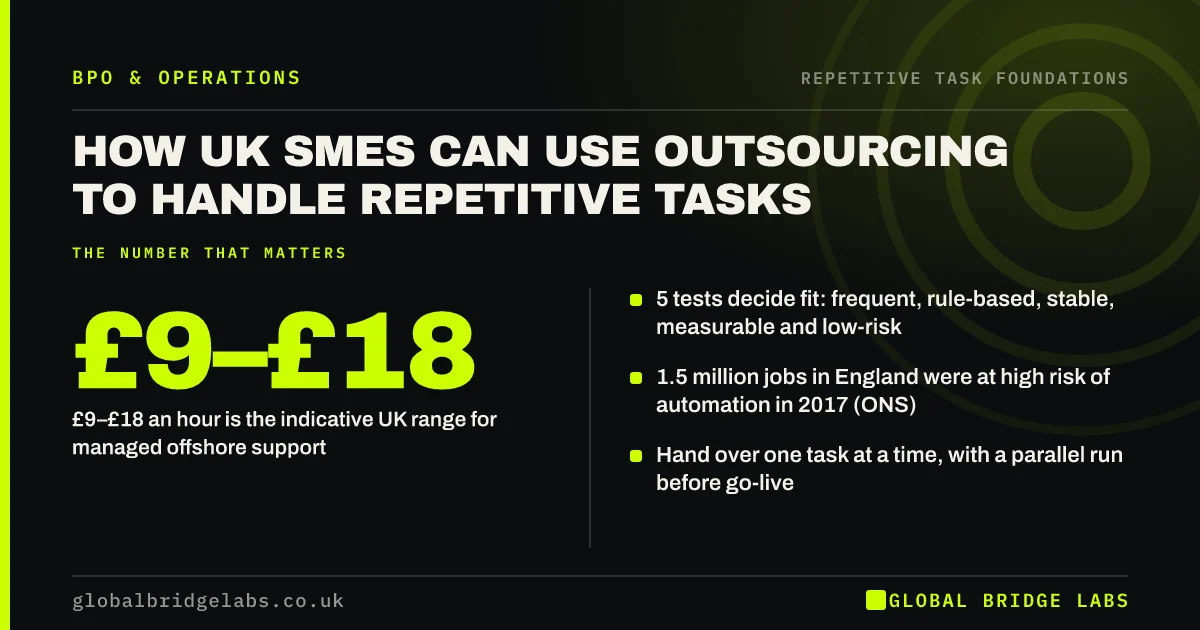
In an illustrative example, 250 POs a month at 8 minutes each for raising, chasing and closing is about 33 hours, plus time spent on the 10% with mismatches. These are example figures. At the indicative managed offshore rate of £9–£18 an hour, that work costs £300–£600 a month outsourced, against senior time in-house. These are not GBL prices.
Send us your PO volumes on WhatsApp and we will work through the hours with you.
Chat on WhatsApp →When should PO processing stay in-house?
Keep it in-house when most purchases are negotiated one by one, when buyers and processors are the same person by necessity, or when there are only a few POs a month. Also keep it while your coding and approval rules are still being agreed, and fix those first.
What does this look like in practice?
A pattern we see: dozens of POs stay open for months because nobody closes them, so the open commitment report is useless. A daily routine that closes matched POs turns it back into a number the owner can trust.
PO processing checklist
Set up the routine with these checks.
- Written approval limits by role.
- Required fields on every PO request.
- Supplier confirmation logged within two days.
- Goods received recorded on delivery.
- Open POs reviewed weekly by age.
Next step
Send us how you raise and close purchase orders today. We will say plainly which steps a managed team could run and what stays with your approvers.
Message us on WhatsApp about PO processing, or book a 30-minute consultation.
Chat on WhatsApp →Sources and further reading
Frequently asked questions
What are the steps in purchase order processing?
The usual steps are raising the PO from an approved request, sending it to the supplier, logging the supplier's confirmation of price and date, recording goods received, matching the invoice and closing the PO. Open POs are reviewed regularly so old ones are chased or cancelled.
Can purchase order admin be outsourced?
Yes. An outsourced team can raise POs from approved requests, chase confirmations, record receipts, flag mismatches and close completed orders. The decision to spend and the choice of supplier should stay with an approver in your business, under written approval limits.
Why do purchase orders stay open?
Usually because nobody owns closing them. Part deliveries, invoices without PO numbers and cancelled orders never recorded all leave POs open. A weekly review of open POs by age, with a daily routine to close matched ones, keeps the list accurate.
Written by

Global Bridge Labs (GBL) is a UK–Sri Lanka partner for social media, websites and BPO. Everything here comes from client delivery, not theory.