On this page
Key takeaways
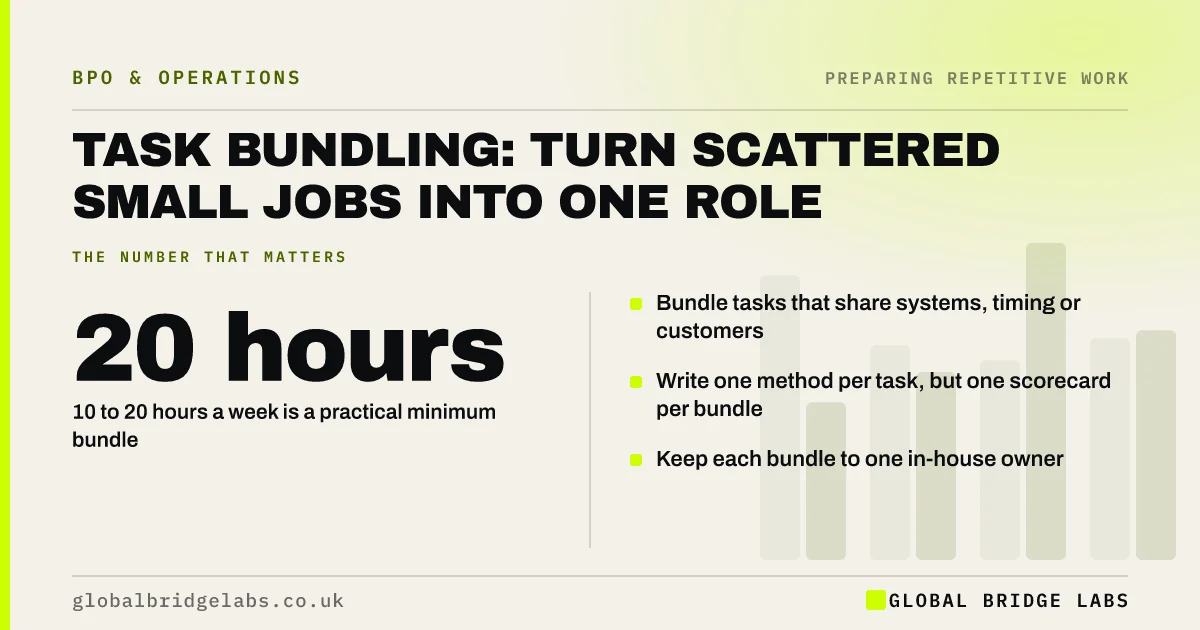
Task bundling means grouping several small repetitive tasks, each too small to outsource alone, into one defined role for an outsourced team. Bundles work best when the tasks share systems, rhythm or customers. A bundle of 10 to 20 hours a week usually gives a team enough volume to learn and stay accurate.
- Bundle tasks that share systems, timing or customers.
- 10 to 20 hours a week is a practical minimum bundle.
- Write one method per task, but one scorecard per bundle.
- Keep each bundle to one in-house owner.
Have lots of small tasks and no idea how to group them? Message us on WhatsApp with the list.
Chat on WhatsApp →What is task bundling?
Task bundling is the practice of combining small recurring tasks into one block of work that a dedicated person or team owns. Each task might take an hour a week, which is too small to hand over alone, but eight of them together make a role. Bundling turns the scattered admin that clogs a small business into something you can manage and measure.
Which tasks bundle well together?
Tasks bundle well when the same person would naturally need the same access and knowledge to do them. Group by shared system, such as everything done in the accounts package, by shared rhythm, such as daily morning tasks, or by shared customer journey, such as everything after an order is placed.
- By system: purchase orders, supplier statements and cash allocation.
- By rhythm: daily reminders, callbacks and order queries.
- By journey: booking, confirmation, reminder and follow-up.
- By sector: job sheets, certificates and notifications in trades.
How big should a bundle be?
As a GBL rule of thumb, aim for 10 to 20 hours a week in a first bundle. Below that, the team does each task too rarely to stay fluent, and briefing time takes a large share. In an illustrative example, six tasks of 1.5 to 4 hours each make a 14-hour bundle; these are example figures, so add up your own.
Want help sizing a first bundle? Send your task hours on WhatsApp.
Chat on WhatsApp →When does bundling go wrong?
Bundling goes wrong when unrelated tasks are thrown together to reach a number of hours, so the team needs five systems and three managers. It also goes wrong when one task in the bundle is unstable and drags the others down. Leave unstable tasks out and add them once they are fixed.
What does this look like in practice?
A pattern we see: an owner rejects outsourcing because no single task is big enough. Grouping the post-order tasks into one bundle creates a role that a managed team runs daily, and the owner stops being the default for every small job.
Bundling checklist
Use these steps to build a bundle.
- Sort the inventory by system, rhythm and journey.
- Pick the group with the most stable tasks.
- Add up weekly hours for the group.
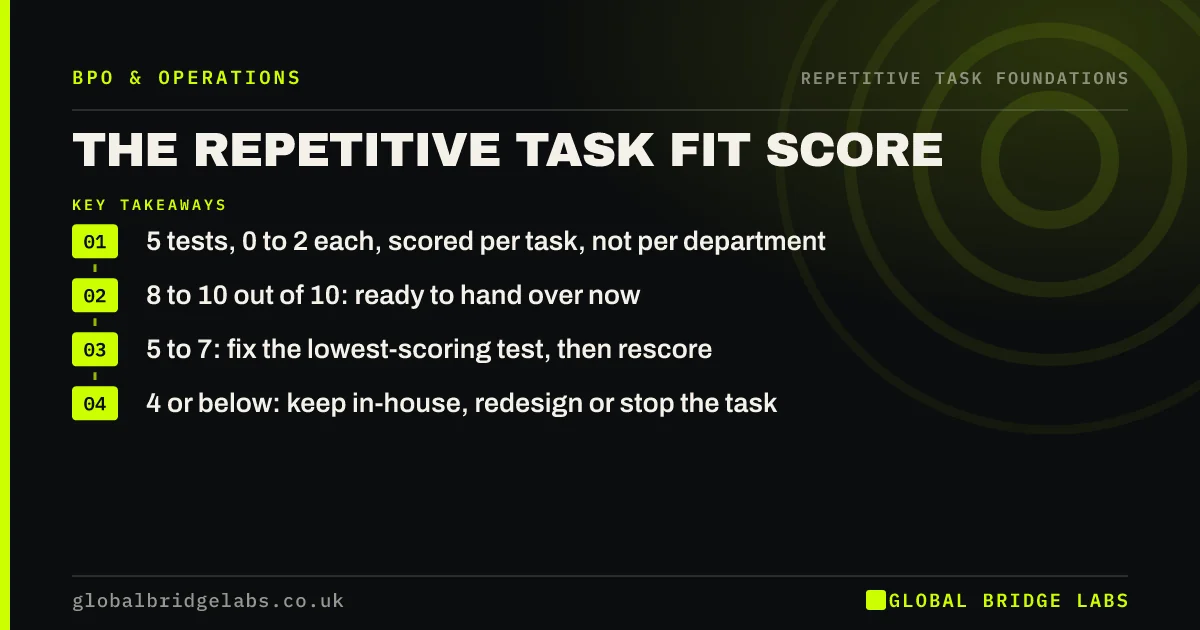
- Leave out any task scoring under 5.
- Name one in-house owner for the bundle.
Next step
Send us your list of small tasks. We will suggest how to group them into a bundle worth handing over and what to leave out for now.
Message us on WhatsApp to plan a task bundle, or book a 30-minute consultation.
Chat on WhatsApp →Sources and further reading
- Rates and thresholds for employers 2026 to 2027 · HM Revenue & Customs
- Contracts and liabilities between controllers and processors · Information Commissioner's Office
Frequently asked questions
Can you outsource lots of small tasks?
Yes, if you bundle them. Grouping small tasks that share systems, timing or customers into one block of 10 to 20 hours a week gives an outsourced team enough volume to learn and stay accurate, and gives you one scorecard and one owner instead of many.
What is the minimum amount of work to outsource?
There is no fixed minimum, but as a GBL rule of thumb a first bundle of 10 to 20 hours a week works best. Smaller amounts can work for a single simple task, though the briefing and review time take a larger share of the benefit.
How do you manage a bundle of different tasks?
Write a short method for each task, but measure the bundle with one weekly scorecard covering volume, turnaround and accuracy per task. Give the bundle one in-house owner, and review the mix every quarter so tasks that grow can be split out.
Written by

Global Bridge Labs (GBL) is a UK–Sri Lanka partner for social media, websites and BPO. Everything here comes from client delivery, not theory.