On this page
Key takeaways
Robotic process automation (RPA) is software that copies the clicks and keystrokes a person makes across screens, so it can run a fixed, high-volume task without changing the systems underneath. For small businesses it suits a narrow band of tasks: stable, rule-based, digital and frequent. Most small-business tasks fail one of those tests, which is where people still win.
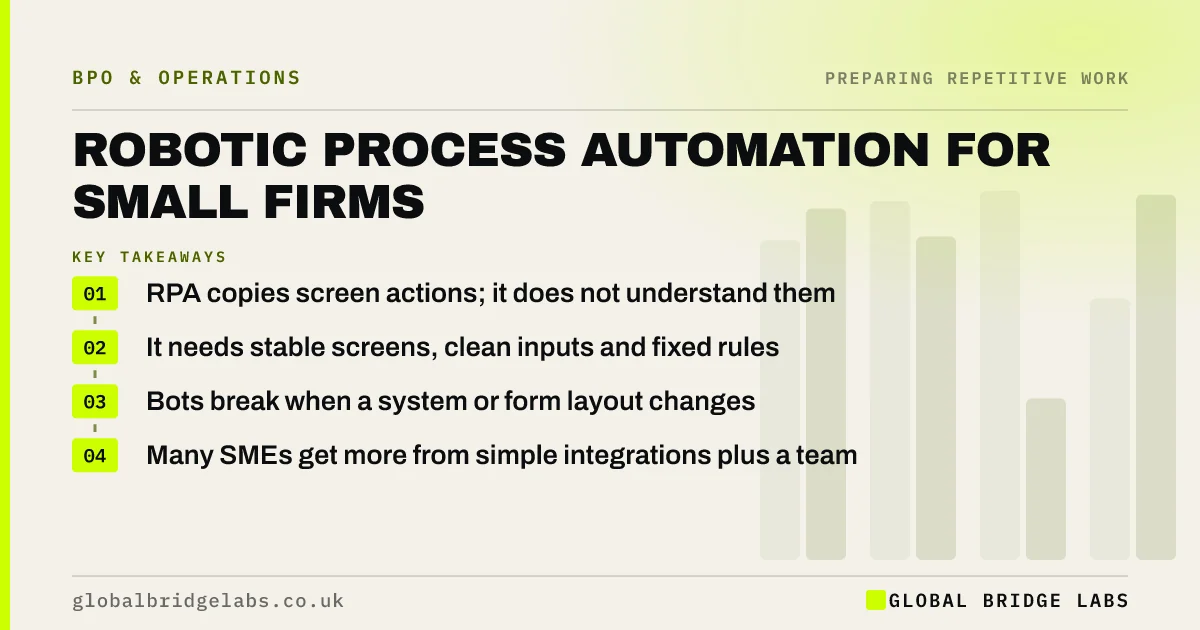
- RPA copies screen actions; it does not understand them.
- It needs stable screens, clean inputs and fixed rules.
- Bots break when a system or form layout changes.
- Many SMEs get more from simple integrations plus a team.
Wondering whether a bot or a person should run a task? Message us on WhatsApp with the task.
Chat on WhatsApp →What is robotic process automation?
Robotic process automation is software configured to follow the same on-screen steps a person would: open a system, copy a value, paste it elsewhere, click submit. It is useful where systems cannot be connected directly. It is not artificial intelligence by default; it follows the recorded steps exactly and stops when anything unexpected appears.
Which tasks suit RPA?
RPA suits tasks that run hundreds of times a week, with structured digital inputs, fixed rules and screens that rarely change. Copying order data between two systems with no integration is a typical example. Tasks that involve reading unstructured emails, chasing people or handling frequent exceptions suit it poorly.
- Good fit: high volume, structured inputs, fixed rules.
- Good fit: two systems with no integration available.
- Poor fit: unstructured documents and free-text emails.
- Poor fit: frequent exceptions, phone calls or chasing.
What does RPA take to run?
RPA needs someone to design the bot, test it, monitor it daily and fix it when a screen changes. In an illustrative example, a bot that saves 10 hours a week may need 2 to 3 hours a month of maintenance and a person to handle the items it rejects. These are example figures. Count the rejected items, not just the processed ones.
- Human in the loop: pairing AI tools with an outsourced team
- Exception handling: the few cases that drive most cost
Want help comparing a bot with a managed team for one task? Send the details on WhatsApp.
Chat on WhatsApp →When do people beat bots?
People beat bots when the task has messy inputs, frequent exceptions, low volume, systems that change often or a customer on the other end. In those cases a managed team working to a written method is quicker to set up and adapts without reprogramming. Often the best answer is a direct integration for the predictable step and a team for everything around it.
What does this look like in practice?
A pattern we see: a small business buys an automation tool for a task that turns out to have a dozen exception types. The bot handles the simple items and the exceptions pile up. A team that handles exceptions daily rescues the project.
RPA readiness checklist
Check these before buying RPA.
- Hundreds of items a week.
- Structured digital inputs.
- Screens unchanged for six months.
- No direct integration available.
- A named person to monitor and fix it.
- A route for rejected items.
Next step
Send us the task you are thinking of automating. We will say plainly whether it suits a bot, an integration, a managed team or a mix.
Message us on WhatsApp to compare options, or book a 30-minute consultation.
Chat on WhatsApp →Sources and further reading
- The probability of automation in England: 2011 and 2017 · Office for National Statistics
- Principle (d): Accuracy · Information Commissioner's Office
Frequently asked questions
What is RPA in simple terms?
RPA, or robotic process automation, is software that repeats the on-screen steps a person takes to complete a task, such as copying data from one system to another. It follows fixed instructions exactly and needs stable screens and clean inputs to work reliably.
Is RPA worth it for a small business?
Sometimes. It is worth it for high-volume, stable, rule-based tasks between systems that cannot be connected directly. For lower volumes, messy inputs or frequent exceptions, simple integrations plus a managed team are usually cheaper to set up and easier to change.
What is the difference between RPA and AI?
RPA follows recorded steps exactly and stops when something unexpected happens. AI tools can interpret text, images or patterns and make predictions. Some products combine the two, but either way a person is still needed for exceptions, checks and decisions the software cannot make.
Written by

Global Bridge Labs (GBL) is a UK–Sri Lanka partner for social media, websites and BPO. Everything here comes from client delivery, not theory.