On this page
- 01Key takeaways
- 02What does processing a credit application involve?
- 03How do you set limits by rule?
- 04What does slow processing cost?
- 05When should credit decisions stay in-house?
- 06What does this look like in practice?
- 07Credit application checklist
- 08Next step
- 09Sources and further reading
- 10Frequently asked questions
Key takeaways
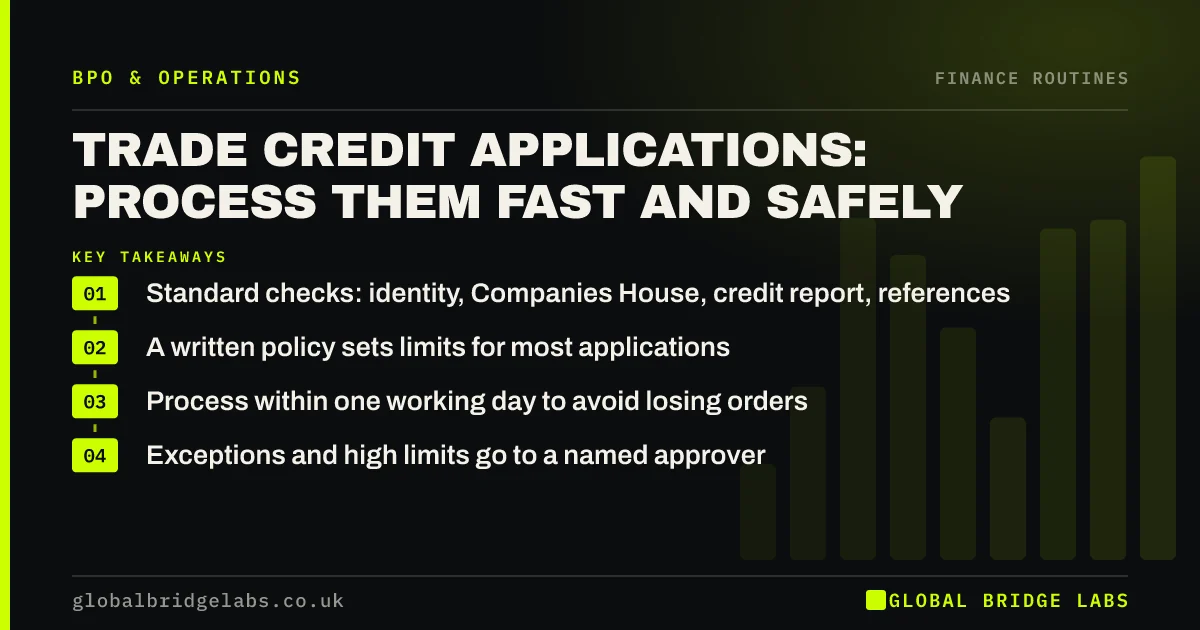
Trade credit application processing is the routine of collecting a new customer's details, running standard checks, applying your credit policy to set a limit and opening the account. Most applications fit clear rules, so a dedicated team can process them within a day. Applications outside the rules go to a named person to decide.
- Standard checks: identity, Companies House, credit report, references.
- A written policy sets limits for most applications.
- Process within one working day to avoid losing orders.
- Exceptions and high limits go to a named approver.
Losing orders while credit applications wait? Message us on WhatsApp with your monthly volume.
Chat on WhatsApp →What does processing a credit application involve?
It involves checking the application is complete, confirming the business exists and who runs it, pulling a credit report, taking references where your policy requires them, applying your limit rules and setting up the account with agreed terms. Each step is repetitive, and the outcome for most applicants follows directly from the policy.
How do you set limits by rule?
Write a simple credit policy that maps check results to limits. In an illustrative policy: a credit score in the top band with two years of filed accounts gets up to £5,000; a lower band gets £1,000 or pro-forma; anything above £5,000 or with adverse records is referred. These are example thresholds; set yours with your finance lead.
- Strong score and filed accounts: standard limit.
- Lower score: reduced limit or pro-forma.
- Adverse records or high limit request: refer.
Want help turning your credit decisions into a policy table? Send us recent examples on WhatsApp.
Chat on WhatsApp →What does slow processing cost?
Slow processing costs first orders. In an illustrative example, a distributor receives 40 applications a month and takes four days to open accounts; if a quarter of applicants buy elsewhere in that time, 10 new customers are lost each month. These are example figures. Same-day processing within policy keeps them.
When should credit decisions stay in-house?
Keep decisions in-house for large limits, strategic customers and any applicant with adverse information, because those need commercial judgement. The team can still prepare the file. Personal data on directors and guarantors is involved, so any provider needs a processor contract and a lawful basis recorded for the checks.
What does this look like in practice?
A pattern we see: every application waits for the finance director, even the obviously safe ones. A written policy lets most open the same day, and the director only sees the few that need a decision.
Credit application checklist
Process applications with these steps.
- Application complete and signed.
- Company and directors confirmed.
- Credit report pulled and filed.
- Limit set by the written policy.
- Referrals decided within one working day.
- Account opened and terms sent.
Next step
Send us your current credit application form and how decisions are made. We will suggest a policy table and a same-day routine.
Message us on WhatsApp about credit applications, or book a 30-minute consultation.
Chat on WhatsApp →Sources and further reading
- Late commercial payments: charging interest and debt recovery · GOV.UK
- Lawful basis for processing personal data · Information Commissioner's Office
- Contracts and liabilities between controllers and processors · Information Commissioner's Office
Frequently asked questions
What checks should you do on a credit application?
Confirm the business exists and who runs it, for example through Companies House, pull a credit report, check filed accounts and take references if your policy requires them. Compare the results with your written credit policy to set a limit or refer the application.
How long should a credit application take?
Most applications that fall within a written policy can be processed within one working day. Applications with adverse information or high limit requests take longer because they need a decision from a named person, but the file can still be prepared the same day.
Can credit application processing be outsourced?
The checks and account set-up can be outsourced to a team working to your written policy. Decisions on large limits, strategic customers and adverse cases should stay in-house. A provider handling directors' personal data needs a processor contract with your business.
Written by

Global Bridge Labs (GBL) is a UK–Sri Lanka partner for social media, websites and BPO. Everything here comes from client delivery, not theory.