On this page
Key takeaways
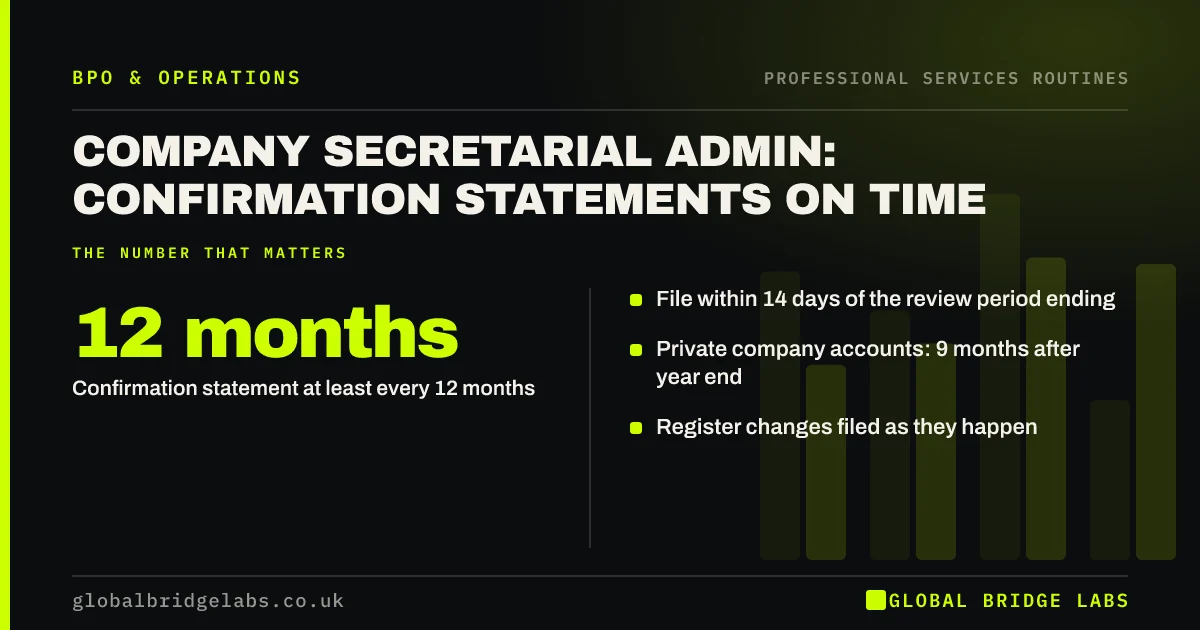
Company secretarial admin covers the recurring filings and records every UK company must keep: a confirmation statement at least once every 12 months, annual accounts, changes to officers and people with significant control, and the statutory registers. Each has a fixed deadline. A calendar and a routine prevent late filing penalties and the risk of being struck off.
- Confirmation statement at least every 12 months.
- File within 14 days of the review period ending.
- Private company accounts: 9 months after year end.
- Register changes filed as they happen.
Running several companies and losing track of filings? Message us on WhatsApp with how many you manage.
Chat on WhatsApp →What does company secretarial admin involve?
It involves tracking filing deadlines, preparing and filing the confirmation statement, reporting changes of directors, registered office and people with significant control, keeping statutory registers up to date, filing annual accounts prepared by your accountant, and keeping minutes of board and general meetings.
Which deadlines matter?
Companies House guidance sets the core deadlines. Missing them can bring penalties for accounts and, if filings stop, the company may be struck off the register.
- Confirmation statement: within 14 days of the review period end.
- Private company accounts: 9 months after the accounting year end.
- Officer and PSC changes: reported promptly after the change.
What does the routine take?
In an illustrative example, a group with six small companies faces six confirmation statements, six sets of accounts and a handful of officer changes a year: perhaps 15 to 25 hours of admin, but spread across many dates that are easy to miss. These are example figures. A shared calendar with reminders 30 days ahead does most of the work.
Send us your company list on WhatsApp and we will help you build the filing calendar.
Chat on WhatsApp →What must stay with directors?
Directors are legally responsible for the company's filings and must confirm the information is correct. Decisions about officers, share changes and accounts approval stay with them. Companies House has introduced identity verification requirements, so check current guidance on who must verify and when.
What does this look like in practice?
A pattern we see: a confirmation statement is missed because the reminder went to a director who has since left. A calendar owned by a routine, not a person, fixes that.
Company secretarial checklist
Keep these current for every company.
- Filing calendar with all deadlines.
- Reminders 30 days ahead.
- Statutory registers updated on change.
- Board and general meeting minutes kept.
- Director sign-off before each filing.
Next step
Send us the companies you manage. We will help you build the filing calendar and say plainly what a team could prepare for directors to approve.
Message us on WhatsApp about company secretarial admin, or book a 30-minute consultation.
Chat on WhatsApp →Sources and further reading
Frequently asked questions
How often do you file a confirmation statement?
Every company must file a confirmation statement at least once every 12 months, within 14 days of the end of its review period, confirming its information at Companies House is up to date. You can file more often if details change.
What happens if you miss a Companies House deadline?
Late annual accounts bring automatic penalties that rise with the delay. Missing a confirmation statement can lead Companies House to start the process of striking the company off the register. Directors can also be prosecuted for failing to file.
Can company secretarial admin be outsourced?
The routine work can: tracking deadlines, preparing filings, updating registers and keeping minutes. Directors remain legally responsible and must confirm the information and approve filings. Check Companies House guidance on identity verification and who can file on the company's behalf.
Written by

Global Bridge Labs (GBL) is a UK–Sri Lanka partner for social media, websites and BPO. Everything here comes from client delivery, not theory.