On this page
Key takeaways
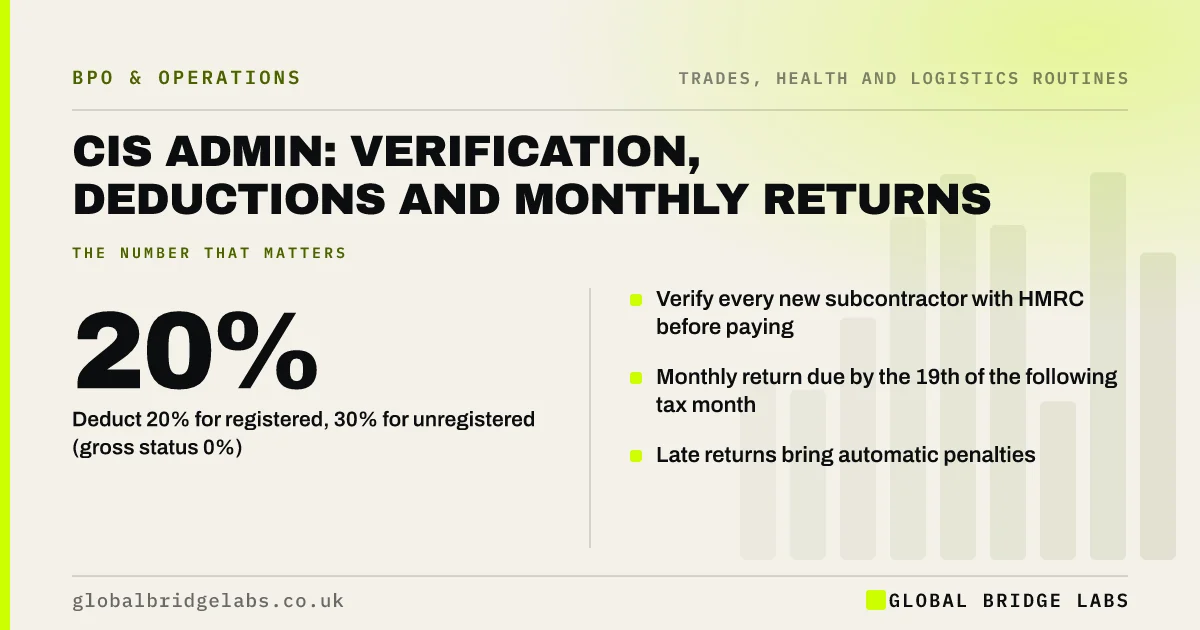
Under the Construction Industry Scheme (CIS), contractors must verify subcontractors with HMRC, deduct tax from payments at the right rate, give subcontractors payment and deduction statements and file a monthly return by the 19th. Each month repeats the same steps. A routine with a subcontractor register prevents late return penalties and wrong deductions.
- Verify every new subcontractor with HMRC before paying.
- Deduct 20% for registered, 30% for unregistered (gross status 0%).
- Monthly return due by the 19th of the following tax month.
- Late returns bring automatic penalties.
Monthly CIS returns a scramble? Message us on WhatsApp with how many subcontractors you pay.
Chat on WhatsApp →What does CIS admin involve?
It involves verifying new subcontractors through HMRC, recording their status and deduction rate, calculating deductions on labour from each payment, issuing payment and deduction statements, filing the monthly return and paying deductions to HMRC. Contractors must file a return each month, or tell HMRC if no payments were made.
What does the monthly routine look like?
Run the same steps each tax month, which runs from the 6th to the 5th. Keep a subcontractor register with verification references so deductions are always at the right rate.
- Verify new subcontractors before first payment.
- Separate labour from materials on invoices.
- Apply the verified deduction rate.
- Issue statements to subcontractors.
- File the return and pay HMRC by the 19th or 22nd electronically.
What does CIS admin take?
In an illustrative example, a contractor paying 25 subcontractors a month spends about 4 to 6 hours on verification, invoice checks, deductions and the return. These are example figures. Errors in the materials split or deduction rate are the costly part, so the invoice check deserves the most care.
Send us your subcontractor count on WhatsApp and we will estimate the routine with you.
Chat on WhatsApp →What should stay with you or your accountant?
Employment status questions, such as whether a worker is genuinely self-employed, need judgement and sometimes advice, and should stay with you and your accountant. A support team runs verification, calculation and filing preparation under your instructions, with the return approved before submission.
What does this look like in practice?
A pattern we see: a subcontractor is paid at the wrong rate for months because their status changed and nobody re-verified. A register with verification dates catches it.
CIS routine checklist
Run every tax month with these points.
- New subcontractors verified first.
- Labour and materials split checked.
- Deduction rate from the register.
- Statements issued to subcontractors.
- Return filed and paid on time.
Next step
Send us how CIS is handled today. We will suggest a monthly routine and say plainly what a team could prepare for your approval.
Message us on WhatsApp about CIS admin, or book a 30-minute consultation.
Chat on WhatsApp →Sources and further reading
Frequently asked questions
When is the CIS monthly return due?
The CIS monthly return must reach HMRC by the 19th of the month following the end of each tax month, which runs from the 6th to the 5th. You must file even if you made no payments, or tell HMRC. Late returns attract automatic penalties.
What CIS deduction rates apply?
Contractors usually deduct 20% from the labour element of payments to registered subcontractors and 30% for those not registered. Subcontractors with gross payment status have no deduction. Always verify each subcontractor with HMRC to get the right rate.
Can CIS admin be outsourced?
Yes, the routine can be: verification, invoice checks, deduction calculations, statements and preparing the return for your approval. Employment status judgements should stay with you and your accountant, and you remain responsible for the return.
Written by

Global Bridge Labs (GBL) is a UK–Sri Lanka partner for social media, websites and BPO. Everything here comes from client delivery, not theory.