On this page
- 01Key takeaways
- 02What is an outsourcing decision scorecard?
- 03How do you score each of the five triggers?
- 04What does each total mean?
- 05Which gates override the score?
- 06What does a worked example look like?
- 07Where does the scorecard fall short?
- 08How do you compare several processes at once?
- 09What does this look like in practice?
- 10Scorecard checklist
- 11Next step
- 12Sources and further reading
- 13Frequently asked questions
Key takeaways
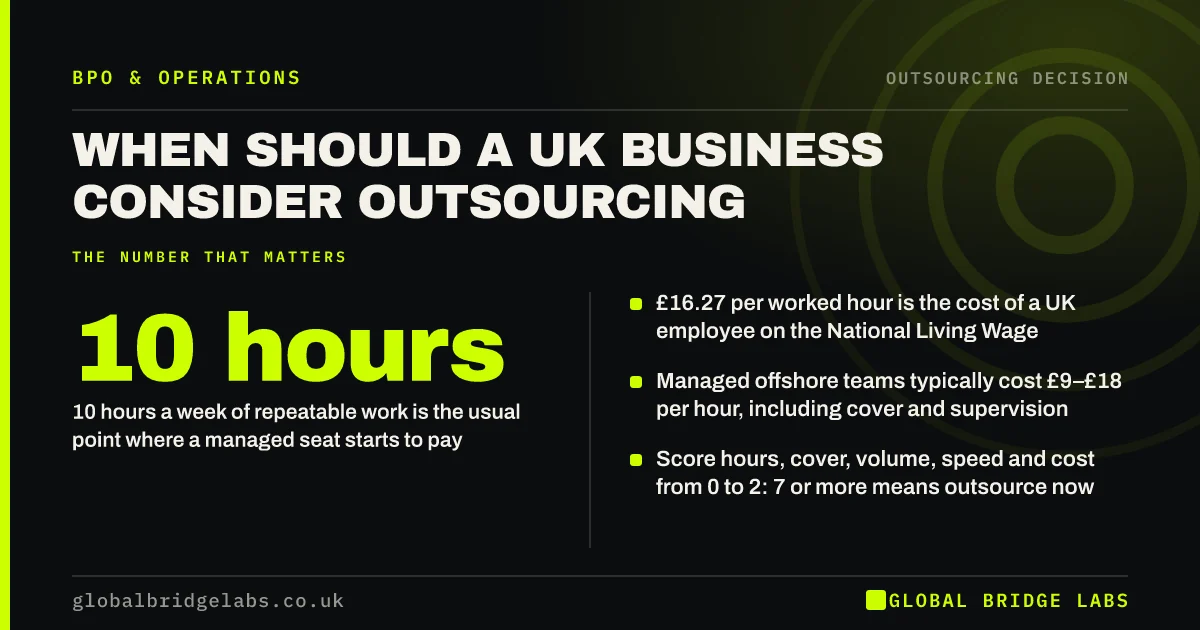
The GBL Outsourcing Trigger Scorecard is an outsourcing decision scorecard that rates one process on five triggers, hours, cover, volume, speed and cost, from 0 to 2 each. A total of 7 or more means outsource now, 4 to 6 means run a pilot, and 3 or less means not yet.
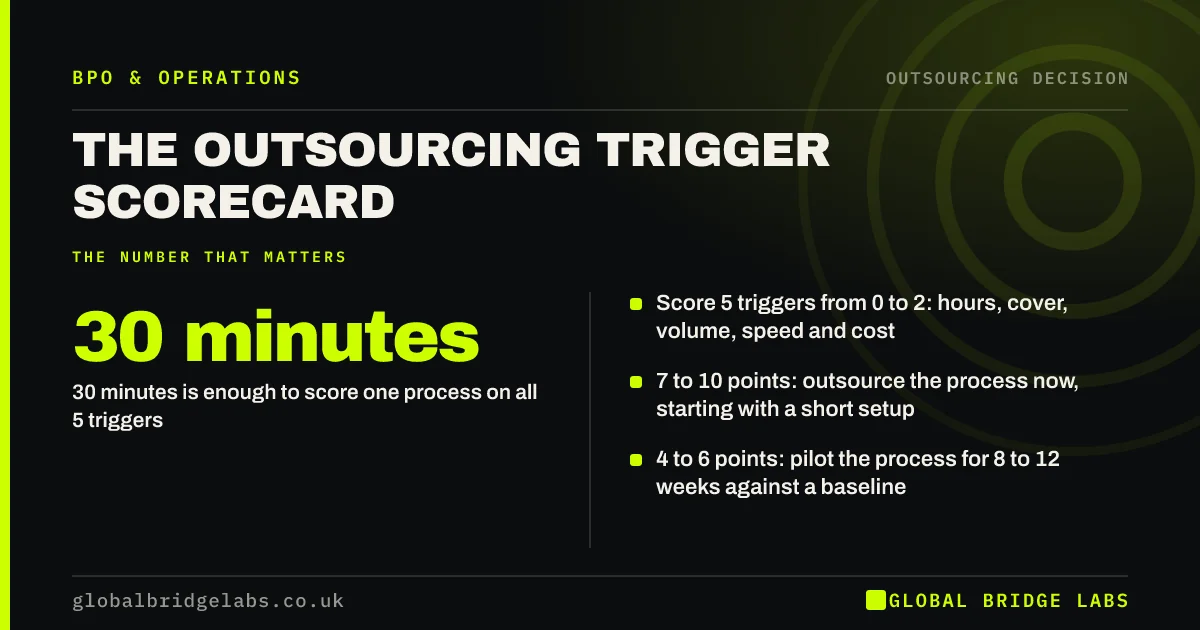
- 30 minutes is enough to score one process on all 5 triggers.
- Score 5 triggers from 0 to 2: hours, cover, volume, speed and cost.
- 7 to 10 points: outsource the process now, starting with a short setup.
- 4 to 6 points: pilot the process for 8 to 12 weeks against a baseline.
- 0 to 3 points: document or automate first and score again next quarter.
Want the scorecard as a one-page sheet? Message us on WhatsApp and ask for the outsourcing trigger scorecard.
Chat on WhatsApp →What is an outsourcing decision scorecard?
An outsourcing decision scorecard is a short scoring sheet that turns the question of whether to outsource into numbers. It rates one process at a time on the factors that make outsourcing pay, so the decision rests on evidence rather than on how stretched everyone feels this week.
Scoring one process at a time matters. A business rarely outsources everything; it outsources the inbox, or the invoicing, or the phones. Each has a different score.
How do you score each of the five triggers?
Score each trigger 0, 1 or 2 using the last 12 weeks of data. Where you have no data, log it for two weeks first. Guessing tends to underrate hours and overrate speed.
- Hours: senior or skilled time on the process. 0 under 5 a week, 1 for 5 to 10, 2 over 10.
- Cover: 0 if one person's hours are enough, 1 if holidays leave gaps, 2 if daily cover is short.
- Volume: 0 if steady, 1 if weekly or seasonal swings reach 30%, 2 if they exceed 30%.
- Speed: 0 if replies meet target, 1 if sometimes late, 2 if routinely late.
- Cost: 0 if cheaper in-house per task, 1 if similar, 2 if clearly dearer in-house.
What does each total mean?
The total sets the next step. High scores mean the business is already paying for not outsourcing. Middle scores mean the case is real but unproven, so a pilot is the right test. Low scores mean the effort of setting up will outweigh the gain for now.
- 7 to 10: outsource now. Start with a two-week setup and a named internal owner.
- 4 to 6: pilot for 8 to 12 weeks with clear success measures.
- 0 to 3: not yet. Document, simplify or automate, then rescore next quarter.
- Any total: stop if the process is the reason customers choose you.
Scored a 4 or more? Send us the process on WhatsApp and we will discuss your requirements.
Chat on WhatsApp →Which gates override the score?
Two gates override any total. The process must be stable enough to write down, and it must not be the core of what you sell. A process that changes every fortnight will fail in anyone's hands, and outsourcing your point of difference hands it to someone who does not own it.
A third gate is data protection. If the process involves personal data, the provider needs a processor contract under UK GDPR and, if offshore, a valid transfer safeguard. It rarely stops a decision, but it sets the timeline.
What does a worked example look like?
Take an e-commerce brand's customer email. The founder spends 12 hours a week on it (hours 2). Nobody covers weekends (cover 2). Volume doubles in November (volume 2). Replies average 30 hours (speed 2). The founder's time is worth far more than a managed seat (cost 2). Total: 10, outsource now.
Now take the same brand's supplier ordering: 3 hours a week, steady, done on time, needs buying judgement. Total: 1. Keep it in-house.
Where does the scorecard fall short?
It measures pressure, not preference. A business may score 8 on a process and still choose to keep it in-house for strategic reasons, such as building a team in a new office. The scorecard also cannot see quality problems hiding in the process itself. Use it to start the conversation, not to end it.
How do you compare several processes at once?
Score every candidate on the same sheet, then add an ease score from 1 to 3 for how simple the process is to write down and check. Rank by trigger score first and ease second. The process at the top of both lists is your first move; the ones scoring high but hard to document become your next project.
Keep the sheet. Rescoring the same list each quarter shows which processes are heating up as the business grows, so you can plan the next handover before it becomes urgent.
- Column 1: process name and current owner.
- Columns 2 to 6: hours, cover, volume, speed and cost, each 0 to 2.
- Column 7: total out of 10.
- Column 8: ease of documenting and checking, 1 to 3.
- Column 9: decision and date to rescore.
What does this look like in practice?
A pattern we see in UK professional services firms: partners score the inbox, the document chasing and the diary, and the document chasing scores highest because fee earners spend hours on it at charge-out rates. That becomes the first process moved, and the inbox follows once the reporting is trusted.
Scorecard checklist
Run this for each process you are considering.
- Name the process and who does it today.
- Log hours for two weeks if you have no data.
- Score hours, cover, volume, speed and cost from 0 to 2.
- Check the gates: stable, not core, data protection manageable.
- Act on the total: outsource, pilot or wait.
- Rescore every quarter.
Next step
Score your top three processes and send us the totals. We will tell you which to start with and what a sensible first scope looks like. 30 minutes, no pitch.
Message us on WhatsApp with your scores, or book a 30-minute consultation.
Chat on WhatsApp →Sources and further reading
- Contracts and liabilities between controllers and processors · Information Commissioner's Office
- International transfers of personal data · Information Commissioner's Office
- National Minimum Wage and National Living Wage rates · GOV.UK
Frequently asked questions
How do you decide whether to outsource a process?
Score it on hours, cover, volume, speed and cost from 0 to 2 each. A total of 7 or more means outsource now, 4 to 6 means pilot, 0 to 3 means not yet. Check that the process is stable and not the core of what you sell before acting.
What factors should you consider before outsourcing?
The time the work takes, whether it needs cover beyond one person, how much volume swings, whether customers are waiting, and the cost per task in-house against a managed rate. Also check process stability, data protection and who will own the relationship internally.
Can I use the scorecard for my whole business?
Score one process at a time. Businesses rarely outsource everything, and each process has a different score. The inbox might score 9 while supplier ordering scores 1. Start with the highest-scoring process that is easy to document.
How often should I rescore?
Every quarter, or after any big change such as a new contract, a resignation or a seasonal peak. Scores move as the business grows, so a process that scored 3 last year may score 7 now.
Written by

Global Bridge Labs (GBL) is a UK–Sri Lanka partner for social media, websites and BPO. Everything here comes from client delivery, not theory.