On this page
Key takeaways
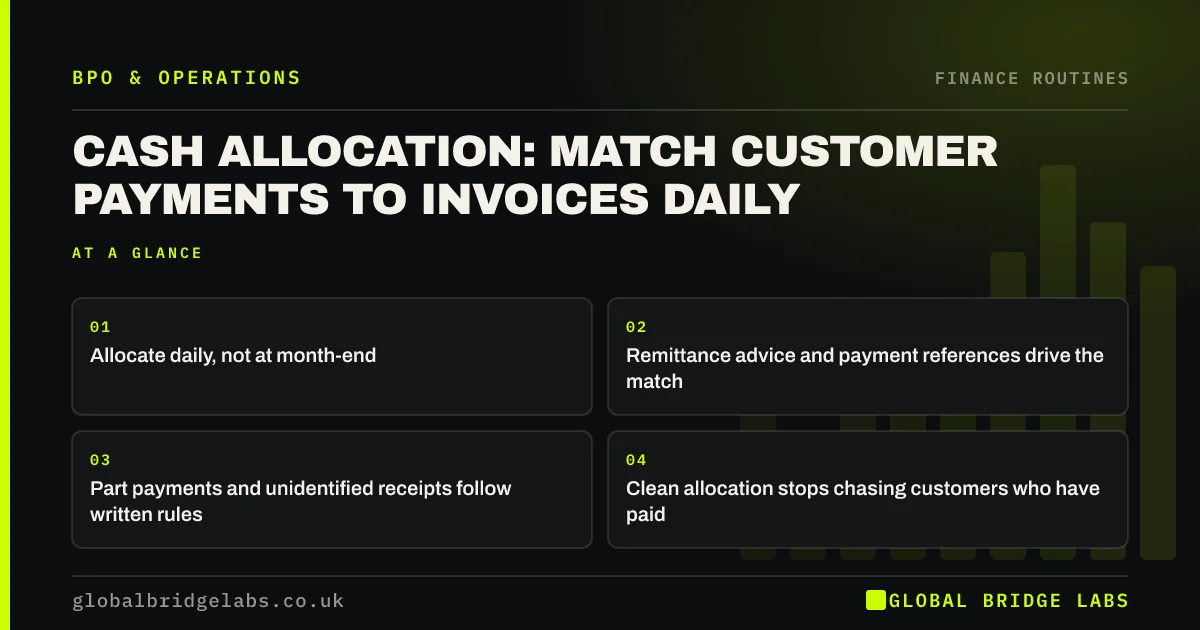
Cash allocation is the daily routine of matching each customer payment to the invoices it pays. When it slips, the ledger shows paid invoices as overdue, credit control chases customers who have paid and unallocated cash builds up. It is rule-based and frequent, so it suits a dedicated team working from bank data and remittance advice.
- Allocate daily, not at month-end.
- Remittance advice and payment references drive the match.
- Part payments and unidentified receipts follow written rules.
- Clean allocation stops chasing customers who have paid.
Want to know how much unallocated cash you are carrying? Message us on WhatsApp and we will help you check.
Chat on WhatsApp →What is cash allocation?
Cash allocation applies each payment received to the specific invoices it settles in your sales ledger. Most payments match one invoice by reference. Others pay several invoices, part of one, or arrive without a usable reference. Each case has a rule: match by remittance, by amount and customer, or hold and query.
Why does slow allocation cost money?
Slow allocation makes your debtor figures wrong. Credit control chases paid invoices, which annoys good customers, and misses genuinely late ones hidden among them. In an illustrative example, £40,000 of unallocated receipts across 60 customers makes the aged debt report unreliable for weeks. These are example figures.
Send us your monthly receipts count on WhatsApp and we will estimate the routine with you.
Chat on WhatsApp →What rules should the routine follow?
Write a short rule for each type of receipt so the team can allocate without asking. Hold anything unidentified for no more than two working days before querying the customer, and log every query so the same customer can be asked to include references in future.
- Exact reference match: allocate immediately.
- Remittance advice: allocate to the invoices listed.
- Amount match for one customer: allocate and note.
- Part payment: allocate oldest first unless told otherwise.
- Unidentified: hold, then query within two days.
When should allocation stay in-house?
Keep it in-house when receipts are few, or when customers pay complex accounts that need commercial knowledge, such as retentions on construction contracts. Write-offs, settlement discounts outside policy and disputes should always sit with your finance lead.
What does this look like in practice?
A pattern we see: credit control looks ineffective, but the real issue is allocation running a week behind. Daily allocation by a dedicated team makes the chasing list accurate, and collections improve with no change to the chasing itself.
Cash allocation checklist
Run the routine with these checks.
- Bank feed reviewed every working day.
- Written rule for each receipt type.
- Unidentified receipts queried within two days.
- Unallocated balance reported weekly.
- Customers asked to quote invoice numbers.
Next step
Send us how payments are allocated today and how far behind it runs. We will say plainly what a daily routine would change and who should own the exceptions.
Message us on WhatsApp about cash allocation, or book a 30-minute consultation.
Chat on WhatsApp →Sources and further reading
Frequently asked questions
What is unallocated cash?
Unallocated cash is money received from customers that has not yet been matched to the invoices it pays. It sits on account, so the related invoices still look unpaid. High unallocated balances make debtor reports unreliable and lead to customers being chased for invoices they have already paid.
How often should payments be allocated?
Daily. Allocating every working day keeps the sales ledger and aged debt report accurate, so credit control chases the right customers. Weekly or monthly allocation lets errors build up and makes unidentified payments harder to trace.
How do you allocate a payment with no reference?
Try the remittance advice first, then match by customer and amount against open invoices. If there is still no clear match, hold the payment, query the customer within two working days and record the outcome. Ask regular payers to include invoice numbers in future.
Written by

Global Bridge Labs (GBL) is a UK–Sri Lanka partner for social media, websites and BPO. Everything here comes from client delivery, not theory.