On this page
- 01Key takeaways
- 02What does referral processing involve?
- 03What should the completeness check cover?
- 04What does a faster routine change?
- 05What must stay with clinicians?
- 06What does this look like in practice?
- 07Referral routine checklist
- 08Next step
- 09Sources and further reading
- 10Frequently asked questions
Key takeaways
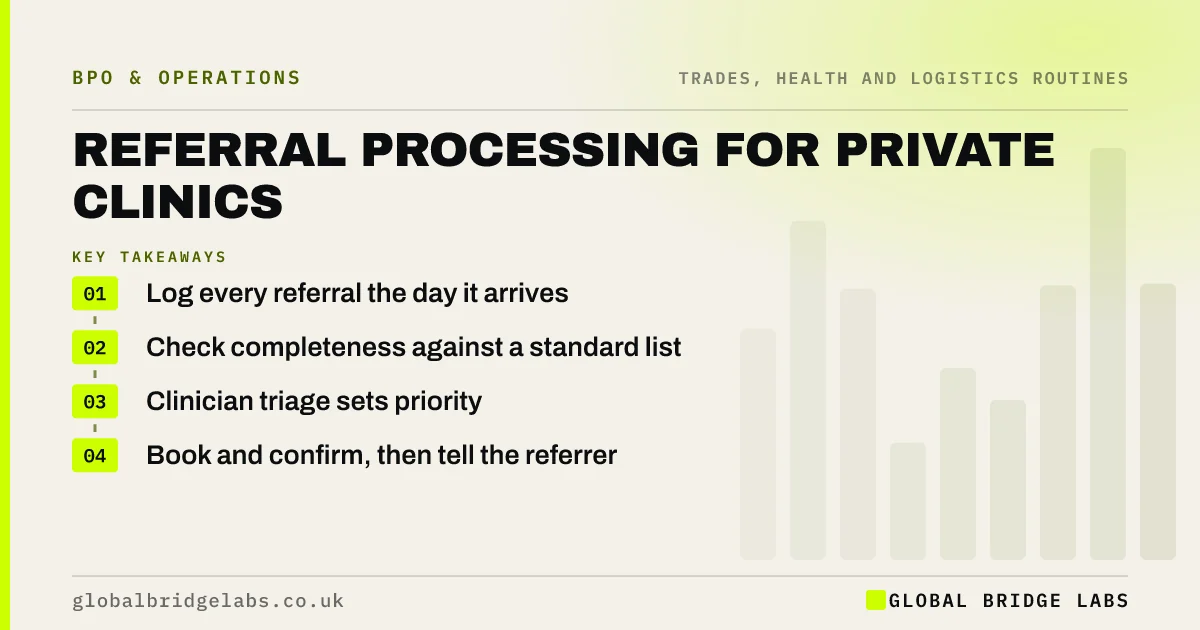
Referral processing is the routine of logging each incoming referral, checking it has what the clinic needs, passing it to a clinician for triage, booking the patient at the right priority and updating the referrer. The logging, checking, booking and updating are repetitive admin; triage is clinical. A same-day routine shortens the time from referral to appointment.
- Log every referral the day it arrives.
- Check completeness against a standard list.
- Clinician triage sets priority.
- Book and confirm, then tell the referrer.
Referrals waiting days to be booked? Message us on WhatsApp with your weekly referral count.
Chat on WhatsApp →What does referral processing involve?
Referrals arrive from GPs, other clinicians, insurers and patients themselves. Each one needs logging, checking for the information and authorisations the clinic needs, chasing anything missing, routing to a clinician for triage, booking at the agreed priority, confirming with the patient and acknowledging to the referrer.
What should the completeness check cover?
Incomplete referrals cause most delays. A standard checklist lets admin chase gaps before the clinician sees the referral.
- Patient details and contact information.
- Reason for referral and relevant history.
- Insurer authorisation number where needed.
- Referrer details for the reply.
What does a faster routine change?
In an illustrative example, a clinic receiving 50 referrals a week takes five days on average to book because referrals wait in an inbox for triage. A same-day log and completeness check, with a daily triage slot for the clinician, brings that to two days. These are example figures.
- Work queue management: stop jobs waiting in the back office
- How to improve efficiency in a private clinic
Send us your weekly referrals on WhatsApp and we will estimate the routine with you.
Chat on WhatsApp →What must stay with clinicians?
Triage and prioritisation must be done by a clinician, because they depend on clinical judgement about urgency. Referrals are special category health data, so any support team needs a processor contract, access limited to what the task needs and, for NHS work, DSPT compliance.
What does this look like in practice?
A pattern we see: referrals are triaged quickly, but booking waits because nobody owns it after triage. A routine that books within a day of triage removes the hidden wait.
Referral routine checklist
Run the routine with these points.
- Logged the day it arrives.
- Completeness check and chasing.
- Daily clinician triage slot.
- Booked within a day of triage.
- Referrer acknowledged.
Next step
Send us your weekly referral volume and current referral-to-booking time. We will suggest a routine and say plainly what a team could run.
Message us on WhatsApp about referral processing, or book a 30-minute consultation.
Chat on WhatsApp →Sources and further reading
- Special category data · Information Commissioner's Office
- Data Security and Protection Toolkit · NHS England
Frequently asked questions
How should a clinic process referrals?
Log each referral the day it arrives, check it has the information and authorisations needed, chase gaps, route it to a clinician for triage, book the patient at the agreed priority, confirm the appointment and acknowledge the referral to the referrer.
Who should triage referrals?
A clinician should triage referrals, because setting priority depends on clinical judgement about urgency and suitability. Admin staff can prepare the referral, check completeness and book once triage is done, which keeps the clinician's time focused on the decision.
Can referral admin be outsourced?
The admin parts can be: logging, completeness checks, chasing, booking and acknowledgements. Triage stays with clinicians. Because referrals contain health data, you need a processor contract, limited access and, for NHS-funded work, Data Security and Protection Toolkit compliance.
Written by

Global Bridge Labs (GBL) is a UK–Sri Lanka partner for social media, websites and BPO. Everything here comes from client delivery, not theory.