On this page
Key takeaways
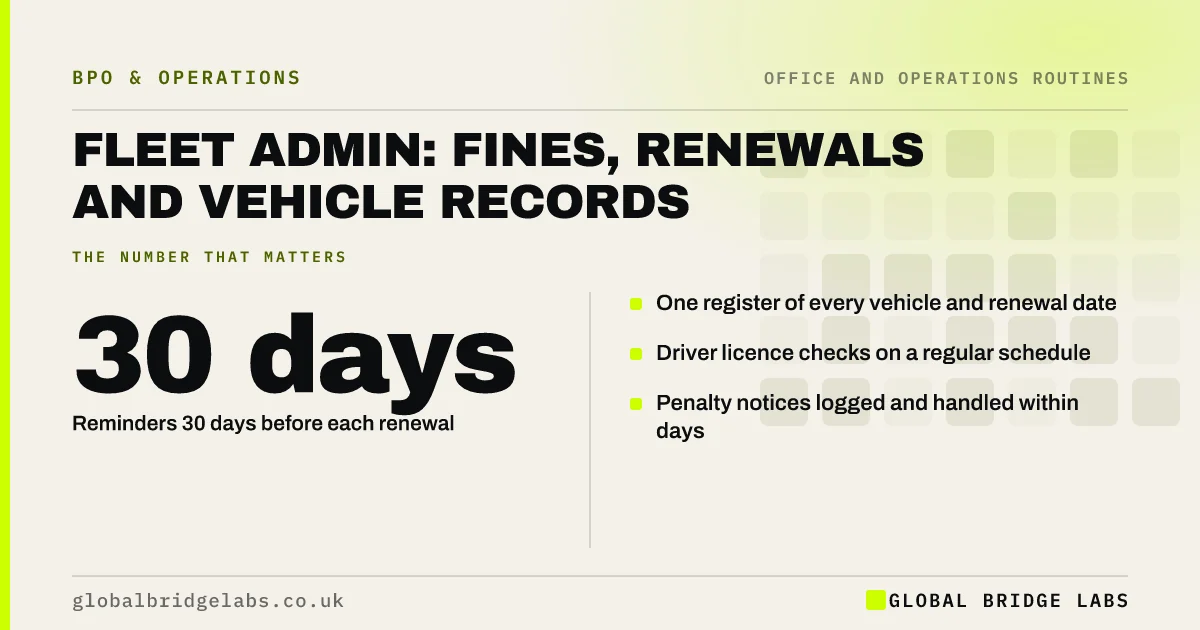
Fleet admin for a small business means keeping every vehicle legal and every driver checked: MOT, tax, insurance and service dates, licence checks, and penalty charge notices handled before discounts expire or charges increase. Most of it is date tracking and paperwork that repeats every month, which suits a register and a dedicated routine.
- One register of every vehicle and renewal date.
- Reminders 30 days before each renewal.
- Driver licence checks on a regular schedule.
- Penalty notices logged and handled within days.
Losing track of renewals and fines across your vans? Message us on WhatsApp with your fleet size.
Chat on WhatsApp →What does fleet admin involve?
It involves maintaining a vehicle register, tracking MOT, tax, insurance and service dates, booking services, checking driving licences, recording defects, handling penalty charge notices and congestion or clean air zone charges, and reallocating fines to drivers where your policy allows. Each item recurs on a schedule.
What should the fleet register record?
Record enough to run every renewal from one place. A missed date can mean an uninsured or untaxed vehicle on the road, which carries penalties.
- Registration, make, model and assigned driver.
- MOT, tax, insurance and service due dates.
- Lease or finance end date and mileage limits.
- Driver licence check dates.
What does fleet admin cost in time?
In an illustrative example, a firm with 15 vans handles about 6 penalty notices, 3 to 4 renewals and several defect reports a month, around 6 to 8 hours of admin. These are example figures. Paying a penalty charge notice within the discount period usually halves it, so speed has a direct value.
Send us your fleet size on WhatsApp and we will estimate the routine with you.
Chat on WhatsApp →What stays with managers?
Decisions on challenging a penalty, disciplinary matters with drivers and vehicle replacement should stay with managers. Goods vehicle operators have additional duties on drivers' hours and tachographs under DVSA rules, which need their own routine and a named responsible person.
What does this look like in practice?
A pattern we see: penalty notices are posted to the office, sit in the tray past the discount period and then escalate. Scanning post daily and logging notices on arrival stops that.
Fleet admin checklist
Run fleet admin with these points.
- Vehicle register with all due dates.
- Reminders 30 days ahead.
- Licence checks on a schedule.
- Penalty notices logged on arrival.
- Defects recorded and actioned.
Next step
Send us your fleet size and how renewals and fines are tracked now. We will suggest a register and routine and say plainly what a team could handle.
Message us on WhatsApp about fleet admin, or book a 30-minute consultation.
Chat on WhatsApp →Sources and further reading
- Drivers' hours · Driver and Vehicle Standards Agency
- Running a limited company: company and accounting records · GOV.UK
Frequently asked questions
What does fleet administration include?
Fleet administration includes keeping a vehicle register, tracking MOT, tax, insurance and service dates, booking services, checking drivers' licences, recording defects and handling penalty charge notices and zone charges. Goods vehicle operators also have drivers' hours and tachograph duties.
How should a business handle penalty charge notices?
Log each notice on arrival with its date and deadline, identify the driver, and decide quickly whether to pay or challenge. Paying within the discount period usually reduces the charge, and missing deadlines can increase it. Follow your written policy on recovering fines from drivers.
Can fleet admin be outsourced?
Yes. A managed team can maintain the register, send renewal reminders, book services, log penalty notices and keep records. Decisions on challenges, driver discipline and vehicle replacement should stay with managers, and operator licence duties need a named responsible person.
Written by

Global Bridge Labs (GBL) is a UK–Sri Lanka partner for social media, websites and BPO. Everything here comes from client delivery, not theory.