On this page
Key takeaways
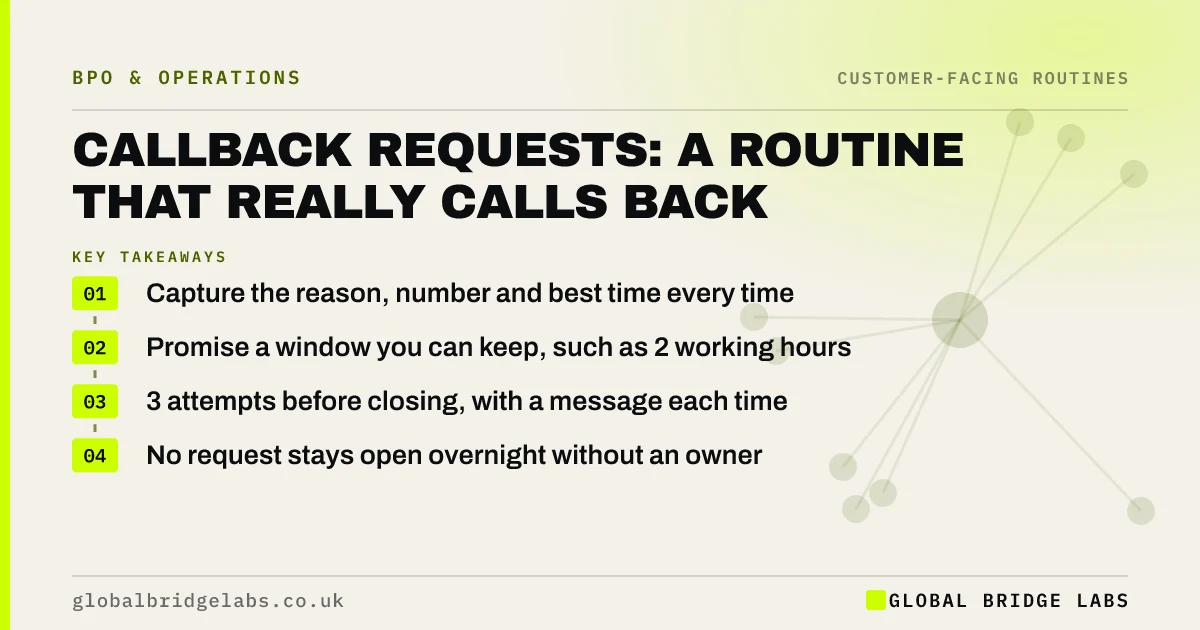
A callback request is a promise, and broken promises cost customers. A callback routine captures each request with the reason and best time, assigns it, calls back within a stated window, retries if there is no answer and logs the outcome. It is repetitive and time-sensitive, which suits a dedicated team working the queue all day.
- Capture the reason, number and best time every time.
- Promise a window you can keep, such as 2 working hours.
- 3 attempts before closing, with a message each time.
- No request stays open overnight without an owner.
Callbacks slipping through the cracks? Message us on WhatsApp with how many you take a day.
Chat on WhatsApp →Why do callbacks get missed?
Callbacks get missed because they are written on notes, sent to one person's inbox or left on a voicemail nobody owns. The person promised to call is busy, and the request has no deadline. A routine gives each request a place, an owner and a time by which it must be done.
What does a callback routine look like?
Every request goes into one queue with the caller's number, reason, urgency and best time. The team calls back within the promised window, makes up to three attempts at different times, leaves a message each time and records the outcome. Requests that need a specialist are passed with full notes, not a bare number.
- One queue for all callback requests.
- Promised window logged with each request.
- Up to three attempts at different times.
- Outcome recorded before the request closes.
What do missed callbacks cost?
In an illustrative example, a trades firm takes 25 callback requests a week, a third of them new enquiries. If a quarter of those are never called back, two or three new jobs a week are lost. At an average job of £600, that is over £1,200 a week. These are example figures.
- Call answering and admin for trades and construction firms
- Losing leads to slow follow-up? When to outsource it
Send us your weekly callback count on WhatsApp and we will estimate what a routine would save.
Chat on WhatsApp →When should callbacks stay with your team?
Callbacks that need specialist advice, such as a quote discussion or a complaint, should go to the right person in your business. The routine still helps: the team captures the request properly, books it into that person's diary and checks it happened.
What does this look like in practice?
A pattern we see: an owner believes every callback is returned, but a week of logging shows a third are not. A shared queue with a promised window fixes it within days.
Callback routine checklist
Check your routine against these points.
- One queue for all requests.
- Reason, number and best time captured.
- A promised window that is kept.
- Three attempts before closing.
- Outcome logged on every request.
Next step
Send us how callback requests are handled today. We will suggest a routine and say plainly what a managed team could run through the day.
Message us on WhatsApp about callback requests, or book a 30-minute consultation.
Chat on WhatsApp →Sources and further reading
- Electronic and telephone marketing under PECR · Information Commissioner's Office
- Online Nation: how the UK uses online services · Ofcom
Frequently asked questions
How quickly should you return a callback request?
Promise a window you can keep every time, such as within two working hours, and state it when the request is taken. For new enquiries, faster is better, because the customer may be contacting other businesses. Consistency matters more than a very short promise you sometimes miss.
How many times should you try to call back?
Three attempts at different times of day is a sensible standard, leaving a message or text each time with a way to reach you. Record each attempt, and close the request only after the final attempt or a successful call.
Can callback requests be outsourced?
Yes. A managed team can capture requests, work the queue, call customers back within the promised window and pass specialist calls to the right person with full notes. It works best with one shared queue and a clear rule for which calls stay in-house.
Written by

Global Bridge Labs (GBL) is a UK–Sri Lanka partner for social media, websites and BPO. Everything here comes from client delivery, not theory.