On this page
- 01Key takeaways
- 02What are the main BPO pricing models?
- 03When does per-hour pricing make sense?
- 04When does per-seat (FTE) pricing make sense?
- 05When does per-transaction pricing make sense?
- 06Does outcome-based pricing work for SMEs?
- 07How do you compare quotes on different models?
- 08What pricing traps should you check?
- 09What does this look like in practice?
- 10Checklist: choose a pricing model
- 11Next step
- 12Sources and further reading
- 13Frequently asked questions
Key takeaways
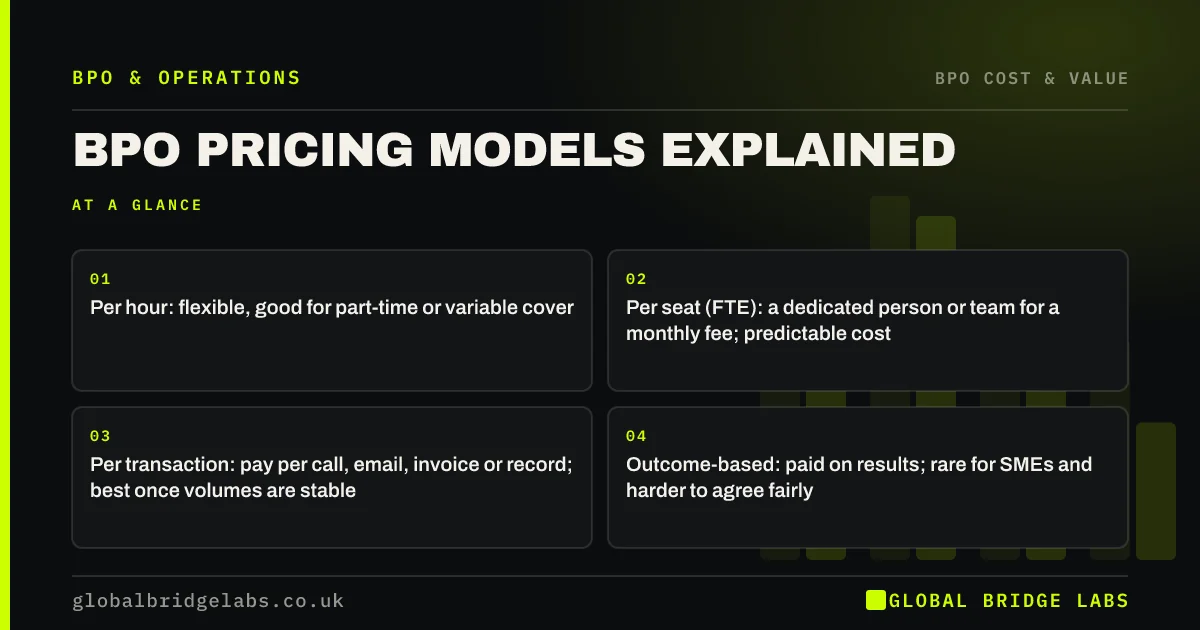
The main BPO pricing models are per hour, per full-time seat (FTE), per transaction and outcome-based. Choose by how predictable your volume is: seats and hours for unpredictable front-office work, per transaction for stable back-office volumes, and outcome-based only when the outcome is easy to measure and mostly in the provider's control.
- Per hour: flexible, good for part-time or variable cover.
- Per seat (FTE): a dedicated person or team for a monthly fee; predictable cost.
- Per transaction: pay per call, email, invoice or record; best once volumes are stable.
- Outcome-based: paid on results; rare for SMEs and harder to agree fairly.
- Check minimum terms, minimum volumes and what happens above forecast.
Unsure which pricing model fits your work? Message us on WhatsApp with your volumes and we will suggest one.
Chat on WhatsApp →What are the main BPO pricing models?
BPO pricing models are the ways a business process outsourcing provider charges for its service. The four common models are time-based (per hour), capacity-based (per full-time-equivalent seat), volume-based (per transaction) and results-based (per outcome). Many contracts combine two, such as a seat fee plus a per-transaction charge above a threshold.
The model shapes behaviour. Pay per hour and you pay for time; pay per transaction and you pay for throughput; pay per outcome and the provider focuses on results. Choose the one whose incentives match what you care about.
When does per-hour pricing make sense?
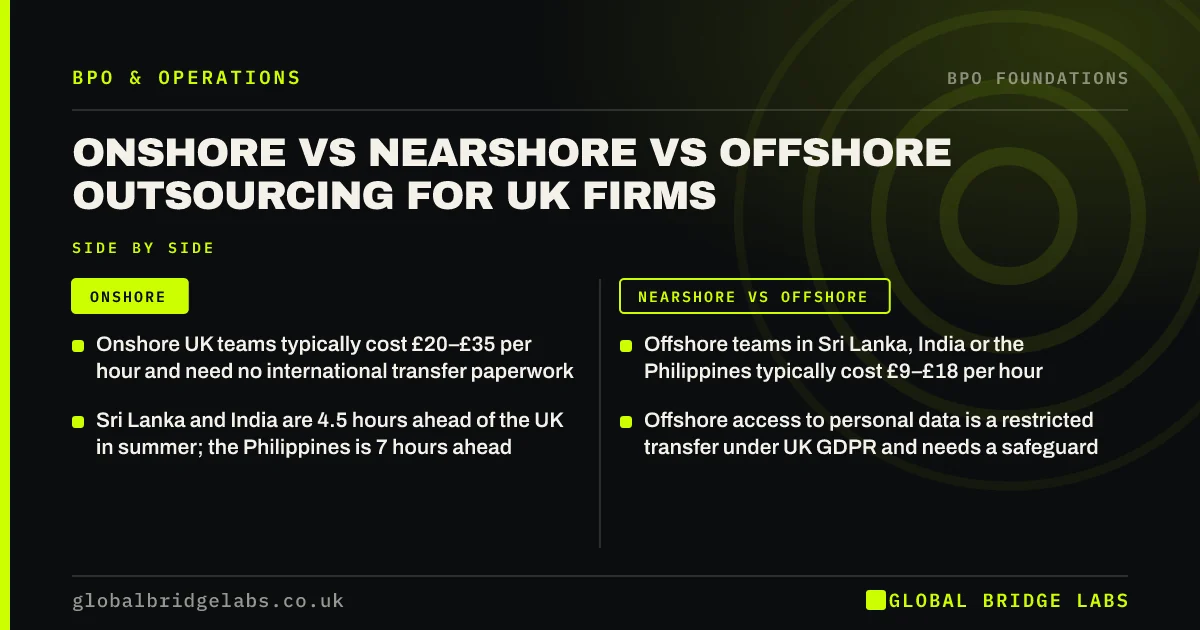
Per-hour pricing makes sense for part-time cover, variable workloads and early engagements where volumes are not yet known. You pay for the hours worked, often with a minimum monthly block. As indicative market ranges, managed offshore hours cost around £9–£18 and onshore UK hours around £20–£35.
The risk is paying for idle time if volumes are low, and the provider having little incentive to work faster. Mitigate with a scorecard that includes throughput.
When does per-seat (FTE) pricing make sense?
Per-seat pricing gives you a dedicated person or team for a fixed monthly fee. It suits steady, full-time workloads such as a support desk covering trading hours, and it is the easiest model to budget. A full-time equivalent (FTE) seat usually means one trained person's working hours, with cover provided when they are away.
The risk is paying for capacity you do not use in quiet periods. Ask whether seats can be flexed monthly.
When does per-transaction pricing make sense?
Per-transaction pricing charges a fixed amount per unit of work: per call, email, invoice, order or record. It suits back-office work with stable, measurable volumes, and it ties cost directly to output. It is also common for message-taking call services.
The risk is quality: a provider paid per unit has an incentive to go fast. Pair it with accuracy targets and sampling. Also agree what counts as one transaction; a customer email thread with five replies might be one or five.
Does outcome-based pricing work for SMEs?
Outcome-based pricing pays the provider for results, such as appointments booked, debts collected or sales made. It sounds attractive but is hard to agree fairly, because outcomes depend on things outside the provider's control, such as your prices, stock and diary availability.
It works best for narrow tasks with clear attribution, such as appointment setting with a qualified definition. For most SME support and admin work, a seat or hourly fee with outcome measures on the scorecard is simpler and fairer.
How do you compare quotes on different models?
Convert every quote into cost per task and cost per month at your expected volume, then at 30% above and below it. That shows which model is cheapest in normal months and which protects you when volumes swing.
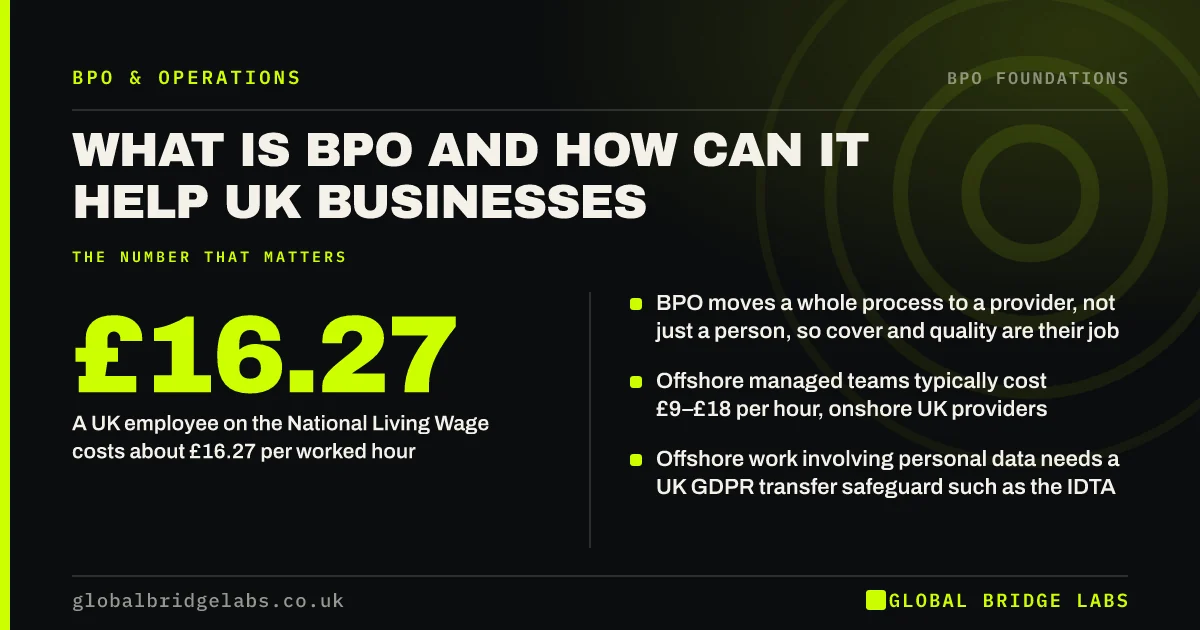
Compare against your in-house cost too. A UK employee on the April 2026 National Living Wage costs about £16.27 per worked hour after employer National Insurance, pension and holiday, before overheads.
Want your quotes converted to cost per task at your real volumes? Send them to us on WhatsApp and we will discuss your requirements.
Chat on WhatsApp →What pricing traps should you check?
Most surprises sit in the terms rather than the rate. Check each of these before signing.
- Minimum term: months you must pay for even if you leave.
- Minimum seats or volumes: charges if you fall below them.
- Overage: price per unit above the forecast.
- Premiums: evenings, weekends and bank holidays.
- Setup and exit fees.
- Annual price increases and how they are calculated.
What does this look like in practice?
At Global Bridge Labs (GBL), engagements are scoped and costed on one page before you commit, on a rolling monthly fee with 30-day terms, so you can scale up or down monthly. That is a deliberate choice: short terms keep the provider focused on earning the next month.
Checklist: choose a pricing model
Work through these for each process.
- Measure volume by week for the last three months.
- Note how much it swings between quiet and busy weeks.
- Decide whether you need dedicated people or flexible capacity.
- Choose seat, hourly or per-transaction pricing to match.
- Add quality and throughput measures whichever model you choose.
- Model cost at expected, low and high volume.
Next step
Tell us your volumes and how they swing, and we will recommend a pricing model and give you a costed plan. 30 minutes, no pitch.
Message us on WhatsApp for a costed plan, or book a 30-minute consultation.
Chat on WhatsApp →Sources and further reading
- National Minimum Wage and National Living Wage rates · GOV.UK
- Rates and thresholds for employers 2026 to 2027 · HM Revenue & Customs
- The Sourcing and Consultancy Playbooks · Cabinet Office
Frequently asked questions
What is FTE pricing in outsourcing?
FTE, or full-time equivalent, pricing charges a fixed monthly fee for one dedicated person's working time, with the provider covering holidays and sickness. It suits steady workloads and is easy to budget. Part-time equivalents, such as 0.5 FTE, are common for smaller businesses.
Is per-transaction pricing cheaper?
It can be when volumes are stable and well defined, because you pay only for output. It can be more expensive when transactions are complex or volumes spike. Always agree what counts as one transaction and pair the price with accuracy targets.
What is the most common BPO pricing model for SMEs?
Per-seat and per-hour pricing are the most common for SMEs, because they are simple, predictable and suit mixed front-office and back-office work. Per-transaction pricing is common for call message-taking and some back-office tasks once volumes are known.
Should I sign a long BPO contract for a lower rate?
Be cautious. A lower rate tied to a 12 or 24-month minimum can cost more if the service disappoints or your needs change. Short rolling terms keep the provider accountable. If you do commit longer, insist on service levels with remedies and a clear exit process.
Written by

Global Bridge Labs (GBL) is a UK–Sri Lanka partner for social media, websites and BPO. Everything here comes from client delivery, not theory.