On this page
Key takeaways
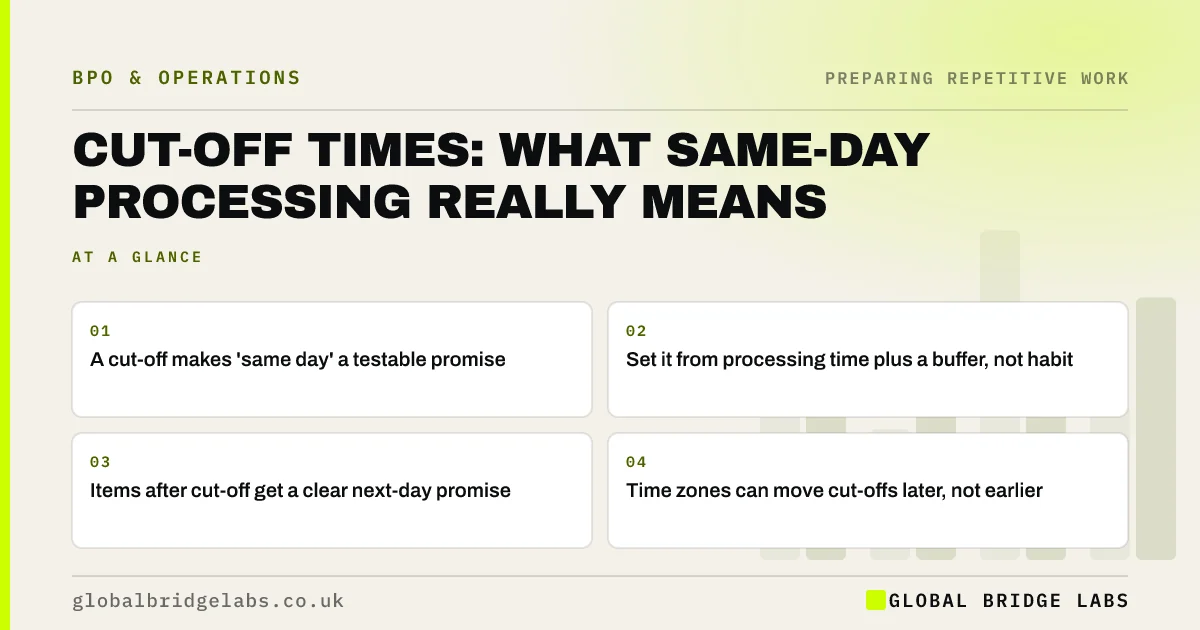
A cut-off time is the latest point at which an item can arrive and still be processed the same day. Setting one for each repetitive task turns a vague 'same day' promise into a rule the team can keep and customers can plan around. With an offshore team, cut-offs also decide which work runs while the UK is closed.
- A cut-off makes 'same day' a testable promise.
- Set it from processing time plus a buffer, not habit.
- Items after cut-off get a clear next-day promise.
- Time zones can move cut-offs later, not earlier.
Want help setting cut-offs for your tasks? Message us on WhatsApp with the turnaround you promise.
Chat on WhatsApp →What is a cut-off time?
A cut-off time is a published deadline for receiving work that will be completed within a stated turnaround. Orders received by 2pm dispatch today; payment requests received by noon are paid in today's run. It protects the team from late-arriving work breaking promises, and tells customers exactly what to expect.
How do you set a cut-off?
Work back from the time the output must leave. Subtract the processing time for a normal batch and a buffer for exceptions, and that is your cut-off. Check it against volumes on your busiest day, not your average one. Publish it, and give items after the cut-off a clear promise for the next working day.
- Start from when the output must leave.
- Subtract batch processing time.
- Subtract a buffer for exceptions.
- Test against the busiest day.
- Publish the cut-off and the next-day rule.
How do time zones change cut-offs?
Sri Lanka is four and a half to five and a half hours ahead of the UK, depending on British Summer Time. A team there can start processing overnight UK work before the UK office opens, so morning outputs are ready at 9am. In an illustrative example, a 5pm UK cut-off for data updates still delivers by 9am next day.
Want to see how overnight processing would change your cut-offs? Send your current deadlines on WhatsApp.
Chat on WhatsApp →When do cut-offs cause problems?
Cut-offs cause problems when they are set too early to be useful, when urgent exceptions have no route around them, or when staff ignore them and promise customers more. Agree an urgent route with a named approver and a limit on how often it is used.
What does this look like in practice?
A pattern we see: a business promises same-day processing with no cut-off, so late items roll into tomorrow without anyone telling the customer. A published cut-off fixes the expectation, and complaints drop even though the work is the same.
Cut-off checklist
Set cut-offs with these checks.
- One cut-off per task with a turnaround promise.
- Calculated from processing time and buffer.
- Tested against the busiest day.
- Published to staff and customers.
- An urgent route with a named approver.
Next step
Send us the turnaround you promise on your main repetitive tasks. We will suggest realistic cut-offs and what an overnight team could add.
Message us on WhatsApp to set your cut-offs, or book a 30-minute consultation.
Chat on WhatsApp →Sources and further reading
- Consumer Rights Act 2015 · legislation.gov.uk
- Maximum weekly working hours · GOV.UK
Frequently asked questions
What does a cut-off time mean?
A cut-off time is the latest time an item can arrive and still be processed within the promised turnaround, usually the same day. Items that arrive later are processed in the next cycle. It turns a general promise into a clear rule for staff and customers.
How do you choose a cut-off time?
Work back from when the output must leave, subtract the time needed to process a normal batch and a buffer for exceptions, and test the result against your busiest day. Publish the cut-off and the promise for items that arrive after it.
Can an offshore team extend cut-off times?
Often, yes. A team several hours ahead of the UK can process work that arrives late in the UK day before the office opens next morning. That can move a cut-off later, as long as the team's working hours and the review step are planned around it.
Written by

Global Bridge Labs (GBL) is a UK–Sri Lanka partner for social media, websites and BPO. Everything here comes from client delivery, not theory.