On this page
Key takeaways
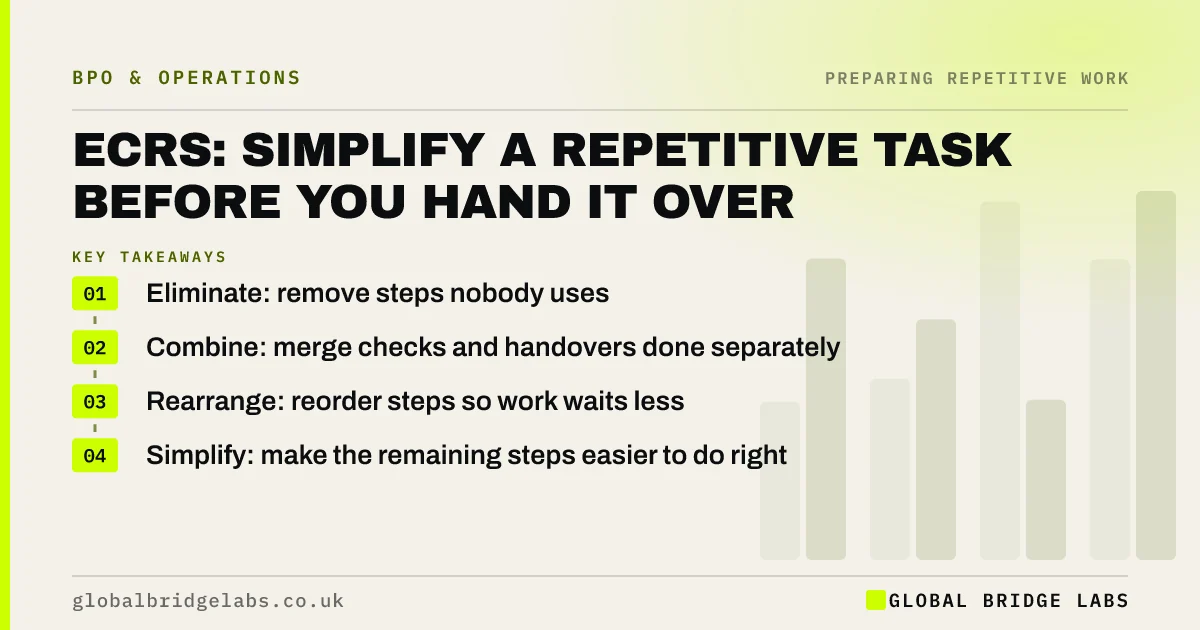
ECRS stands for eliminate, combine, rearrange and simplify, a four-question method from industrial engineering for removing waste from a process. Applied to a repetitive office task before outsourcing, it shrinks the work you pay for and the method you have to explain. Ask the questions in order: the biggest savings come from eliminating steps, not speeding them up.
- Eliminate: remove steps nobody uses.
- Combine: merge checks and handovers done separately.
- Rearrange: reorder steps so work waits less.
- Simplify: make the remaining steps easier to do right.
Want a second pair of eyes on a task before you hand it over? Message us on WhatsApp with the steps.
Chat on WhatsApp →What is the ECRS method?
ECRS is a structured way to question each step of a process. For every step, ask whether it can be eliminated, combined with another, rearranged in sequence or simplified. The method grew out of work-study and lean manufacturing, but it fits office tasks well because most office processes have grown by adding steps rather than redesigning them.
How do you apply ECRS to a repetitive task?
Write the task as a numbered list of steps from trigger to finished output, then ask the four questions of each step with the person who does it. Mark each step keep, remove, merge, move or simplify. Rewrite the method and time it again. Do this before writing the outsourcing method, or you will document waste.
- Eliminate: does anyone use this output or check?
- Combine: are two people checking the same thing?
- Rearrange: can a step happen earlier to avoid waiting?
- Simplify: can a template, field or rule replace effort?
What does ECRS save in numbers?
In an illustrative example, a 14-step supplier invoice task takes 9 minutes per invoice. ECRS removes two unused spreadsheet updates, combines two approvals and adds a coding template, leaving 9 steps at 5 minutes. On 400 invoices a month that is about 27 hours saved before any outsourcing. These are example figures, not a benchmark.
- Standard times: how long should a routine task take?
- Purchase order processing: raise, match and close POs
Want us to run ECRS on one of your tasks with you? Send the steps on WhatsApp.
Chat on WhatsApp →When should you not simplify first?
Skip a full ECRS review when the task is small, already lean, or urgent to hand over because a person has left. In that case, hand over the current method with a note to review it after 30 days, and let the outsourced team suggest simplifications once they have done it a few hundred times.
What does this look like in practice?
A pattern we see: the step everyone treats as essential turns out to exist because of a problem fixed years ago. Asking who uses each output is the quickest way to find those steps.
ECRS checklist
Run these checks on the task you plan to hand over.
- Write every step from trigger to output.
- Ask who uses each output and check.
- Merge duplicate checks and approvals.
- Move steps to cut waiting.
- Add templates and rules to simplify.
- Time the new method before writing it up.
Next step
Send us the steps of one repetitive task. We will go through ECRS with you and say plainly what to remove before anyone is paid to do it.
Message us on WhatsApp to simplify a task, or book a 30-minute consultation.
Chat on WhatsApp →Sources and further reading
- Labour productivity · Office for National Statistics
- Human factors: managing human failures · Health and Safety Executive
Frequently asked questions
What does ECRS stand for?
ECRS stands for eliminate, combine, rearrange and simplify. It is a process improvement method from industrial engineering that asks those four questions of every step in a process, in that order, to remove waste before trying to make the remaining work faster.
Why simplify a task before outsourcing it?
Because you pay for every step and have to explain every step. Removing unused steps and merging duplicate checks reduces the hours bought, shortens the written method and lowers the chance of errors during handover. It also shows which parts genuinely need judgement.
Can an outsourced team help simplify a process?
Yes, and a good one will. After a few hundred repetitions a dedicated team sees which steps add nothing and which inputs cause rework. Ask for improvement suggestions in each monthly review and agree who approves changes to the method.
Written by

Global Bridge Labs (GBL) is a UK–Sri Lanka partner for social media, websites and BPO. Everything here comes from client delivery, not theory.