On this page
- 01Key takeaways
- 02What are the most common mistakes?
- 03Why does an unwritten method cause failure?
- 04Why does moving too much at once fail?
- 05Why do you need an in-house owner?
- 06When is outsourcing the mistake itself?
- 07What does this look like in practice?
- 08Mistake-avoidance checklist
- 09Next step
- 10Sources and further reading
- 11Frequently asked questions
Key takeaways
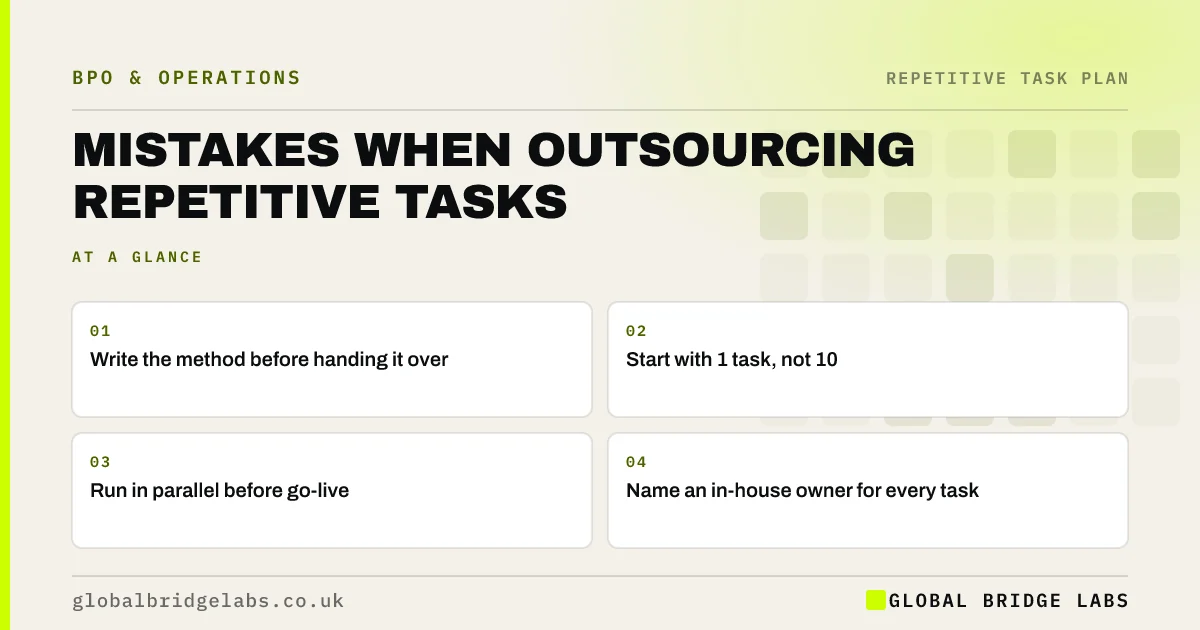
Most failures in outsourcing repetitive tasks come from the handover, not the team. The common mistakes are handing over an unwritten method, outsourcing too many tasks at once, skipping the parallel run, leaving no in-house owner and judging the work on hours rather than accuracy and turnaround. Each has a simple fix that costs little up front.
- Write the method before handing it over.
- Start with 1 task, not 10.
- Run in parallel before go-live.
- Name an in-house owner for every task.
Had a handover that went wrong? Message us on WhatsApp and we will help you work out why.
Chat on WhatsApp →What are the most common mistakes?
The same mistakes appear across sectors and task types. Most come from rushing the start because the in-house team is already overloaded.
- Handing over a method that lives in one person's head.
- Moving several tasks in the same week.
- Going live without a parallel run.
- No named owner in your business.
- Measuring hours instead of accuracy and turnaround.
- Never stepping down the quality checks.
Why does an unwritten method cause failure?
Because the outsourced team learns the method by making mistakes, and every mistake is visible to you. The person who knew the method spends weeks answering questions, and decides outsourcing does not work. Writing the method, rules and exceptions first takes a few hours and saves weeks.
Why does moving too much at once fail?
When several tasks move together, problems overlap and nobody can tell which method, rule or input caused them. In an illustrative example, moving five tasks in one week produces dozens of queries; moving one task a fortnight produces a few each time. These are example figures. One stable task builds the method for the rest.
Planning to move several tasks? Send us the list on WhatsApp and we will suggest an order.
Chat on WhatsApp →Why do you need an in-house owner?
Someone in your business must answer questions, approve exceptions, review samples and agree method changes. Without that person, queries wait, exceptions pile up and quality drifts. The owner's time falls quickly once the task is stable, usually to an hour or two a week.
When is outsourcing the mistake itself?
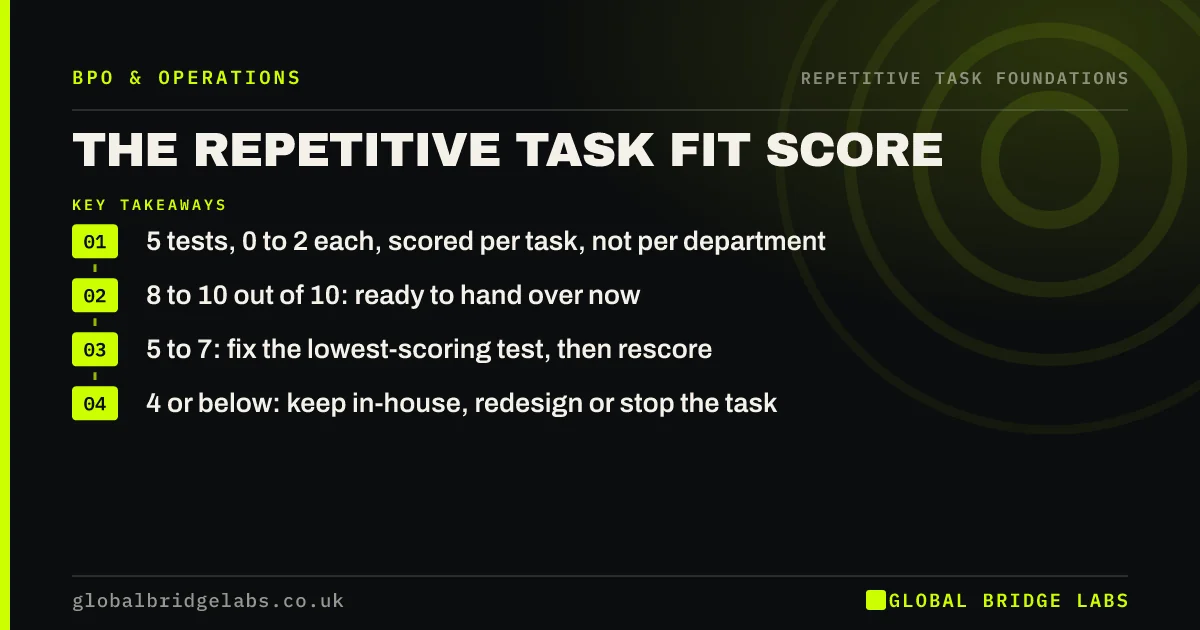
Outsourcing is the wrong move when the task scores low on the fit score, when it is quicker to do yourself, or when the real problem is a process nobody has agreed. Fix or stop the task first. Sometimes the right outcome of the review is to keep the task in-house.
What does this look like in practice?
A pattern we see: a business tries outsourcing once, hands over three tasks with no written method, and concludes it does not work. The second attempt, one written task with a parallel run, succeeds with the same type of team.
Mistake-avoidance checklist
Check these before any handover.
- Method, rules and exceptions written.
- Only one task moving now.
- Parallel run planned.
- Named owner with time set aside.
- Accuracy and turnaround targets agreed.
- Step-down rule for quality checks.
Next step
Tell us which task you plan to hand over and how. We will check the plan against these mistakes and say plainly what to change.
Message us on WhatsApp to review your handover plan, or book a 30-minute consultation.
Chat on WhatsApp →Sources and further reading
- Contracts and liabilities between controllers and processors · Information Commissioner's Office
- Human factors: managing human failures · Health and Safety Executive
Frequently asked questions
Why does outsourcing admin tasks sometimes fail?
Usually because of the handover: the method was never written down, too many tasks moved at once, there was no parallel run, nobody in-house owned the task, or success was judged on hours rather than accuracy and turnaround. Each is avoidable with a few hours of preparation.
How many tasks should you outsource at once?
One, at least at first. Get the first task stable, with a written method, scorecard and settled quality checks, then add the next one. Moving tasks one at a time makes problems easy to trace and builds a method you can reuse.
How do you recover from a bad outsourcing handover?
Pause new tasks, write down the method for the task that went wrong, agree targets, run a short parallel period and name an owner. Most failed handovers recover once the method and ownership are clear, whoever does the work.
Written by

Global Bridge Labs (GBL) is a UK–Sri Lanka partner for social media, websites and BPO. Everything here comes from client delivery, not theory.