On this page
Key takeaways
Food businesses must give accurate information on the 14 major allergens, and food prepacked for direct sale needs full ingredient labels. Keeping that information right is a repetitive admin routine: checking supplier specification changes, updating the allergen matrix, reprinting menus and labels and telling staff. The safety decisions stay with the food business operator.
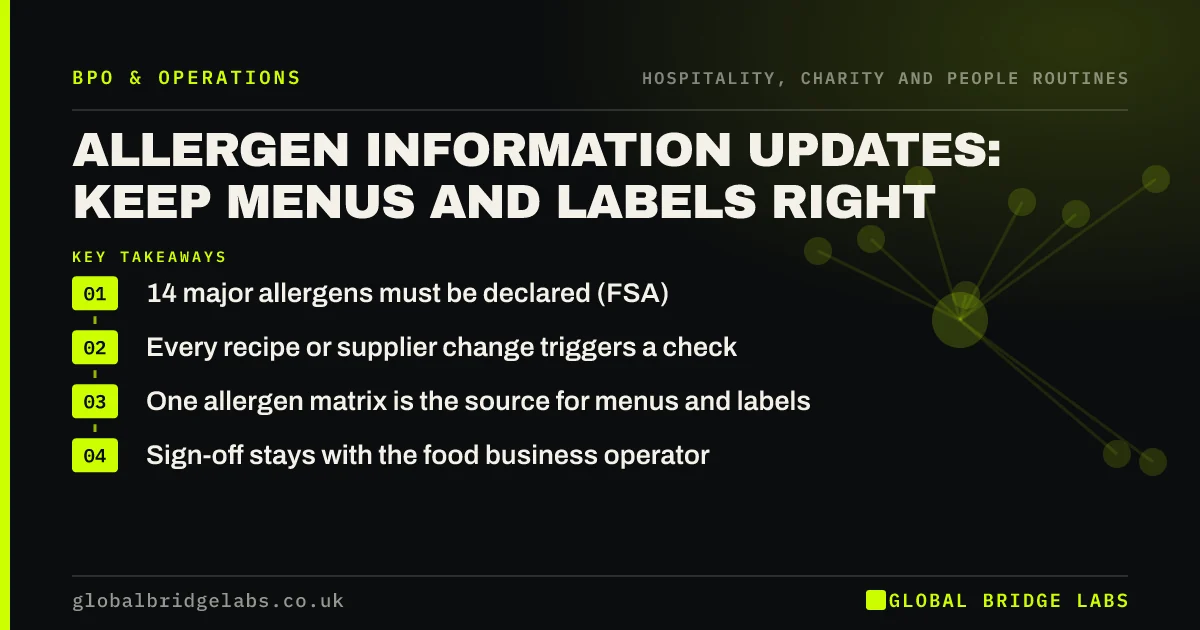
- 14 major allergens must be declared (FSA).
- Every recipe or supplier change triggers a check.
- One allergen matrix is the source for menus and labels.
- Sign-off stays with the food business operator.
Menus changing faster than your allergen records? Message us on WhatsApp with your number of dishes.
Chat on WhatsApp →Why does allergen information go out of date?
It goes out of date when a supplier changes a product, a chef swaps an ingredient or a new dish is added, and the matrix is not updated at the same time. The Food Standards Agency expects businesses to manage allergen information accurately, including for food sold online or by phone.
What does the update routine involve?
Keep one allergen matrix linked to recipes and supplier specifications. When anything changes, check the specification, update the matrix, update menus, labels and online listings, and brief staff. Review all supplier specifications on a fixed cycle as well, because changes are not always announced.
- Supplier specifications collected and filed.
- Matrix updated for every recipe change.
- Menus, labels and online menus regenerated.
- Staff briefed on changes.
- Full specification review each quarter.
What does the routine take?
In an illustrative example, a restaurant group with 80 dishes and seasonal menu changes spends about 3 to 5 hours a month checking specifications and updating records, more in a menu change month. These are example figures. The cost of a mistake is far higher: a customer reaction and enforcement action.
Send us your dish count and menu cycle on WhatsApp and we will estimate the routine with you.
Chat on WhatsApp →What must stay with the kitchen?
Recipe decisions, cross-contamination controls and final sign-off of allergen information must stay with the food business operator and kitchen team. A support team can collect specifications, maintain the matrix and prepare menus and labels for sign-off, but must never assume an ingredient is allergen-free.
What does this look like in practice?
A pattern we see: a supplier substitutes a sauce with a different recipe, and the matrix is never updated. A rule that every delivery substitution triggers a specification check closes that gap.
Allergen update checklist
Run the routine with these points.
- One matrix for all dishes.
- Specifications on file for every ingredient.
- Check triggered by any change.
- Menus and labels regenerated from the matrix.
- Operator sign-off recorded.
Next step
Send us how allergen information is kept today. We will suggest a routine and say plainly what a team could maintain for your sign-off.
Message us on WhatsApp about allergen updates, or book a 30-minute consultation.
Chat on WhatsApp →Sources and further reading
- Allergen guidance for food businesses · Food Standards Agency
- Running a limited company: company and accounting records · GOV.UK
Frequently asked questions
What are the 14 major allergens?
The 14 major allergens under UK food law are celery, cereals containing gluten, crustaceans, eggs, fish, lupin, milk, molluscs, mustard, tree nuts, peanuts, sesame, soya and sulphur dioxide above a set level. Food businesses must give information about these when they are used as ingredients.
How often should allergen information be updated?
Every time a recipe, ingredient or supplier product changes, with a full review of supplier specifications on a fixed cycle, such as quarterly. Accurate information must be available for every dish at all times, including for food ordered online or by phone.
Can allergen admin be outsourced?
The record-keeping can be: collecting specifications, maintaining the matrix and preparing menus and labels. Recipe decisions, cross-contamination controls and final sign-off must stay with the food business operator, and nothing should be marked allergen-free without verified information.
Written by

Global Bridge Labs (GBL) is a UK–Sri Lanka partner for social media, websites and BPO. Everything here comes from client delivery, not theory.