On this page
Key takeaways
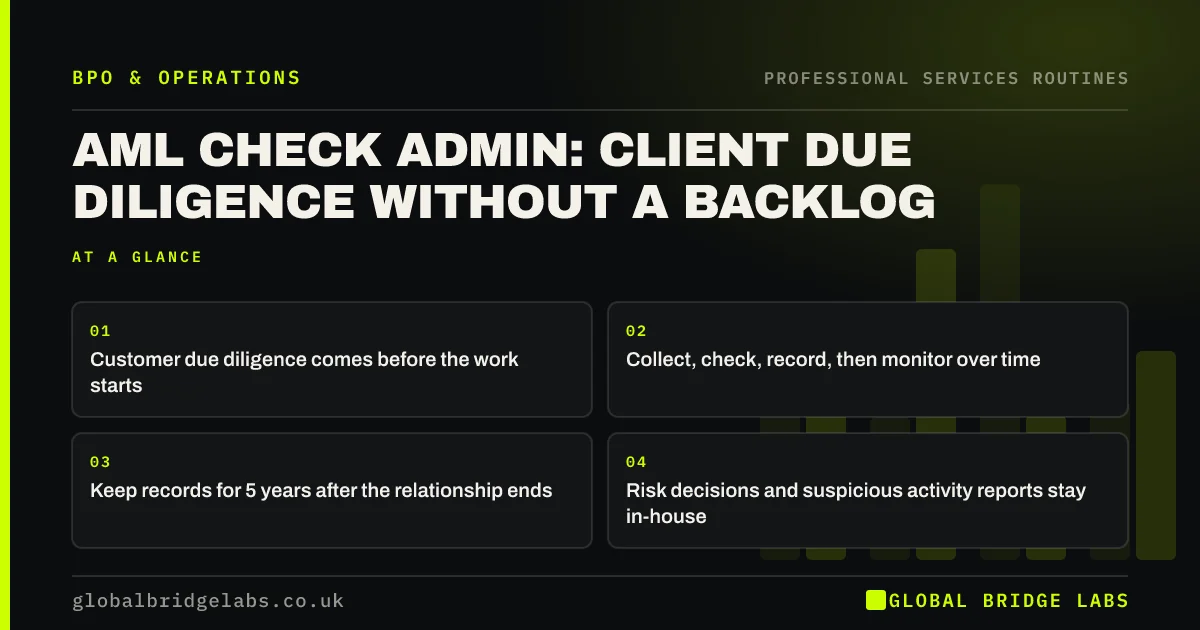
Under the Money Laundering Regulations 2017, regulated firms such as accountants, conveyancers and estate agents must carry out customer due diligence before taking on clients and keep it current. Collecting documents, running electronic checks, chasing missing items and filing records is repetitive admin. The risk assessment and any reporting decision must stay with your firm.
- Customer due diligence comes before the work starts.
- Collect, check, record, then monitor over time.
- Keep records for 5 years after the relationship ends.
- Risk decisions and suspicious activity reports stay in-house.
New clients waiting on ID checks? Message us on WhatsApp with your monthly onboarding volume.
Chat on WhatsApp →What does AML check admin involve?
It involves requesting identity and address evidence, running electronic verification, checking company ownership for business clients, screening for politically exposed persons and sanctions, recording the results and risk rating, chasing missing documents and refreshing checks when circumstances change. HMRC and professional bodies supervise firms for compliance.
Which steps can a support team run?
A support team can run the collection and checking steps under your firm's written policy, acting as your processor. Your firm remains responsible for compliance and must make the risk judgement. Under the regulations, firms can rely on certain third parties in limited circumstances, but responsibility stays with the firm.
- Request and chase identity documents.
- Run electronic verification and screening.
- Check company ownership and controllers.
- Record results in the client file.
- Flag anything outside policy to the MLRO.
What does the backlog cost?
In an illustrative example, an accountancy practice onboards 25 clients a month and each check takes about 45 minutes including chasing. That is around 19 hours a month, usually by qualified staff. These are example figures. Work cannot start until checks are complete, so a backlog delays fees as well as using senior time.
- Self Assessment preparation support for accountants
- How to improve efficiency in an accountancy practice
Send us your onboarding volume on WhatsApp and we will estimate the routine with you.
Chat on WhatsApp →What must stay with your firm?
The firm-wide risk assessment, each client's risk rating, the decision to accept or decline a client, enhanced due diligence decisions and any suspicious activity report must stay with your firm and your money laundering reporting officer (MLRO). Never ask a support team to decide whether something is suspicious.
What does this look like in practice?
A pattern we see: partners run ID checks themselves because they think nobody else is allowed to. A written policy separating the admin from the judgement lets a team do the chasing while partners make the decisions.
AML admin checklist
Run the routine with these points.
- Written CDD policy and procedures.
- Standard document request for each client type.
- Checks recorded in the client file.
- Exceptions flagged to the MLRO.
- Refresh dates tracked for ongoing monitoring.
Next step
Send us your current onboarding steps. We will help you separate the admin from the judgement and say plainly what a support team could run.
Message us on WhatsApp about AML check admin, or book a 30-minute consultation.
Chat on WhatsApp →Sources and further reading
- The Money Laundering, Terrorist Financing and Transfer of Funds Regulations 2017 · legislation.gov.uk
- Money Laundering Regulations: your responsibilities · HM Revenue & Customs
- Contracts and liabilities between controllers and processors · Information Commissioner's Office
Frequently asked questions
Can AML checks be outsourced?
The admin can be: collecting documents, running electronic verification and screening, and recording results under your written policy. Your firm stays responsible for compliance, and the risk assessment, client acceptance and any suspicious activity report must remain with your firm and its MLRO.
How long must AML records be kept?
Under the Money Laundering Regulations 2017, records of customer due diligence and supporting evidence must generally be kept for five years after the business relationship ends or the occasional transaction is completed. Check your supervisor's guidance for detail and exceptions.
Who supervises AML compliance for small firms?
It depends on the sector. HMRC supervises many businesses, including estate agents and some accountancy service providers, while professional bodies supervise their members, such as accountancy bodies and the SRA for solicitors. Check which supervisor covers your firm.
Written by

Global Bridge Labs (GBL) is a UK–Sri Lanka partner for social media, websites and BPO. Everything here comes from client delivery, not theory.