On this page
Key takeaways
A decision table lists the conditions that matter for a recurring decision and the action for each combination. It turns a judgement call made the same way many times into a rule anyone can apply. For outsourcing, it is the single most useful document after the method itself, because it shows the team what to decide and what to refer.
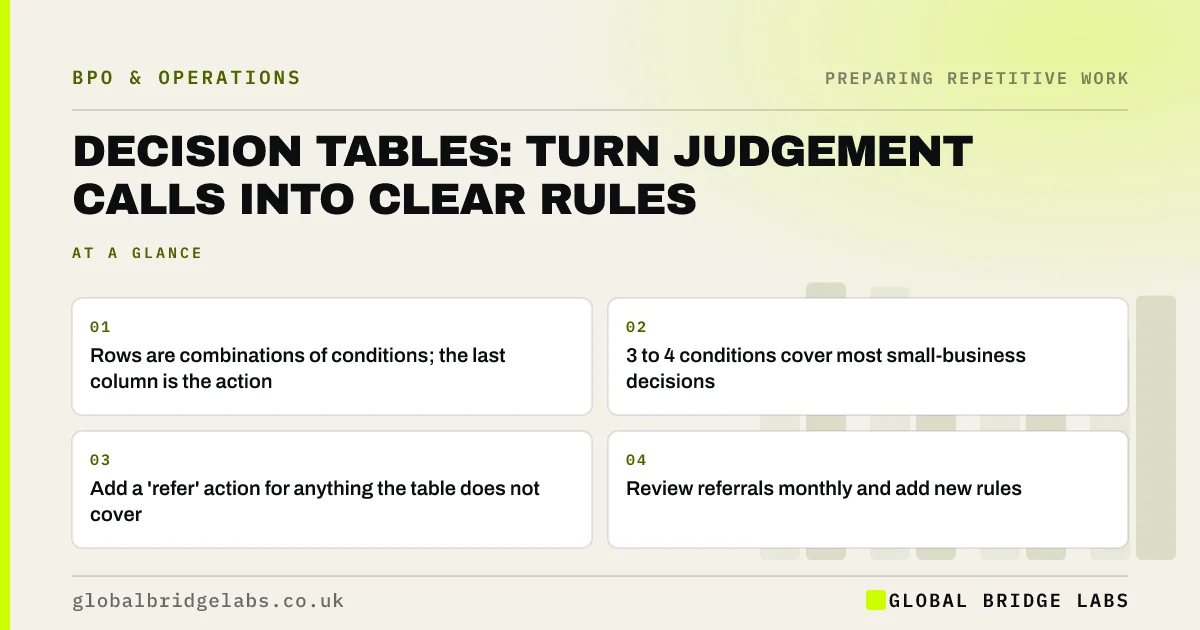
- Rows are combinations of conditions; the last column is the action.
- 3 to 4 conditions cover most small-business decisions.
- Add a 'refer' action for anything the table does not cover.
- Review referrals monthly and add new rules.
Want help turning a judgement call into a table? Message us on WhatsApp with the decision.
Chat on WhatsApp →What is a decision table?
A decision table is a grid that maps conditions to actions. Each column before the last is a condition, such as order value or customer history; each row is a combination; the final column says what to do. It replaces 'use your judgement' with a rule that can be checked, which is what lets a dedicated team handle the decision consistently.
How do you write one?
Start with the last 20 to 30 times the decision was made and note what the decider looked at. Those factors become your conditions. Give each a few simple values, write the action for each combination, and add a final row that refers anything unusual to a named person. Test the table against past decisions before using it.
- Collect 20 to 30 past decisions and their reasons.
- Choose 3 to 4 conditions with simple values.
- Write the action for each combination.
- Add a refer row and a named person.
- Test against past cases, then go live.
What does a decision table look like?
In an illustrative refund table, the conditions are order value (under or over £150), days since delivery (within 30 or not) and prior refunds (none or one or more). Under £150, within 30 days and no prior refunds: approve. Over £150 or prior refunds: refer. These are example thresholds; set your own from past cases.
- Under £150, within 30 days, no prior refund: approve.
- Under £150, after 30 days: offer a credit note.
- Over £150, any timing: refer to the manager.
- Any prior refund in 90 days: refer.
- Refund processing: fast, fair and correctly recorded
- Warranty claims admin: log, check and resolve faster
Want a decision table drafted from your past cases? Send them on WhatsApp.
Chat on WhatsApp →When does a decision table not help?
A table does not help when the decision is rare, when the factors change each time, or when the law requires a named person to decide, such as a suspicious activity report under money laundering rules. In those cases have the team prepare the facts and keep the decision in-house.
What does this look like in practice?
A pattern we see: writing the table exposes that two managers have been deciding the same case differently. Agreeing one rule improves consistency for customers before any work is handed over.
Decision table checklist
Check your table against these points.
- Every condition has clear, testable values.
- Every combination has one action.
- There is a refer row with a named person.
- The table matches at least 20 past decisions.
- Referrals are reviewed monthly.
Next step
Send us one recurring decision and a few past examples. We will help you draft the table and the referral rule.
Message us on WhatsApp to write a decision table, or book a 30-minute consultation.
Chat on WhatsApp →Sources and further reading
- Consumer Rights Act 2015 · legislation.gov.uk
- The Money Laundering, Terrorist Financing and Transfer of Funds Regulations 2017 · legislation.gov.uk
Frequently asked questions
What is a decision table used for?
A decision table is used to make a recurring decision consistently. It lists the conditions that matter and the action for each combination, so anyone trained on it reaches the same answer. In outsourcing it tells the team which cases to decide and which to refer.
How many conditions should a decision table have?
Most small-business decisions need three or four conditions with two or three values each. More than that and the table becomes hard to read and maintain. If a decision needs many more factors, it may be a genuine judgement call that should stay in-house.
What happens when a case is not in the table?
It goes to the refer row: the team passes it to a named person with the facts, within an agreed turnaround. Review referred cases each month. If the same kind of case keeps appearing, add a new row so the team can handle it next time.
Written by

Global Bridge Labs (GBL) is a UK–Sri Lanka partner for social media, websites and BPO. Everything here comes from client delivery, not theory.