On this page
- 01Key takeaways
- 02What is cost per task?
- 03How do you calculate cost per task?
- 04What does a worked example look like?
- 05Why is cost per task better than comparing salaries?
- 06Which tasks should you measure first?
- 07How do outsourced providers price per task?
- 08Where does cost per task mislead?
- 09How do you track cost per task over time?
- 10What does this look like in practice?
- 11Cost per task checklist
- 12Next step
- 13Sources and further reading
- 14Frequently asked questions
Key takeaways
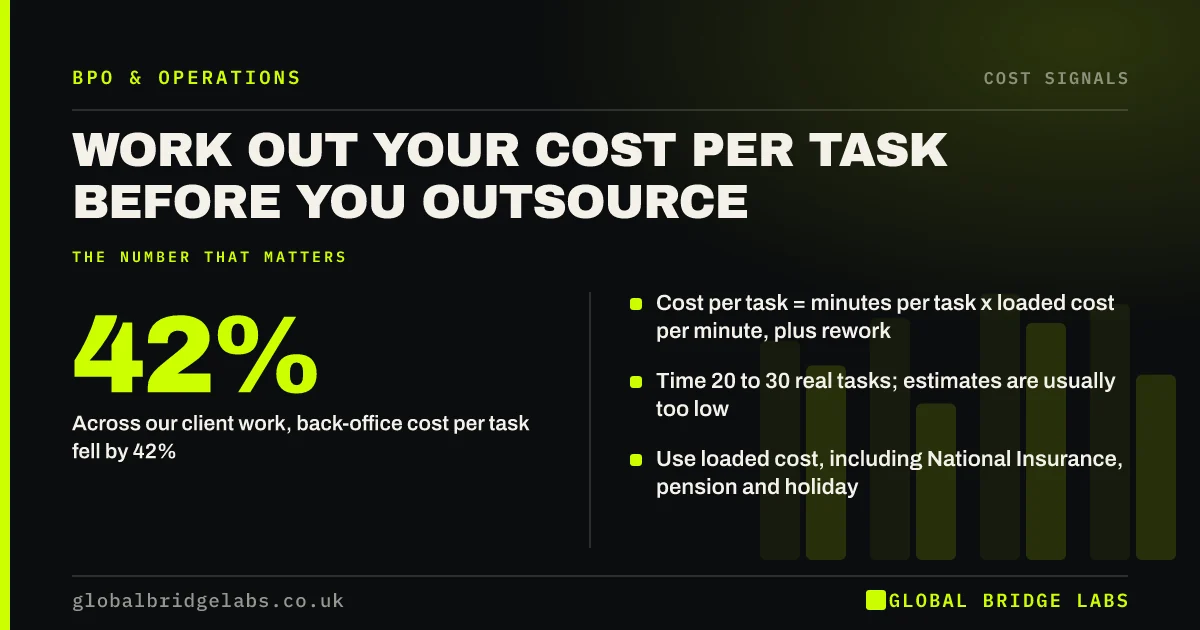
How to calculate cost per task: multiply the average minutes per task by the loaded cost per minute of whoever does it, then add rework and chasing. It turns vague admin into a number you can compare with an outsourced quote. Across our client work, back-office cost per task has fallen by 42% once the process was documented and run by a managed team.
- Cost per task = minutes per task x loaded cost per minute, plus rework.
- Time 20 to 30 real tasks; estimates are usually too low.
- Use loaded cost, including National Insurance, pension and holiday.
- Across our client work, back-office cost per task fell by 42%.
Want help working out your cost per task? Message us on WhatsApp.
Chat on WhatsApp →What is cost per task?
Cost per task is the full cost of completing one unit of work, such as processing an invoice, answering an email or booking an appointment. It combines the time taken with the loaded cost of the person doing it. It is the fairest way to compare in-house work with outsourcing, because it measures output rather than salaries.
How do you calculate cost per task?
Use four steps. Time a sample of real tasks, find the loaded hourly cost of the person, convert it to a cost per minute, and multiply. Then add the time spent on errors, rework and chasing, spread across all tasks.
- Time 20 to 30 real tasks and take the average minutes.
- Find the loaded hourly cost of whoever does them.
- Divide by 60 to get the cost per minute.
- Multiply average minutes by cost per minute.
- Add rework: minutes spent fixing errors, divided across all tasks.
What does a worked example look like?
An office manager on £32,000 a year costs about £37,000 with on-costs, or roughly £21 per worked hour, which is 35p a minute. Processing a supplier invoice takes 8 minutes, plus 2 minutes of rework on average. The cost per invoice is about £3.50. At 600 invoices a month, that is £2,100.
The same task done by a managed team at an indicative £12 per hour, at 10 minutes each, costs about £2 per invoice. The gap grows if the in-house work sits with the owner.
Send us one task and its volume on WhatsApp and we will compare the cost per task.
Chat on WhatsApp →Why is cost per task better than comparing salaries?
Salaries hide how work is actually done. A cheaper person who takes twice as long, or a skilled person doing admin between other jobs, looks fine on a salary list but expensive per task. Cost per task also exposes rework, which is often a quarter or more of admin time in undocumented processes.
Which tasks should you measure first?
Measure the high-volume tasks first: emails answered, calls handled, invoices raised, orders entered, appointments booked and records updated. They are the most likely outsourcing candidates and small savings multiply across hundreds of tasks a month.
How do outsourced providers price per task?
Some providers charge per transaction, such as per invoice or per order, while most charge per hour or per seat. Per-task pricing makes comparison easy but needs a clear definition of a task and its standard. Hourly pricing is simpler to start with; convert it to a cost per task using the provider's expected handling time.
Where does cost per task mislead?
It misleads when quality differs. A task done faster but wrongly costs more once the fix is counted. It also ignores value: a sales enquiry answered in five minutes may be worth far more than its cost. Pair cost per task with an accuracy measure and, for customer contact, a speed measure.
How do you track cost per task over time?
Measure it once as a baseline, then recalculate every quarter using the same method. Volume and hours usually come from your systems; handling time can be re-sampled with a small batch of timed tasks. A falling cost per task shows the process is improving, whoever runs it. A rising one is an early warning of rework or complexity creeping in.
- Baseline: cost per task before any change.
- Quarterly: re-sample 20 tasks and recalculate.
- Track rework minutes separately from first-time handling.
- Compare in-house and outsourced numbers on the same basis.
What does this look like in practice?
A pattern we see in UK wholesalers: the finance lead says invoice processing is cheap because the administrator is on a modest salary. Timing 30 invoices shows 12 minutes each including matching queries, and the true cost per invoice is double the estimate. That number, not the salary, makes the case for moving the process.
Cost per task checklist
Use these steps for each process.
- Pick one high-volume task.
- Time 20 to 30 real examples.
- Calculate the loaded cost per minute.
- Add rework and chasing time.
- Multiply by monthly volume.
- Compare with an outsourced quote converted to cost per task.
Next step
Send us a task, its volume and who does it. We will help you calculate the cost per task and compare it with a managed team.
Message us on WhatsApp with your task, or book a 30-minute consultation.
Chat on WhatsApp →Sources and further reading
- Rates and thresholds for employers 2026 to 2027 · HM Revenue & Customs
- Workplace pensions: what you, your employer and the government pay · GOV.UK
- Holiday entitlement · GOV.UK
Frequently asked questions
How do you calculate the cost of an admin task?
Time 20 to 30 real examples to get average minutes, convert the loaded hourly cost of whoever does it to a cost per minute, multiply, then add time spent on rework and chasing. Multiply by monthly volume to see the total cost of that task.
What is a good cost per invoice processed?
It depends on complexity and who does it. Simple supplier invoices handled by a managed team often cost a few pounds each; the same invoice handled by a senior person with queries can cost several times more. Measure your own number before comparing.
Why measure cost per task instead of salary?
Because salary ignores speed, rework and who is doing the work. Cost per task shows the real price of each unit of output, so you can compare in-house and outsourced options fairly and see where errors are inflating the cost.
Written by

Global Bridge Labs (GBL) is a UK–Sri Lanka partner for social media, websites and BPO. Everything here comes from client delivery, not theory.