On this page
- 01Key takeaways
- 02What are core and non-core activities?
- 03How do you tell core from non-core?
- 04Why does core vs non-core matter for cost?
- 05Which activities are usually non-core?
- 06Can a non-core activity become core?
- 07Should you ever outsource core work?
- 08How do you map core and non-core work in one session?
- 09What does this look like in practice?
- 10Core vs non-core checklist
- 11Next step
- 12Sources and further reading
- 13Frequently asked questions
Key takeaways
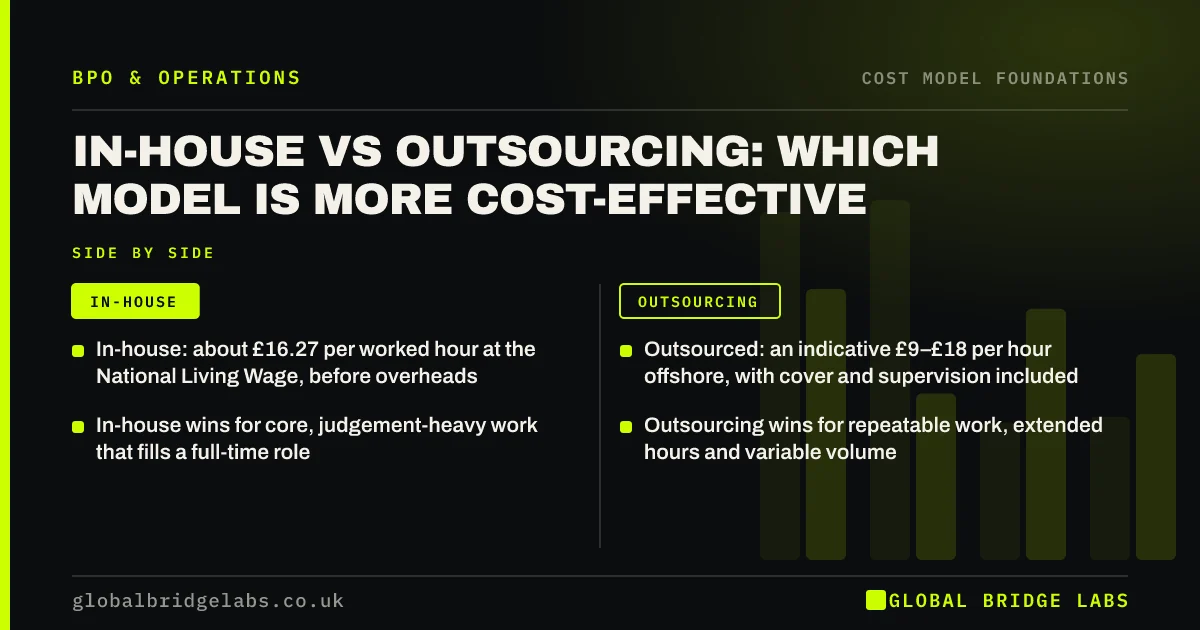
Core vs non-core activities is the test of what makes customers choose you. Core activities create your advantage and belong in-house. Non-core activities are necessary but done the same way by every business, so they are the most cost-effective to outsource. Sort activities before comparing any costs.
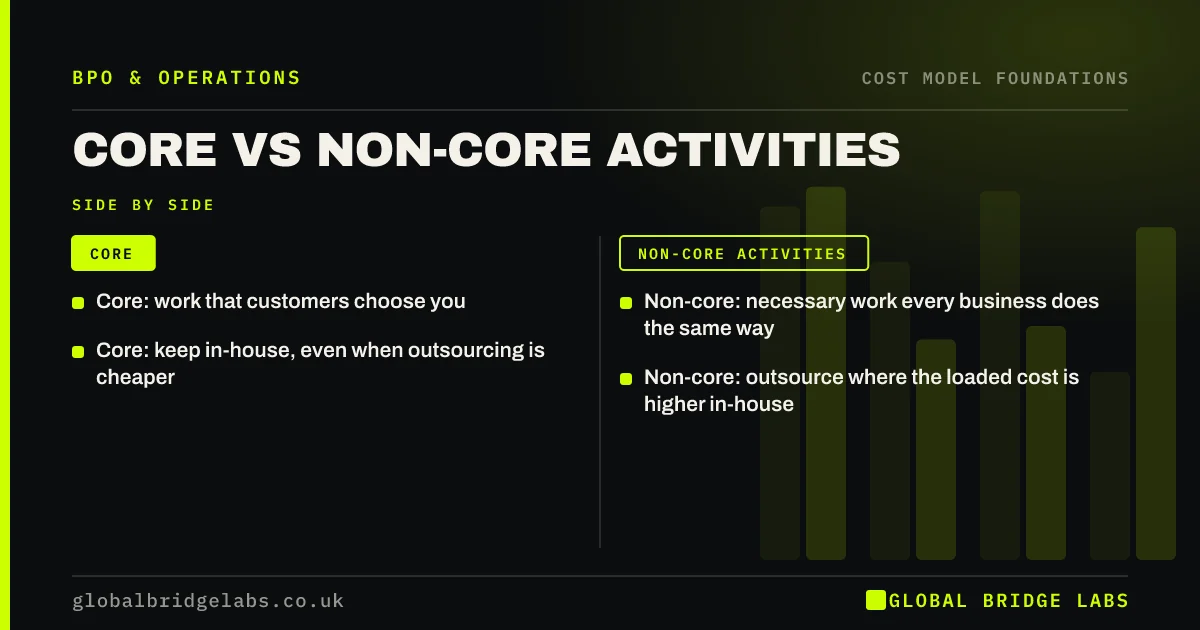
- Core: work that customers choose you for.
- Non-core: necessary work every business does the same way.
- Core: keep in-house, even when outsourcing is cheaper.
- Non-core: outsource where the loaded cost is higher in-house.
Want help sorting your activities into core and non-core? Message us on WhatsApp.
Chat on WhatsApp →What are core and non-core activities?
Core activities are the functions that create your competitive advantage, such as your product, expertise, pricing and key relationships. Non-core activities are functions every business needs but that do not set you apart, such as data entry, invoicing, first-line support and diary management. Both matter; only core activities differentiate.
How do you tell core from non-core?
Ask three questions of each activity. Would customers notice or care if a competent provider did it? Does it rely on knowledge only your business has? Would doing it better win you more customers? If the answers are no, it is probably non-core.
- Customer noticing: would anyone choose you less if a provider did it well?
- Unique knowledge: does it depend on context only you have?
- Advantage: would doing it better win more business?
Why does core vs non-core matter for cost?
Non-core work done in-house often sits with expensive people. When a £45,000 manager, costing about £29.98 per worked hour, spends 10 hours a week on admin, that is about £13,900 a year of senior time on work an outsourced team could do for £9–£18 an hour. Moving it frees capacity for core work.
Want the cost of your non-core hours worked out? Send us the roles on WhatsApp.
Chat on WhatsApp →Which activities are usually non-core?
For most UK SMEs, the following are non-core and strong outsourcing candidates, because they follow rules and can be measured.
- Data entry and CRM updates.
- Invoicing, credit control and supplier admin.
- First-line customer email, chat and phones.
- Appointment booking and diary management.
- Order processing and returns admin.
- Routine reporting and document chasing.
Can a non-core activity become core?
Yes. Customer service is non-core for many firms but core for a brand that wins on service. The test is your strategy, not the function's name. If fast, personal service is why customers pay more, keep the parts that deliver it in-house and outsource only overflow or out-of-hours cover.
Should you ever outsource core work?
Rarely, and only parts of it. You might outsource specialist execution, such as software development, while keeping product ownership in-house. The rule is to keep decisions and relationships in-house and buy capacity, not the other way round.
How do you map core and non-core work in one session?
A two-hour workshop with the people who do the work is usually enough. List every recurring activity on a whiteboard or spreadsheet, note who does it and the hours per week, and ask the three core questions for each. Then sort into core, non-core and unsure.
The unsure pile is the interesting one. It often hides activities that are core in part: for example, complaint handling where the first response is routine but the resolution needs judgement. Split those into their routine and judgement parts.
What does this look like in practice?
A pattern we see in UK mortgage brokerages: advisers spend a large share of their week chasing documents and updating case notes. Advice and client relationships are core; chasing and data entry are not. Moving the non-core work to a managed team lets advisers see more clients without adding headcount.
Core vs non-core checklist
Use this list with your team.
- List every recurring activity and who does it.
- Ask the three core questions for each.
- Estimate the hours and loaded cost of non-core work.
- Flag non-core work done by senior or expensive staff.
- Choose one non-core process to move first.
Next step
Send us your activity list. We will help you sort it into core and non-core, and cost the non-core work in-house and outsourced, in a 30-minute call.
Message us on WhatsApp to sort core from non-core, or book a 30-minute consultation.
Chat on WhatsApp →Sources and further reading
- Rates and thresholds for employers 2026 to 2027 · HM Revenue & Customs
- Workplace pensions: what you, your employer and the government pay · GOV.UK
- The Sourcing and Consultancy Playbooks · Cabinet Office
Frequently asked questions
What are examples of non-core business activities?
Data entry, invoicing, credit control, first-line customer support, appointment booking, order processing, CRM updates and routine reporting. They are necessary for the business to run, but most businesses do them the same way, so doing them slightly better rarely wins customers on its own.
Why outsource non-core activities?
Because they are often done by expensive in-house staff, need holiday and sickness cover, and fluctuate in volume. Outsourcing them lowers cost per task and frees your team for the core work that wins and keeps customers, such as selling, delivery, advice and product improvement.
Is customer service core or non-core?
It depends on your strategy. For most SMEs, first-line support is non-core and can be outsourced to a managed team. If exceptional service is the reason customers choose you, keep the key parts in-house and outsource only overflow, routine questions and out-of-hours cover.
What is a core competency?
A core competency is a capability that gives a business its advantage and is hard for competitors to copy, such as specialist expertise, a trusted relationship or a unique process. Core competencies belong in-house, and time spent on non-core work should be reduced so more goes into them.
Written by

Global Bridge Labs (GBL) is a UK–Sri Lanka partner for social media, websites and BPO. Everything here comes from client delivery, not theory.