On this page
Key takeaways
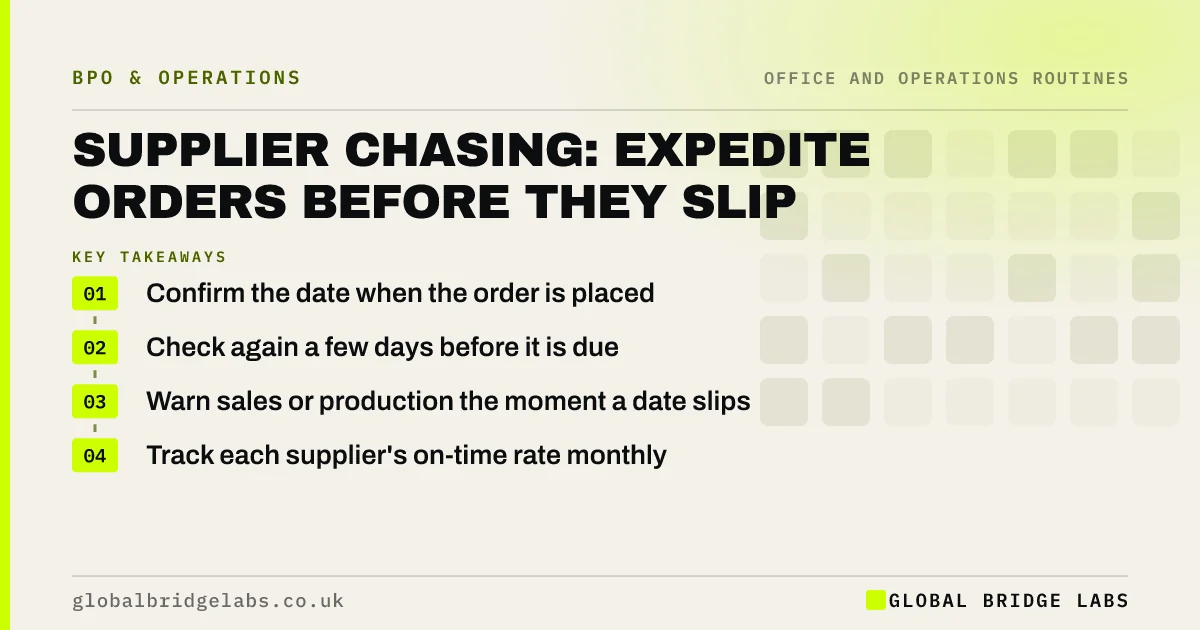
Expediting is the routine of confirming delivery dates with suppliers and chasing orders before they become late, not after. A simple schedule, confirm on order, check a week before, chase on the due date, catches most slips early enough to act. Logging each supplier's on-time rate gives you facts for the next negotiation.
- Confirm the date when the order is placed.
- Check again a few days before it is due.
- Warn sales or production the moment a date slips.
- Track each supplier's on-time rate monthly.
Finding out orders are late on the day they were due? Message us on WhatsApp with your open PO count.
Chat on WhatsApp →What is purchase order expediting?
Expediting means actively following up open purchase orders to secure the agreed delivery date, and acting early when it is at risk. It is different from chasing after a delivery is missed. The work is repetitive: the same check, the same message, the same log entry for every open order.
What does the routine look like?
Run a daily list of open POs by due date. Each order gets three touchpoints and a log entry. When a supplier gives a new date, the routine updates the PO and tells whoever depends on it.
- On order: confirm the date in writing.
- Before due: check progress and dispatch.
- On due date: chase if not received.
- New date: update the PO and warn dependants.
- Monthly: report on-time rate by supplier.
What does late stock cost?
In an illustrative example, a manufacturer has 120 open POs and 15% arrive late, with a third of those discovered only on the day. Each surprise costs rescheduled production or a missed customer date. Checking a week ahead turns most surprises into managed delays. These are example figures.
- Order to dispatch time: how fast should orders leave?
- Supplier statement reconciliation: catch missing invoices
Send us your open PO count on WhatsApp and we will estimate the routine with you.
Chat on WhatsApp →When should chasing stay with buyers?
Keep it with buyers for strategic suppliers, critical shortages and any conversation about penalties or switching supplier. A support team handles the routine confirmations and chases, and escalates when a delay crosses an agreed threshold.
What does this look like in practice?
A pattern we see: the same two suppliers cause most late deliveries, but nobody has the data to raise it. A month of logging gives the buyer a clear on-time rate to discuss.
Expediting checklist
Run the routine with these points.
- Daily list of open POs by due date.
- Date confirmed in writing on order.
- Check before the due date.
- Dependants warned on any slip.
- Monthly on-time report by supplier.
Next step
Send us how open orders are chased today. We will suggest a routine and say plainly what a team could take on.
Message us on WhatsApp about supplier chasing, or book a 30-minute consultation.
Chat on WhatsApp →Sources and further reading
Frequently asked questions
What is expediting in purchasing?
Expediting is following up open purchase orders with suppliers to secure the agreed delivery date and act early if it is at risk. It typically means confirming the date when ordering, checking progress before the due date and chasing promptly if the goods do not arrive.
How do you chase a supplier for a late order?
Contact them on or before the due date with the PO number, agreed date and quantity, ask for a confirmed new date and dispatch details, and record the answer. Tell anyone depending on the order, and escalate to the buyer if the delay crosses an agreed threshold.
Can supplier chasing be outsourced?
Yes. A managed team can run the daily open-order list, confirm dates, chase suppliers, update POs and report on-time rates. Conversations with strategic suppliers, penalties and decisions to switch supplier should stay with your buyers.
Written by

Global Bridge Labs (GBL) is a UK–Sri Lanka partner for social media, websites and BPO. Everything here comes from client delivery, not theory.